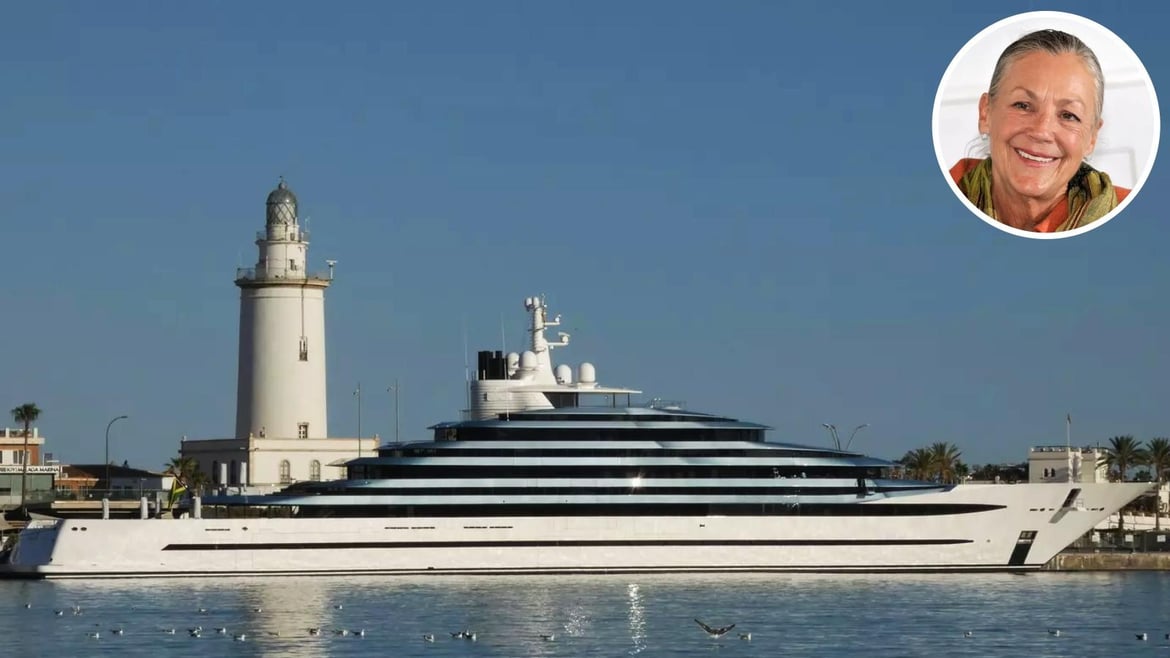
The 110-meter superyacht Kaos has remained docked in the Spanish port city of Málaga over the last couple of days, grabbing the attention of locals and yacht enthusiasts. Docked at pier number one, the vessel’s sheer size and elegant design make it hard to miss. With her sleek metallic profile and towering decks, the $300 million vessel owned by Walmart heiress Nancy Walton Laurie projects effortless glamour. But behind the polished steel and glossy blue paintwork is a staggering reality: even when the billionaire is not on board.

As per Luxurylaunches’ calculations, Kaos devours an estimated 7.2-megawatt-hours of electricity per day simply to keep the yacht alive. That figure translates to roughly €2,800–€3,600 daily ($3,300–$4,200) in electricity costs, enough to power 250 American homes for a full day. Luxurylaunches crunched some numbers to put the staggering figures into perspective.

Life on a vessel of this size is powered by systems that can never truly sleep. Kaos runs with a permanent crew of 45, and keeping them comfortable requires constant cooling, dehumidification, lighting, and ventilation. On large yachts, HVAC systems dominate the load, often accounting for 30 to 60 percent of all energy use.

For Kaos, this means chilled-water plants, air handlers, and dehumidifiers working relentlessly to offset Málaga’s summer heat. Doors that slide open to the quay bring in humid air, forcing the system into continuous dehumidification cycles, while overnight cool-down keeps guest and crew areas at a set temperature before service begins. On a hot day, engineers estimate a 150 to 220 kW HVAC draw is realistic, with peaks far higher during turnarounds or parties.

Stabilization adds another hidden drain. Kaos carries Quantum XT fins with Zero-Speed capability, allowing her to counter-roll even when stationary in a harbor swell. But at anchor, the fins must work harder, “paddling” the water to provide balance. That means an additional 20 to 60 kW consumed continuously, more if the seas are rough. Legacy hydraulic systems are particularly inefficient at idle, and even hybrid setups demand a steady chunk of power to keep guests comfortable in the pool, spa, gym, and cinema without feeling the queasy sway of the sea.

Then there are the kitchens. With 31 guests and 45 crew to feed, the yacht’s galleys operate like a small luxury hotel at sea. Multiple combi-ovens, induction ranges, salamanders, professional dishwashers, blast chillers, ice makers, and walk-in freezers all run daily. Commercial dishwashers alone consume about 1 kWh per cycle and are used repeatedly during meal service.

Crew and guest laundry, powered by professional-grade marine washers and dryers, adds steady demand during changeovers and guest-heavy cruises. On a yacht of Kaos’s scale, galley and service areas easily average 25 to 50 kW across the day, with peaks much higher during mealtimes.

Water systems layer on more consumption. Reverse-osmosis desalination units, essential for producing fresh water, draw between 18 and 37 kW for their high-pressure pumps, with booster motors adding another 5 kW. Though most watermaking happens at sea, top-ups in port are common, and when combined with sewage treatment, bilge pumping, fuel polishing, and firefighting systems, engineers estimate 10 to 25 kW of load even when stationary.

The leisure amenities create yet another constant drain. Kaos carries a large pool on the aft deck with an aquarium wall, plus spa tubs, a hammam, and a beach club. Heating and circulation for these alone add 10 to 30 kW, depending on water temperature and usage. Waste-heat recovery systems can offset part of the demand, but on a hot day, keeping water cool and filtered still demands significant electricity.

Add in technology, and the numbers grow further. AV racks, satellite communication domes, Wi-Fi, CCTV, and server cooling run nonstop, drawing 10 to 20 kW. Lighting, though efficient with LEDs, still adds load when spread across such an enormous vessel with guest suites, crew areas, and decorative features glowing deep into the night.

Taken together, the ballpark figure of 300 kW continuous usage is credible. Multiply that by 24 hours, and Kaos consumes 7,200 kWh daily. For comparison, that single day of idle consumption would power a mid-sized American neighborhood. It is a reminder that in the world of superyachts, the scale of comfort and extravagance comes with equally super-sized energy demands.

Kaos: The optical illusion superyacht
Delivered by Oceanco in 2017, Kaos began life as Jubilee, a commission from Qatar’s former Emir. At 110 meters, she was the largest yacht ever built in the Netherlands at the time and immediately stood out for her trompe l’oeil design that created the illusion of extra decks. Following the Emir’s passing, the yacht was acquired in 2019 by Nancy Walton Laurie, who refitted her at Lürssen with updated interiors by Sam Sorgiovanni and Reymond Langton.

Kaos accommodates 31 guests in 15 suites, supported by a crew of 45, and features a private owner’s deck, a large pool with aquarium views, a spa, gym, and cinema. Her interiors are said to be lined with precious stones, silk carpets, and onyx. Designed to cruise quietly over 5,000 nautical miles, she remains a marvel of engineering and artistry, but also a floating power plant, consuming energy on a scale that few outside the superyacht world can imagine.