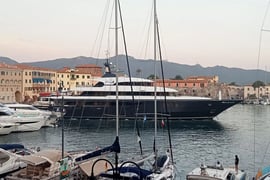
A mysterious American billionaire appears to have commissioned one of the most theatrical superyachts currently under construction, and the name alone says almost everything about the owner’s personality. Known as Project Ziggy, the 101.4-meter Lürssen vessel saw a technical launch in Germany this week, immediately triggering speculation that its ultra-wealthy owner may be an obsessive David Bowie fan with a taste for architecture, spectacle, and floating excess on an industrial scale.

The name “Ziggy” carries far more cultural weight than a typical yacht codename. David Bowie’s Ziggy Stardust persona was imagined as an alien rock star descending to Earth with glam rock flamboyance, androgynous styling, and a messianic aura before collapsing under the pressure of celebrity and mythmaking. More than fifty years later, Ziggy Stardust still represents space age theater, outsider cool, and larger than life performance. Naming a 333-foot superyacht after that character feels less like a coincidence and more like a declaration of identity from someone wealthy enough to turn pop culture obsession into floating architecture.

A floating glass fortress designed like a modern amphitheater
Built by Lürssen in Rendsburg, Germany, Project Ziggy is scheduled for delivery in 2028 and already ranks among the most ambitious yachts currently emerging from Northern Europe. With a steel hull, aluminum superstructure, and an estimated volume of around 4,018 gross tons, this is not merely a long yacht intended for harbor bragging rights. It is an enormous private residence engineered for extended life at sea.
British studio Harrison Eidsgaard is responsible for both the exterior and interior design, while Lürssen was tasked with the naval architecture. The shipyard’s own language describing the yacht feels unusually cinematic for a German engineering company. Words like “muscular architecture,” “glass and steel,” and “fluid yet angular” paint the picture of a vessel designed less like a traditional yacht and more like a futuristic coastal compound that somehow floats.

The first images reveal why the yacht has already become a talking point within the industry. The stern unfolds almost like a seaside amphitheater, with sweeping outer structures descending toward the water while the upper decks gradually step backward above them. Instead of adding a beach club as a fashionable afterthought, the entire aft section appears organized around life at water level. The recessed beach club looks integrated deep into the architecture, creating the impression of a private resort carved directly into the hull itself.

The kind of yacht that exists beyond conventional luxury
Project Ziggy also carries some of the largest structural glass sections ever installed on a Lürssen. That detail matters because massive glass installations on a vessel this size create enormous engineering challenges involving vibration, hull flex, and structural stress. The yacht’s extensive glazing is not just an aesthetic flourish. It is a statement about modern billionaire expectations, where owners increasingly demand floating estates with the openness and light of contemporary mansions.

The vast foredeck is fully certified for helicopter operations, while the cascading aft decks are expected to include multiple pools and wellness spaces designed for long-term living onboard. Every available detail suggests a yacht intended to function as a self-contained luxury ecosystem rather than a seasonal toy.
Industry estimates place the project somewhere between $300 million and $375 million, with the most realistic figure likely falling in the $325 million to $350 million range. That is enough money to buy a fleet of conventional superyachts, though conventional clearly was never the point of something called Ziggy.
[All yacht images supplied by Lurssen]