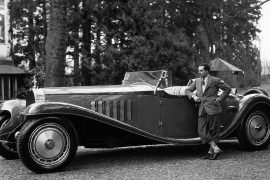
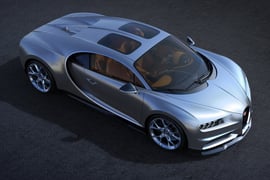
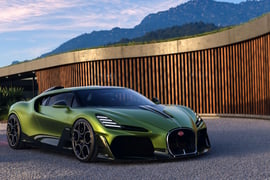
The Malaysian royal garage has just welcomed one of the rarest Bugattis ever built, and this time the story is not about another hypercar quietly entering a billionaire collection. The delivery belongs to the Crown Prince of Johor, Tunku Ismail Sultan Ibrahim, whose latest acquisition is a one-of-one configuration of the Bugatti W16 Mistral, a machine that already sits at the very edge of the modern hypercar world even before personalization enters the conversation.

The Mistral itself occupies a unique place in Bugatti history because it serves as the final road-going swansong for the company’s legendary W16 engine. For two decades, that 8.0-liter quad-turbocharged unit defined the Bugatti era that began with the Veyron and reached its peak with the Chiron. The Mistral closes that chapter. Everything that follows will move into the hybrid age led by the Tourbillon and its new naturally aspirated V16 powertrain.

Under the dramatic open bodywork sits the most potent version of that engine ever fitted to a production Bugatti. The W16 in the Mistral produces the full 1,600 PS tune, or about 1,578 horsepower, borrowed from the Chiron Super Sport 300+. Power is delivered to all four wheels through a seven-speed dual clutch gearbox, sending the car from zero to 62 miles per hour in roughly 2.4 seconds. Numbers like that would already define a headline hypercar, yet the Mistral adds an even more dramatic statistic to the record books.

In 2024, Bugatti verified the W16 Mistral as the fastest open-top production car in the world after it reached 453.91 Km/h (about 282 mph) during an officially monitored run certified by SGS TÜV. Bugatti still quotes a nominal top speed of over 260 mph in its official literature, yet the record run is what places the Mistral alongside the Veyron Grand Sport Vitesse and the Chiron Super Sport 300+ in a trilogy of machines built to chase ultimate speed. The difference this time is that the final chapter happens entirely in the open air.
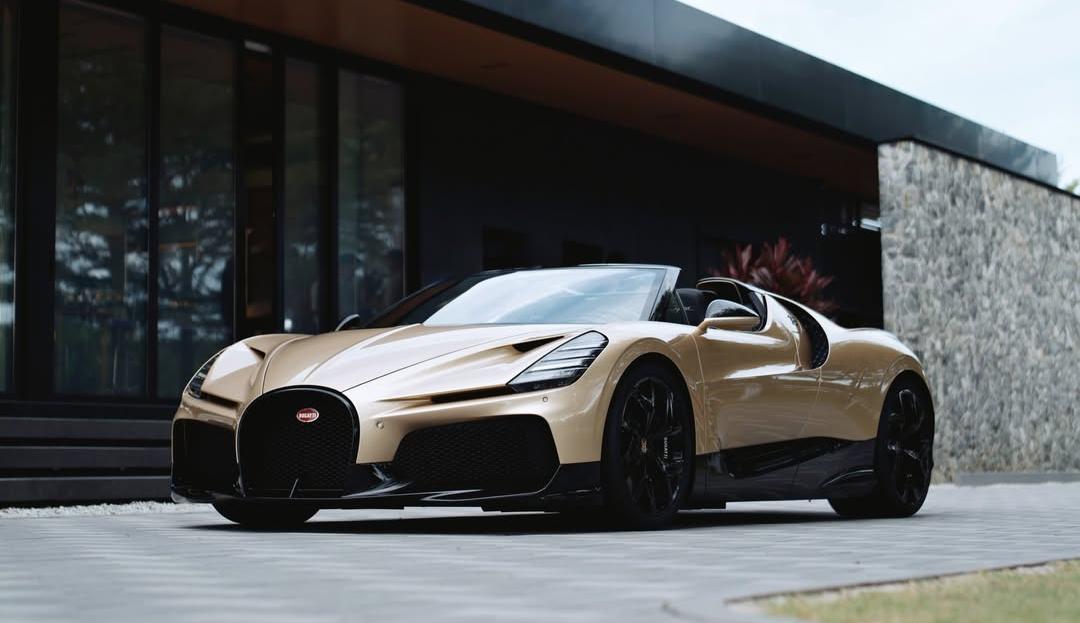
Bugatti has been careful to explain that the Mistral is not simply a Chiron with the roof removed. The car uses its own carbon fiber monocoque and heavily reworked structure that had to pass the same crash and torsional stiffness standards as the coupe, despite having no fixed roof. The design reflects that engineering effort with front lighting shaped as four diagonal LED slashes that double as air management elements, a wraparound windscreen that flows into the side intakes, and a full-width rear light graphic forming an illuminated X with the Bugatti script in the center. Behind the occupants sit two dramatic air intakes that feed the W16 while also acting as rollover protection.

Inside, the cabin continues Bugatti’s approach of combining modern materials with historic references. Carbon fiber runs throughout the structure, while metal switchgear and rich leather create a tactile atmosphere suited to an open-top grand tourer capable of crossing continents at extraordinary speed. The gear selector hides one of the brand’s most charming details. Encased in amber sits a miniature dancing elephant sculpture inspired by Rembrandt Bugatti’s mascot from the Type 41 Royale. A large analog speedometer remains proudly centered in the instrument cluster so that the sweeping needle becomes part of the theater whenever the car stretches its legs.

Only 99 examples of the Mistral will ever be built, and each carried a base price of around 5 million euros (about $5.8 million) before customization. Every build slot sold out before the public even saw the car. The example commissioned for the Crown Prince of Johor stands apart within that already rare group through a restrained specification featuring a porcelain-like light exterior tone paired with gloss black wheels. The cabin carries an even more personal detail in the form of a gold inlaid monogram topped by the Johor royal crown set into a carbon fiber panel, effectively marking the car as inseparable from its owner.

Tunku Ismail Sultan Ibrahim has become one of Southeast Asia’s most prominent automotive collectors, and his garage reflects a pattern of securing landmark hypercars at the moment they enter history. He was widely reported as the first Malaysian to receive a LaFerrari finished in a distinctive purple shade, and the country’s first Koenigsegg Jesko Attack later joined the collection. His garage also includes the Mercedes AMG One alongside a matching AMG GT Black Series P One Edition.

Even the more rugged machines are used with purpose, as his Brabus G700 6×6 once appeared during floods in Johor carrying supplies through deep water. In Johor, any vehicle wearing the license plate TMJ is known to belong to the Crown Prince, a designation created specifically for him by the local government. With the arrival of a one-of-one Bugatti Mistral, that plate will now sit on one of the most historically significant open-top hypercars ever built.