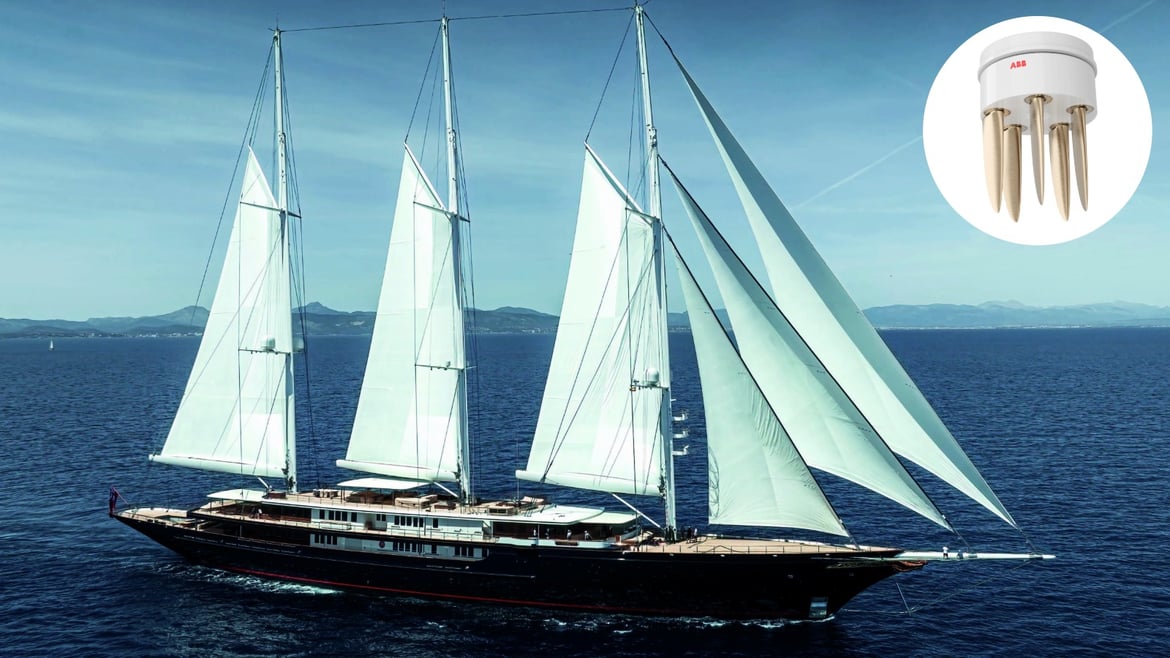
Oceanco and ABB have come together to introduce their revolutionary Dynafin propulsion system, born of more than a decade of research, which promises to reshape how large private yachts move through water. At its heart, Dynafin is a cycloidal propulsor that replaces a single spinning screw with a large horizontal wheel under the hull fitted with multiple vertical blades. A main electric motor turns the wheel slowly, roughly 30 to 80 rpm, while smaller motors continuously adjust each blade’s pitch so the blade tips follow a trochoidal path through the water.

That trochoidal motion keeps the blades attacking the water at an optimal angle and, according to model tests done at MARIN with an Oceanco hull model, can yield open-water efficiency figures in the 80 to 85 percent range and up to about 20% fuel savings compared with current best-in-class electric propulsion solutions.
Tested over months and compared against state-of-the-art podded and propeller systems, Dynafin’s gains are not merely theoretical. They are the product of carefully integrated control, blade geometry, and hull pairing that Oceanco and ABB positioned inside a broader strategy of diesel-electric platforms, optimized hulls, and alternative fuels such as methanol or HVO.

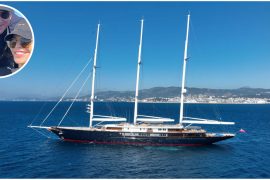
What if Jeff Bezos’ $500 million superyacht Koru was fitted with a Dynafin propulsion system?
To make this a bit more real, let us look at a concrete example. Jeff Bezos’ 410 foot, three masted sailing yacht Koru, built by Oceanco, is a perfect test case. Using publicly available estimates crunched by Luxurylaunches, she carries around 750,000 liters of fuel and, at a cruising speed of about 15 knots, burns roughly 2,000 liters per hour.

A common itinerary for the centibillionaire and his glamorous wife is the transatlantic and Mediterranean leg between Fort Lauderdale and Saint-Tropez. Using a clean round distance of 4,200 nautical miles and a cruise speed of 15 knots produces an engine-running time of about 280 hours for that leg. At 2,000 liters per hour, Koru would burn about 560,000 liters for the crossing, which converts to roughly 470 metric tons of fuel at an assumed density of 0.84 kilograms per liter.

Using a conventional emissions factor of 3.2 tons of CO₂ per ton of fuel burned, that one passage creates about 1,505 metric tons of CO₂. Put another way, the trip consumes approximately 75% of a 750,000-liter tank and represents about 21% of an estimated annual footprint of 7,150 tons of CO₂ for a yacht like Koru.

Now apply the Dynafin performance claim. Oceanco and ABB’s MARIN validation indicates up to 20 percent fuel savings over current best-in-class systems for the large yacht hull forms they tested. A 20% reduction on the 560,000-liter baseline equals a saving of 112,000 liters, leaving a trip fuel total of 448,000 liters. The mass of fuel saved is about 94 metric tons and the CO₂ avoided for the crossing is about 301 metric tons. The trip CO₂ therefore falls from roughly 1,505 tons to about 1,204 tons, while tank usage drops from about 75% to about 60% of capacity. Those numbers are straightforward but meaningful. A single technology swap that reduces a transatlantic crossing by roughly 300 tons of CO₂ per passage offers owners more range, smaller fuel bills, and a visibly lower emissions figure for one of the biggest routine voyages a superyacht undertakes.

Beyond the headline savings, there are operational angles that matter. Dynafin’s high low-speed control and precision maneuvering make it attractive for harbors and tight berthing, where batteries can provide silent, emission-free operation at zero speed. In cruising mode, the system is designed to integrate with diesel-electric architectures and alternative fuels so the generators and hotel loads can be optimally matched to propulsion demand. That integrated energy management is the real yardstick for long-term sustainability, because fuel savings compound across seasonal itineraries and across a fleet of large yachts.

There are caveats. Dynafin is not yet a retrofit one-size-fits-all solution for every hull, and integration complexity, maintenance regimes, and initial procurement costs must be weighed. Yet for a new-build program or a yard like Oceanco that pairs hull optimization, diesel-electric platforms, and alternative fuels with next-generation propulsors, Dynafin is a logical component.

For a yacht the size of Koru, the numbers show a clear win: significant fuel and emissions reductions for a routine high-consumption passage, tangible operational benefits in-port, and a neat fit with the industry pivot toward hybrid, low-emission superyachts. If the superyacht world is serious about cutting its most visible environmental impacts, systems such as Dynafin provide a credible, tested path forward.