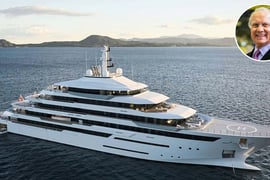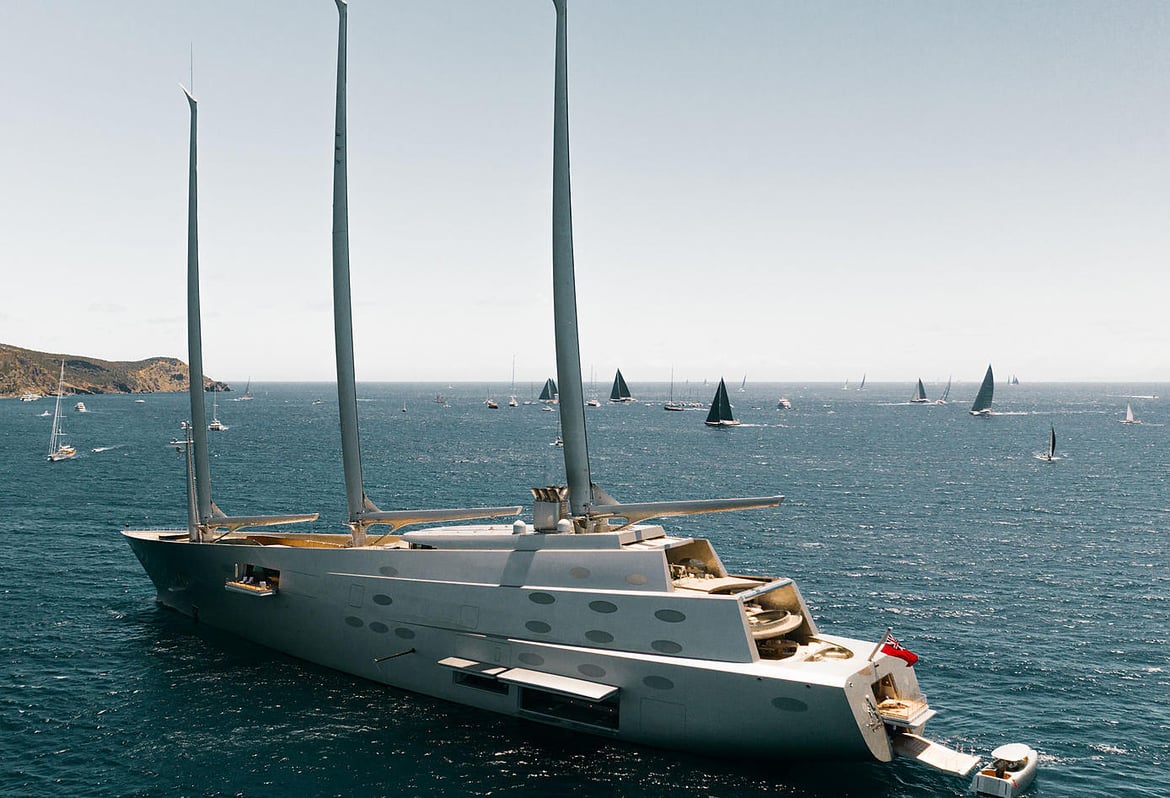
Anchored just off Trieste for more than three years, Sailing Yacht A has become both a symbol of power and an emblem of unintended consequences. Designed by Philippe Starck and built by Nobiskrug, the 468-foot (about 143 meters) vessel remains under administrative freeze after being seized by Italy’s Guardia di Finanza in March 2022 under EU sanctions against Andrey Melnichenko. Its silver hull has become a familiar sight on the Adriatic skyline, but behind the quiet façade lies a logistical and environmental burden few have considered.

At Luxurylaunches, we crunched some numbers, and according to our calculations, the vessel burns roughly 5,500 liters of diesel every single day while at anchor. Because the yacht is stationed offshore, it cannot plug into shore power. Its immense onboard generators therefore run continuously, supplying electricity to run the air conditioning, onboard stablizers, security, and crew operations.

Over the course of a year, this equates to around 2 million liters of fuel, or nearly 1,700 metric tons of carbon dioxide emissions, which is roughly equivalent to the annual footprint of 250 average households in Italy.

The reason for such high fuel consumption is hidden in what engineers call “hotel load,” the electrical demand required to keep a ship habitable even when stationary. On Sailing Yacht A, the hotel load is immense. With a permanent crew of 20, systems that are normally taken for granted, air conditioning, lighting, and water, operate around the clock. The yacht’s climate control and humidity management system alone draws continuous power to protect its finely finished interiors from condensation and mold.

Zero-speed stabilizers, designed to keep the yacht steady even without propulsion, remain active at all times to ensure safety and prevent excessive rolling in the swell. The refrigeration and galley plant, with multiple walk-in cold rooms and freezers, supports the live-aboard crew. Watermakers convert seawater into fresh water for daily use, while wastewater treatment units run continuously to meet environmental discharge regulations. Add to that the constant hum of safety, fire detection, and security systems, plus lighting, entertainment networks, and hydraulic packs, and the energy demand becomes staggering.

Multiple technical directories list Sailing Yacht A’s fuel tank capacity at around 850,000 liters. At its present consumption rate, the yacht could theoretically operate its generators for five to six months before needing to refuel. Local newspaper Il Piccolo reported that in late July 2024, the vessel sailed to Venice for bunkeraggio, or refueling, a procedure that reportedly occurs about once every three months. For perspective, a single load of 413,000 liters is equivalent to about 14 standard 30,000-liter road tankers, though in Venice such quantities are typically delivered by bunker barge.

All of this points to a paradox. Sailing Yacht A, built as one of the most advanced hybrid sailing vessels in the world, now functions like a stationary power plant burning thousands of liters of fuel every day. For Trieste, it is a strange neighbor. A futuristic silhouette that mesmerizes visitors while quietly consuming more energy than some villages.

The city’s mayor recently expressed his frustration with the astronomical maintenance cost of the luxury vessel, which is close to $1 million per month. For local authorities, the yacht is not only a financial headache but also a floating reminder of how the ripples of geopolitics extend far beyond the headlines, leaving both environmental and economic costs in their wake.