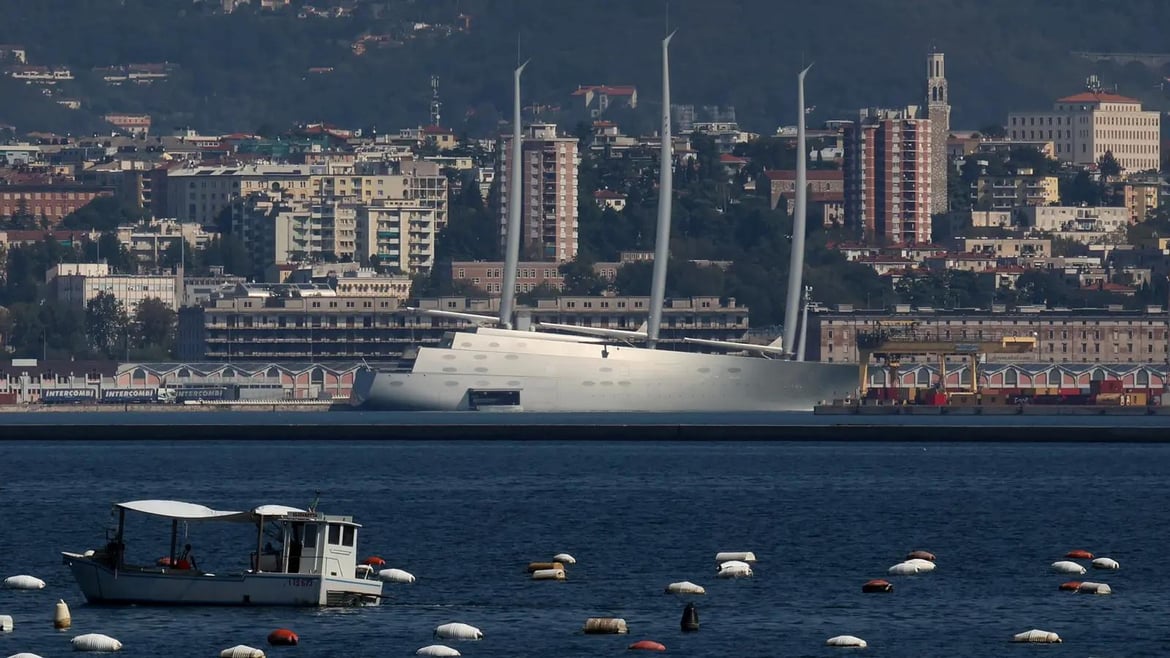
It is not every day that the world’s largest sailing yacht turns into a stationary landmark. Yet in Trieste, a 143-meter (about 467-foot) giant of steel, glass, and carbon fiber has done precisely that. Seized four years ago by Italian authorities, Sailing Yacht A now rests permanently along the Adriatic waterfront. Astonishingly, the $600 million vessel costs an estimated $35,000 a day to maintain, secure, and preserve in working order.

The sheer scale of that daily expense recently caught the attention of Matteo Salvini, Italy’s Deputy Prime Minister and Minister of Infrastructure and Transport. While walking along the waterfront, he paused to observe the yacht’s towering silhouette and questioned the logic of taxpayers covering the cost of sustaining such an asset, as reported by Il Piccolo. His remarks were brief and practical, centered on the visible reality of public funds being used to maintain a privately built superyacht.

That daily figure covers far more than dockage. A yacht of this magnitude cannot simply be tied up and ignored. Its complex onboard systems must remain operational to prevent deterioration. Engineers and technicians oversee critical components. Security personnel guard it around the clock. Even drone activity in the surrounding airspace is restricted. Exposure to saltwater and shifting weather conditions demands constant vigilance. Stillness does not mean inactivity when it comes to a vessel of this scale.
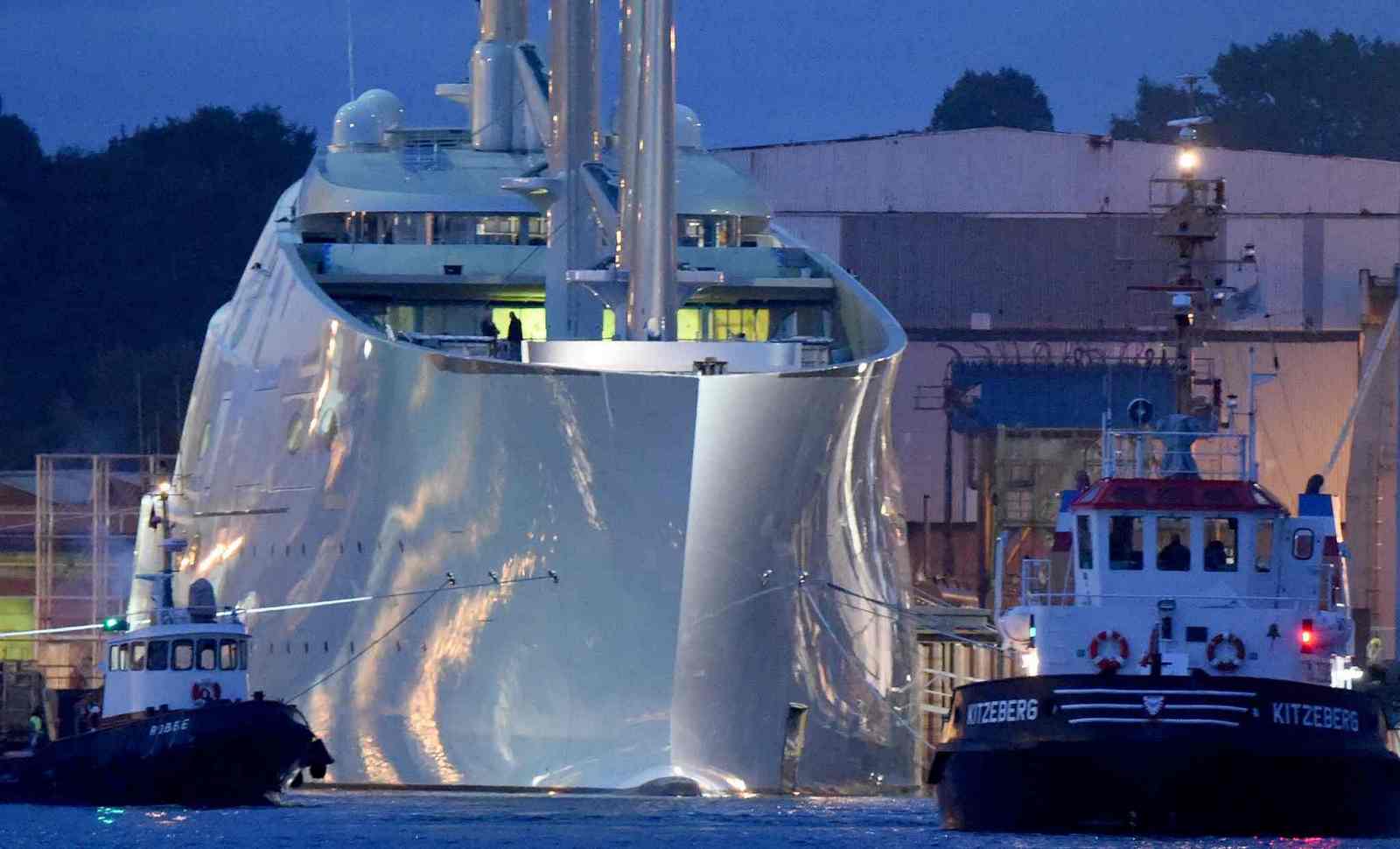
Sailing Yacht A was conceived as a technical statement. At nearly half the length of a football field, with three masts rising more than 300 feet above the waterline, it redefined what a modern sailing yacht could be. Though often described as the largest sailing yacht in the world, it functions as a motor vessel supported by auxiliary sails, blending advanced propulsion with dramatic design. Its construction reportedly cost around $600 million, placing it among the most expensive private yachts ever built.

Since being frozen in 2022 under sanctions right after the Ukraine conflict, the yacht has not moved from the Gulf of Trieste. Over time, it has shifted from a headline attraction to an everyday fixture. Tour guides now point it out to visitors as part of the harbor narrative. Travelers stop along the promenade to photograph its sharp, futuristic lines. For locals, it has become a familiar presence, woven into the city’s skyline.

There is a quiet contrast in that transformation. A vessel engineered for global voyages now remains anchored in one place. Built to symbolize motion and freedom on open seas, it instead represents pause and preservation. For now, Sailing Yacht A remains exactly where it is, maintained with precision, guarded without interruption, and standing as one of the most striking silhouettes on the Adriatic coast.