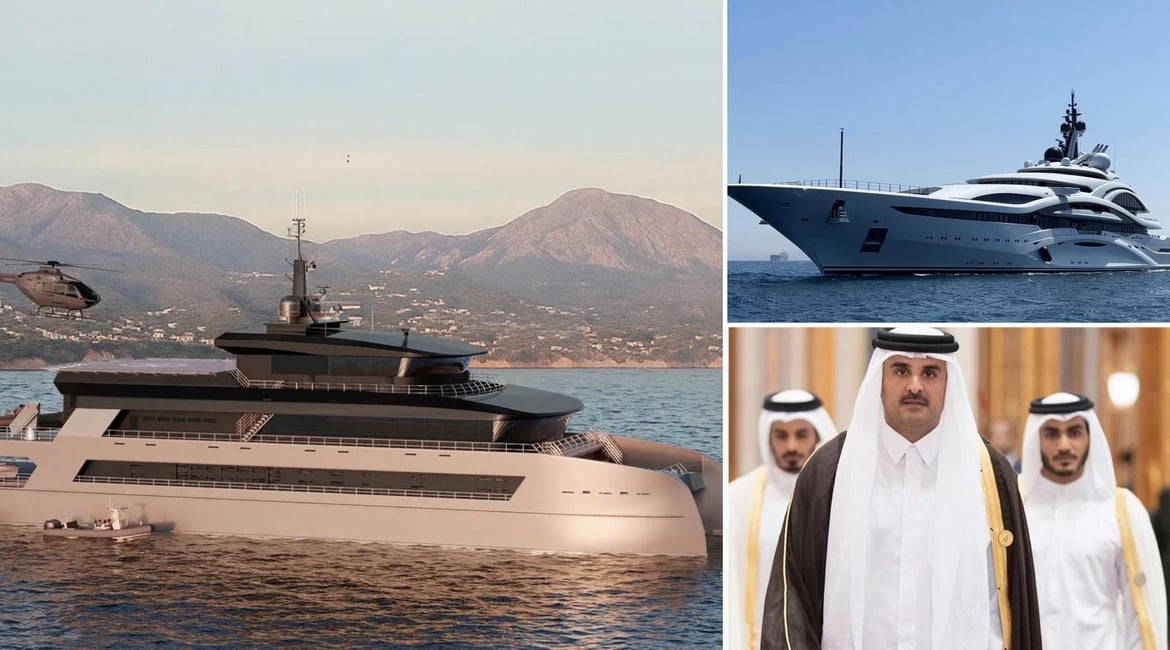
In recent years, the idea of national identity extending to the sea has taken on new symbolic weight. Superyachts are no longer seen only as private retreats. They can become cultural envoys, mobile embassies, and statements of technical capability. If a scenario ever arose in which the Emir of Qatar offered the magnificent Al Lusail to the United States as a ceremonial gift, mirroring the gesture associated with a Boeing 747 aircraft in aviation history, then the question of escort and protection would naturally follow.

A vessel of Al Lusail’s stature would not travel alone. It would need a guardian with quiet strength, one that offers protection without overshadowing elegance. In that sense, ShadowCat’s Sentinel concept may be the most suitable support platform for such a role.

A mobile perimeter of protection
Sentinel is a 233-foot (71 meters) catamaran support yacht conceived by ShadowCat and developed with global security firm Allmode. At first glance, it resembles the typical “shadow vessel” that accompanies a mothership to carry tenders, submarines, and toys. Yet Sentinel is different in intention and execution. It was designed not as a logistics barge, but as a moving perimeter of protection. Its core brief is security first.

This begins with the structure. Circulation routes and critical compartments are reinforced with ballistic shielding. A purpose-built citadel provides a secure refuge during high-threat events. Communications hubs are shielded and encrypted, ensuring continuity of operations even under duress. These are not common features in civilian support yachts. They represent the architecture of foresight.

Sentinel also carries an integrated surveillance network. Autonomous and piloted drones provide continuous awareness of the surrounding sea and sky, feeding optical, thermal, and radar data through encrypted channels linked directly to the mothership. The synchronized intelligence flow between vessels allows both to behave as one cohesive platform. Threats are assessed and responded to long before they approach visual range.
The vessel is also engineered for operational independence. It carries armored SUVs, ATVs, submersibles, tenders, and sportfishing craft, all deployable by hydraulic launch, including onto unprepared shoreline. This creates a complete mobility system. On land, at sea, and in the air, Sentinel supports swift movement and secure transitions.

Aviation capability is central to its design. Sentinel includes two certified helipads, allowing simultaneous helicopter operations for transfer, support, or emergency extraction. A full aviation hangar supports medevac response, refueling, and continuous tempo flight operations in varying sea states. The twin hull catamaran form adds stability, making takeoffs and landings safer and more consistent.

Image – Instagram / Moza bint Nasser
Medical support is equally robust. The modular medical suite can be configured with isolation zones, dedicated treatment facilities, a recompression chamber for dive-related incidents, and physician quarters. This allows the medical team to stabilize and treat patients with a level of care comparable to shore-based hospital environments, even during long ocean transits.

Personnel integration has been planned with similar attention. Security teams, logistics coordinators, drone pilots, and medical staff reside in purpose-designed quarters separate from guest accommodation. Their presence remains discreet and efficient, maintaining the serenity of the mothership while sustaining readiness in the background.

Protecting a national symbol at sea
If Al Lusail were to serve as a diplomatic, cultural, or representational yacht for a US leader, Sentinel would be an apt escort. Its dual helipads would support a Marine One-style aviation rhythm without imposing on guest decks. The ballistic shielding and citadel would provide hardened command continuity at sea. The ability to deploy armored vehicles directly to shore would enable controlled movements in unfamiliar or unsecured ports. The persistent overwatch created by drones and sensor arrays would sanitize harbors, approaches, and anchorages before arrival. Medical resilience ensures that emergency care can be sustained even far from coastal support.

Most support yachts are built around leisure, entertainment, and storage. Sentinel is built around assurance. It protects quietly, without spectacle. It allows the mothership to remain a place of calm, ceremony, and state representation, while the work of vigilance happens just beyond view.

In that sense, Sentinel is not merely a support yacht. It is continuity delivered in maritime form. It is presence without display. It is preparedness shaped into elegance. If a floating palace were ever to be placed in the service of national symbolism, Sentinel would be the vessel that guards its horizon.