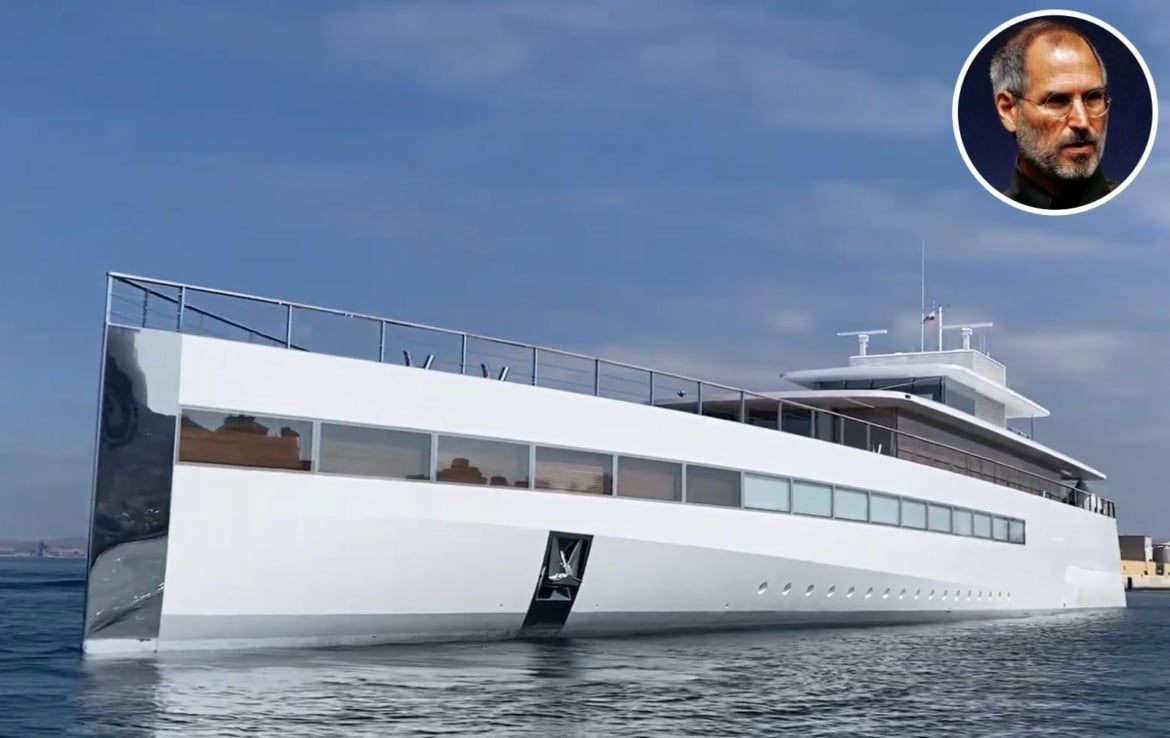
Perfection, in Steve Jobs’ world, was never supposed to come undone at the finish line. Yet, Venus, the stunning superyacht he spent years shaping with Philippe Starck, was impounded over a €3 million (about $3.5 million) dispute just as it prepared to leave port. Conceived as a floating extension of his design philosophy, the yacht was refined with the same intensity he once applied to Apple products, with Jobs deeply involved in every decision, working closely with Starck to ensure every surface, proportion, and detail met his exacting standards.

By the time Venus was completed, Jobs was no longer there to see it. He had died a year earlier, leaving behind a project that felt unusually personal even by billionaire standards. Delivery in late 2012 should have been a quiet transition from shipyard to sea, a handover moment where the engineering disappeared, and the experience began. But according to Dutch financial outlet FTM, just as the yacht was preparing to leave Amsterdam, it was stopped.

The order came through a Dutch bailiff acting on Starck’s behalf. Venus was impounded at the port, unable to move, its first real journey interrupted before it began. The reason was framed simply at first as an unpaid bill of €3 million, but the reality was far more precise and far more telling. This was not about whether money was owed, but how it had been calculated in the first place.

Starck’s compensation had been tied to 6% of the yacht’s cost, a structure that sounds straightforward until the definition of cost begins to shift. If Venus was measured against its original projected budget of €150 million (roughly $173 million), the designer’s fee would come to €9 million (north of $10 million). If it was calculated against the claimed final build cost of around €105 million (about $121 million), the number dropped to roughly €6 million. That difference created a €3 million gap, and that gap was enough to anchor one of the most refined yachts in the world to a Dutch port.

What makes the dispute more revealing is how it points to the nature of the Jobs-Starck collaboration itself. Reports suggested that while the percentage-based fee had been discussed, it may never have been formally locked in with complete contractual precision. The heirs argued the lower figure aligned with the actual cost, while Starck’s side suggested the broader agreement had never been definitively settled. It was less a disagreement over payment and more a collision between two interpretations of an understanding that had never been fully written down.

The timing made the situation almost theatrical. Venus had already been in Amsterdam for days, sitting at a free quay, effectively ready to leave. This was not a construction delay or a mid-project dispute. It was a finished object, delivered, polished, and waiting, stopped at the exact moment it was meant to transition into use. A yacht designed with obsessive clarity suddenly caught in a moment of ambiguity.

Resolution came the way these disputes often do, without a clean public conclusion. Dutch reports indicated that Jobs’ heirs moved to cover the disputed amount or provided a financial guarantee that satisfied the claim. The seizure was lifted, and Venus was finally allowed to sail, its first chapter already marked by something Jobs would have likely hated, unresolved detail.

In the end, the yacht left Amsterdam, but not before revealing how even a project shaped by Jobs’ obsessive control could slip into ambiguity once he was no longer there to define every term. Even the layout carried his imprint in a way that felt unusually personal. His teenage children’s cabins were placed at the very front of the 265-foot vessel, while his own cabin sat at the far end, deliberately separated so he could work, think, and exist in near silence.