China is preparing to put one of its most intriguing civilian aviation projects through a critical test, as the TMS-10 low-boom supersonic demonstrator moves toward its first attempt at sustained supersonic flight. Developed by Tianmushan Laboratory in Hangzhou, the aircraft is being used to validate technologies for a future 10 to 15-seat supersonic business aircraft designed to cruise at around Mach 2. Unlike the large airliners envisioned during the original supersonic era, the proposed aircraft is aimed at business travelers and high-end tourism, placing it closer to a supersonic private jet than a modern Concorde replacement. Its most unusual promise, however, is not simply its speed, but the effort to make its sonic boom dramatically quieter.

According to China Focus, the technology could eventually cut the journey between Beijing and Shanghai to just 30 minutes, compared with around two hours on the existing route spanning more than 1,000 kilometers (about 620 miles). That figure describes a potential future application rather than a service that TMS-10 itself is about to operate, since the aircraft currently being tested is a technology demonstrator. Tianmushan says the high-speed demonstrator has completed airframe manufacturing, aerodynamic wind-tunnel testing and flight-control law development and is now in final assembly and integration. The first supersonic flight is expected around the end of 2026, marking the next major step in a program that remains at the pre-research, concept-evaluation and technology-validation stage.
Building a quieter way through the sound barrier
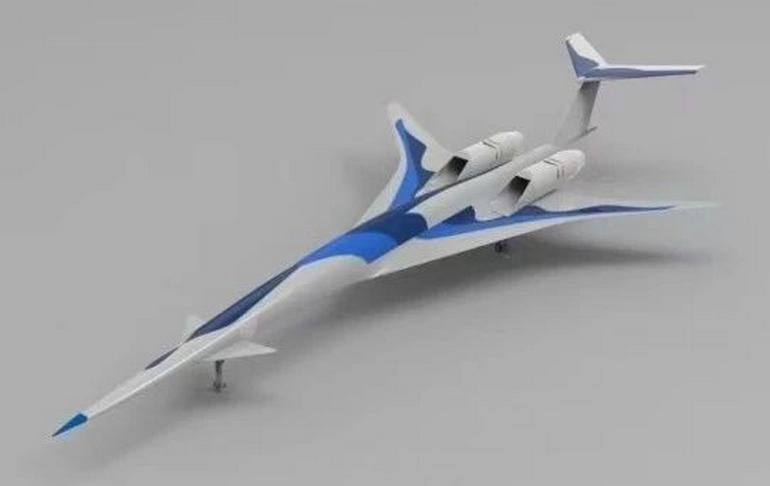
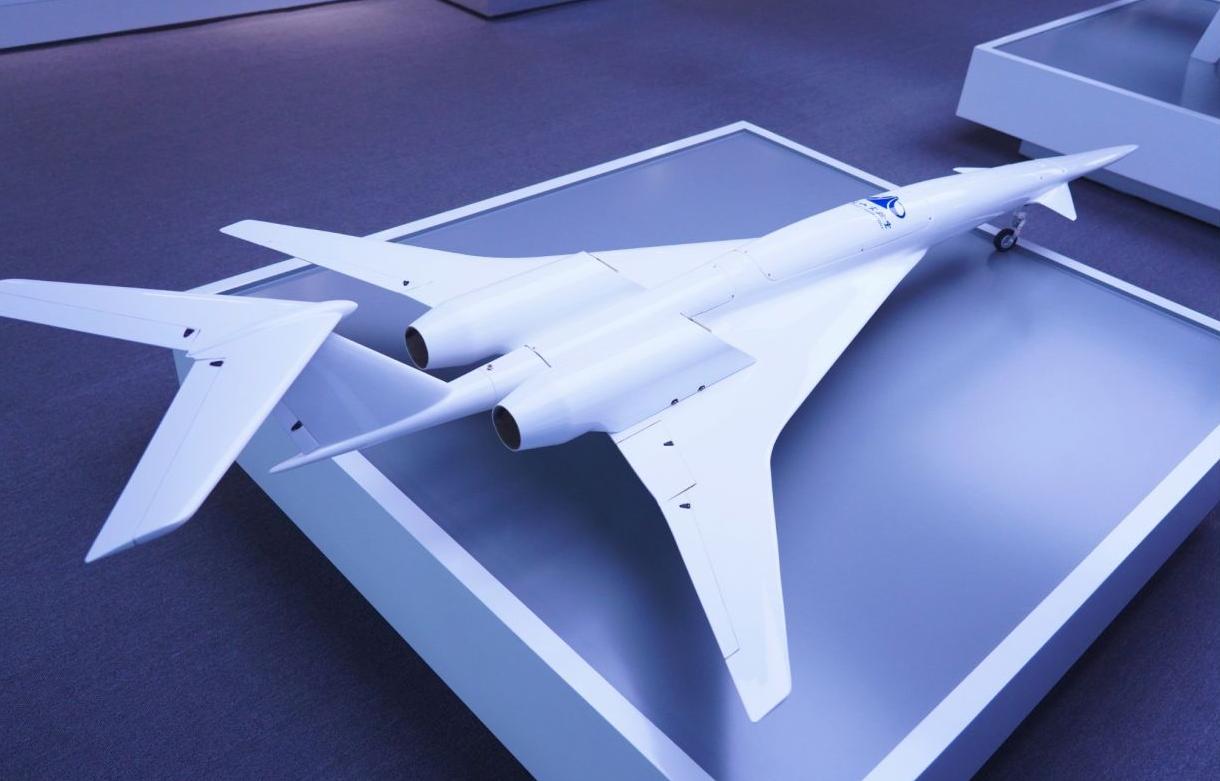
The aircraft’s approach to controlling the sonic boom begins with its distinctive three-surface aerodynamic layout, combining a forward canard, a large arrow-shaped main wing and a rear horizontal surface integrated with a T-tail. The long, slender fuselage and widely separated lifting surfaces have been developed with extensive computational optimization intended to reduce wave drag across subsonic, transonic and supersonic flight.

The canard is designed to prevent shock waves generated around the nose and wings from combining into a stronger disturbance, while the T-tail helps redistribute the rear shock waves so that they become more dispersed and weaker as they travel toward the ground. Tianmushan has said the selected configuration reduced its predicted far-field sonic boom by more than 60 percent and could produce a sound on the ground comparable to a car door closing, although that remains a development claim that must ultimately be confirmed through flight measurements.
The upcoming flight will therefore be as much about sound as it is about speed. Engineers want to see how the aircraft behaves while crossing the difficult transonic region, where shock waves form and aerodynamic loads and control characteristics can change rapidly. The demonstrator is expected to establish sustained and stable supersonic flight rather than simply touch Mach 1, while onboard and ground-based measurements will be used to compare the real pressure signature with computer simulations and wind-tunnel predictions. Researchers will be looking at whether the shock waves remain separated as intended, how the pressure disturbance changes with altitude and speed, and whether the predicted low-boom signature survives in real atmospheric conditions.
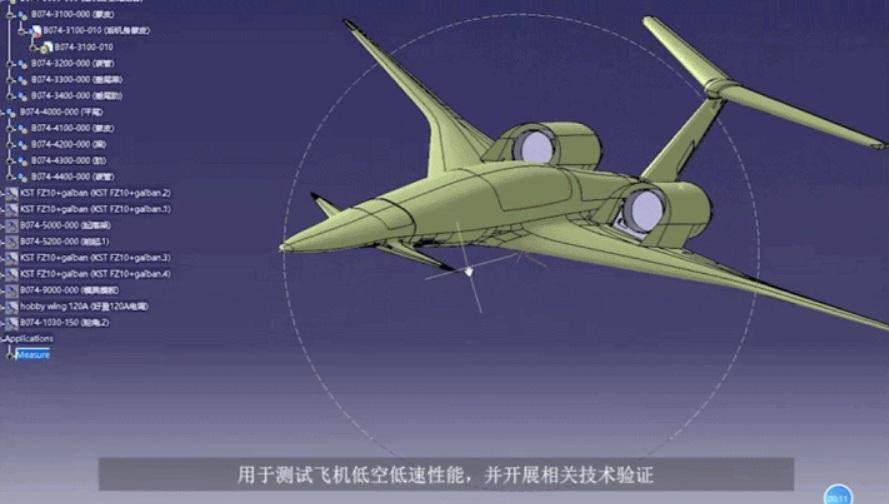
The work has already progressed beyond computer models. More than a year ago, a 1:18-scale TMS-10 demonstrator completed its first low-speed flight at Dingzhou Airport in Hebei, measuring 2.9 meters long, carrying a 1.5-meter wingspan and weighing about 12.5 kilograms. The carbon-fiber aircraft flew for 2 minutes and 50 seconds, reached 241 meters and achieved 46 meters per second, or roughly 103 mph, while completing a full circuit under closed-loop stability control. The next demonstrator is considerably more ambitious and will test the aerodynamic configuration and flight-control system at the speeds where the project’s low-boom technology actually matters.

A different path from Boom’s supersonic aircraft
The Chinese concept can be compared with Boom Supersonic’s XB-1, although the two programs are pursuing different aircraft and markets. XB-1 is a technology demonstrator for Boom’s planned Overture airliner, which is designed to carry 64 to 80 passengers at Mach 1.7, while TMS-10’s eventual aircraft is intended for only 10 to 15 passengers at approximately Mach 1.8 to Mach 2. Boom’s XB-1 already crossed the sound barrier in January 2025 and subsequently demonstrated what the company calls “Boomless Cruise,” with specialized microphone arrays confirming that an audible sonic boom did not reach the ground during its supersonic runs. Boom achieves this through a combination of altitude, speed and atmospheric effects known as Mach cutoff, whereas Tianmushan is pursuing a quieter pressure signature through the aircraft’s aerodynamic configuration itself.
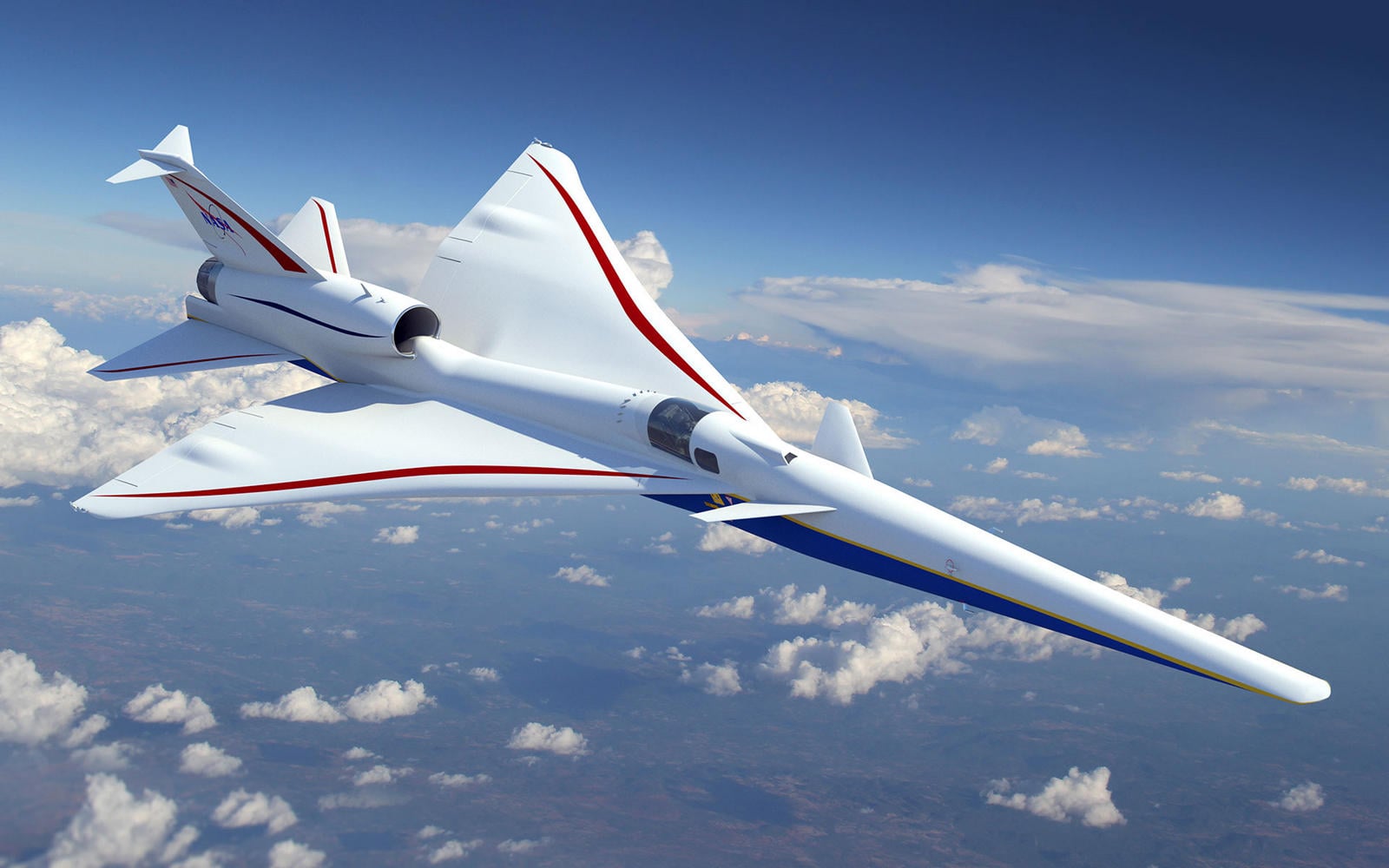
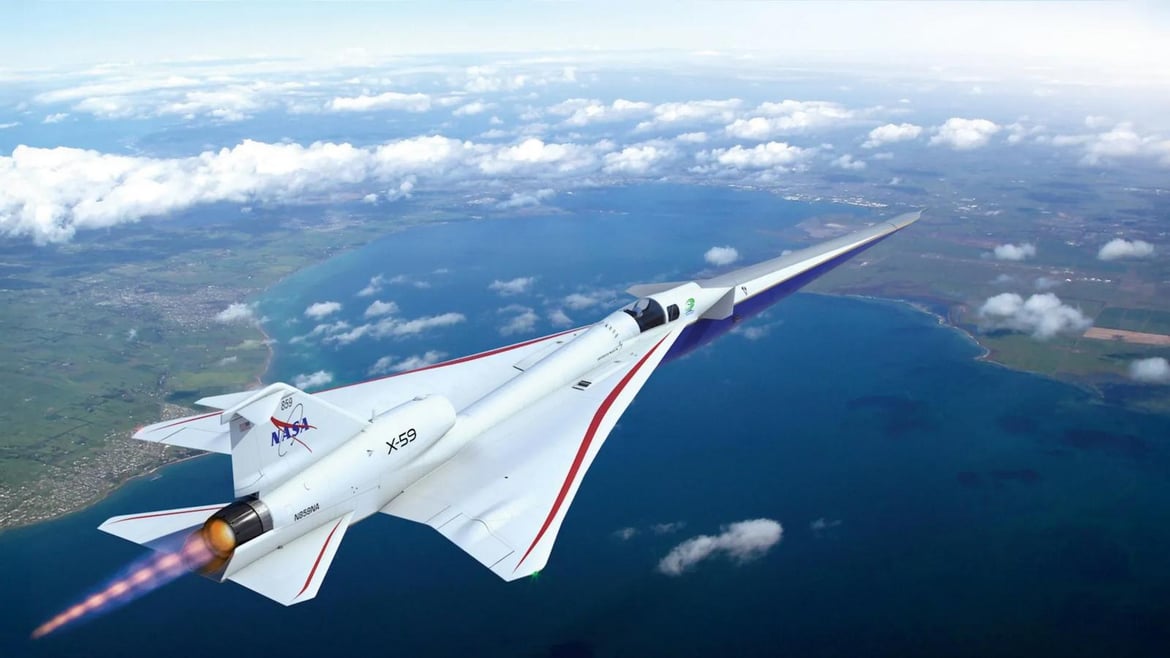
There is also an interesting difference in the scale of investment behind the two efforts. Liang Yu, an associate researcher with the team, has said Tianmushan had invested more than 20 million yuan, or roughly $2.8 million, before the 2025 flight, while Lockheed Martin’s contract to design and build NASA’s X-59 alone was valued at $247.5 million. The comparison is not like-for-like because X-59 is a much larger NASA experimental program, but it illustrates how modest the early TMS-10 effort has been. The Chinese program now plans to progress toward a roughly 10-ton low-boom demonstrator, a variable-cycle propulsion system and validation of key structural components before any future move toward formal engineering development.
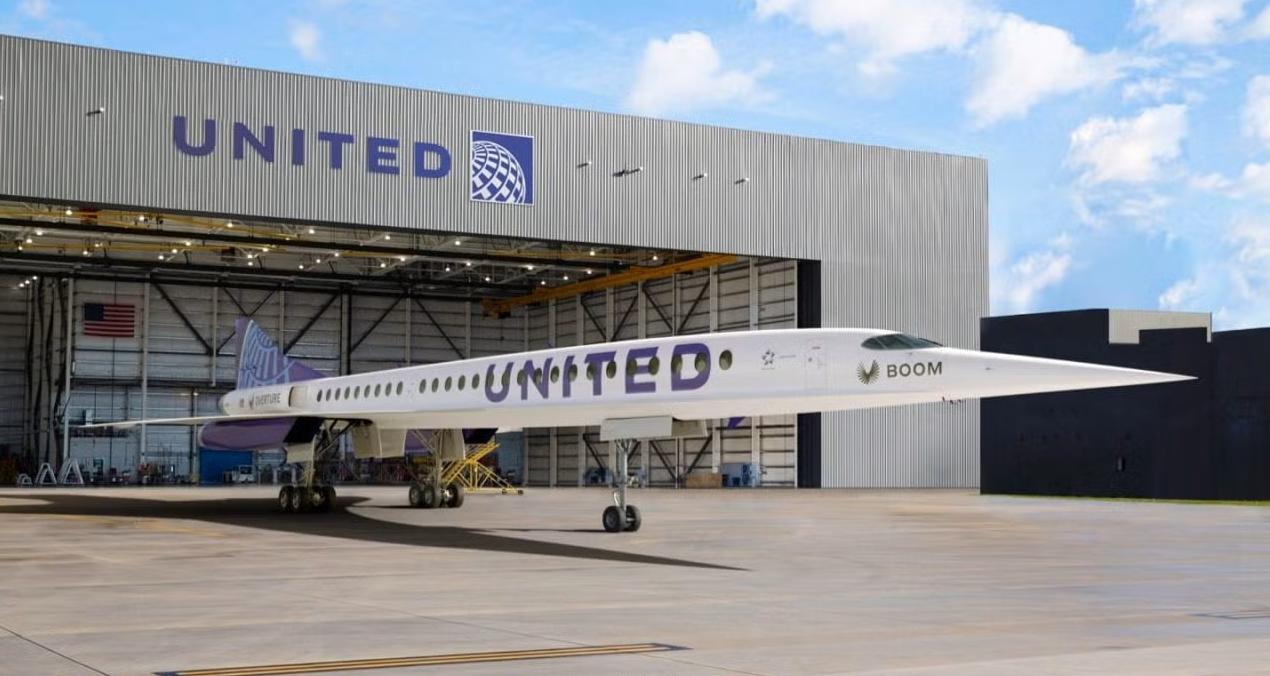
For Tianmushan, the ultimate ambition extends well beyond a single experimental aircraft. The laboratory’s chief engineer, Chen Yingchun, previously served as executive deputy chief designer of the C919 and as China’s chief designer for the CR929 widebody program, while the TMS-10 effort involves Tianmushan, Beihang University and COMAC. The immediate objective is to prove that a carefully shaped supersonic aircraft can cross the sound barrier while maintaining stable flight and producing a substantially weaker sonic signature at the ground. If those predictions hold up under flight testing, TMS-10 could provide a foundation for a new class of ultra-premium aircraft designed to make very long journeys dramatically shorter without simply accepting the conventional sonic boom as an unavoidable price of speed.