Six decades after Europe began testing the engines that would eventually power Concorde, America is preparing to fire up an engine core that could determine whether supersonic luxury travel has a future. Boom Supersonic is getting ready to test the “Sprint Core,” the crucial heart of its Symphony engine, in a milestone that could bring the company one step closer to cutting the flying time between New York and London roughly in half.

Boom founder and CEO Blake Scholl recently appeared on The Captain & Kennedy Air Show podcast, where he discussed the company’s progress and its preparations to test Symphony’s Sprint Core. “We’re a few weeks away from that thing running for the first time,” Scholl said. The timing is particularly striking because Boom is targeting passenger service around 2030, while Scholl has also recently made the ambitious claim that production of the Overture supersonic aircraft could begin in about two years.

The engine that has to make Overture possible
The Sprint Core contains the high-pressure compressor, combustor and high-pressure turbine, forming the compact, intensely hot, and mechanically demanding center of Symphony. According to Boom, the core is “built as a stand-alone test article.”

This is where Boom moves beyond the relatively familiar territory of XB-1. That demonstrator proved the company could design and fly a supersonic aircraft, but it relied on three established GE J85 military-derived engines that produced roughly 12,300 pounds of combined thrust. Symphony is being designed to deliver about 40,000 pounds of thrust per engine, with four engines planned for Overture.

The upcoming run will test far more than whether the machinery turns. Boom needs to determine whether the compressor can generate the necessary pressure and airflow without unacceptable stall or surge behavior, whether the combustor can ignite reliably and maintain a stable flame, and whether turbine blades, vanes, seals, bearings and rotating components can withstand extreme heat, pressure, vibration and mechanical loads. Engineers will also examine the cooling passages and compare actual pressures, temperatures, shaft speeds and thermal expansion with their computer models.

Earlier single-nozzle combustor tests at Georgia Tech examined ignition, flame shape, stability, emissions and high-temperature operation. Boom propulsion engineer Nishant Jain compared that first fire to “rubbing sticks and seeing the first fire.” The Sprint Core is the next major step, putting that flame together with a compressor and spinning turbine inside an integrated machine.

A Concorde-era clock is ticking
The test will take place at the Colorado Air and Space Port near Watkins in Adams County, about 35 miles from Boom’s headquarters. The company has announced a $3 million to $5 million program to adapt the site with instrumentation, data acquisition and control-room facilities. The location also has an unusually appropriate aerospace history. It was previously used by Reaction Engines for hypersonic research, including a 2019 DARPA-backed program that simulated Mach 5 airflow and exposed a precooler to temperatures approaching 1,800°F.

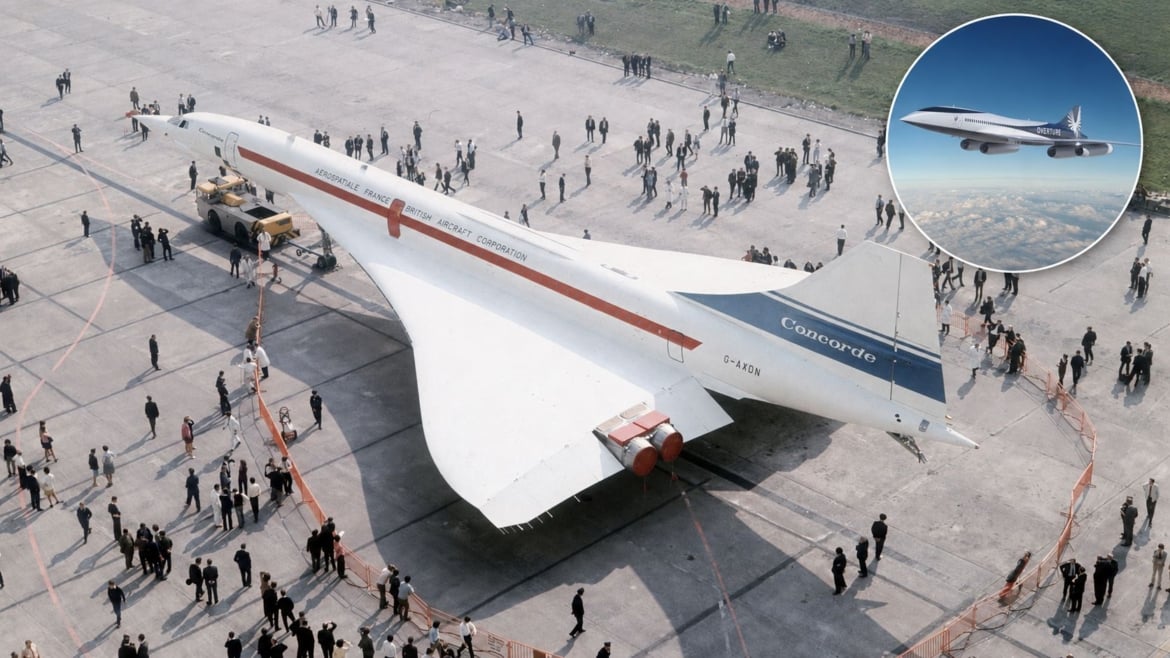
The historical parallel with Concorde is hard to ignore. The full-size Olympus 593B was first run on a test bed in November 1965, roughly three years and four months before Concorde’s maiden flight and more than a decade before the aircraft entered commercial service. Boom’s anticipated Q3 2026 Sprint Core test would leave only around three to three-and-a-half years before its aspirational 2030 passenger-service target.

There is an important difference. The Sprint Core is not yet a complete production Symphony engine, making Boom’s timetable especially aggressive. A successful run would be a major milestone, but turning one prototype into a certified engine that can be manufactured repeatedly will require extensive additional testing, refinement and certification work.

Symphony also faces a different thermal challenge from conventional airliner engines. Boom says its most demanding sustained operating condition will be supersonic cruise rather than takeoff. The engine therefore has to remain extremely hot and heavily loaded for an extended period, placing enormous importance on cooling, endurance and component life.

The luxury is speed itself
If Symphony reaches production, Overture is planned as an all-premium airliner carrying approximately 64 to 80 passengers. Boom is targeting fares comparable to today’s business-class tickets instead of the exceptionally high prices associated with Concorde.

The real luxury, however, would be time. The ideal Overture journey is straightforward, which is to leave New York after breakfast and reach London in time for an afternoon meeting. That schedule advantage could make speed itself the defining premium feature. Concorde showed how powerful that proposition could be. Its cabin was narrow, yet airlines turned the aircraft into a luxury experience with truffle pastries, bespoke tableware, fashion-designed uniforms and interiors associated with designers including Raymond Loewy and Andrée Putman.

Boom’s planned production chain extends beyond its own facilities. Future production Symphony engines are intended to be assembled by StandardAero in San Antonio, while Overture airframes are planned for final assembly at Boom’s Superfactory in Greensboro, North Carolina. The company describes its commercial pipeline as 130 orders and pre-orders, but that figure should not be presented as 130 firm orders. It includes 95 explicitly described options, consisting of 40 from American Airlines, 35 from United Airlines, and 20 from Japan Airlines. American has placed a non-refundable deposit on 20 aircraft, United has signed a purchase agreement covering 15, and Japan Airlines has made a strategic investment in Boom and obtained 20 options. For now, however, the biggest question is sitting inside that Sprint Core. XB-1 demonstrated that Boom could build and fly a supersonic aircraft. Symphony has to prove that the company can develop the propulsion system capable of powering a commercial one. If the core fires successfully, Boom will have taken perhaps its most consequential step yet toward making supersonic luxury travel a commercial reality again.