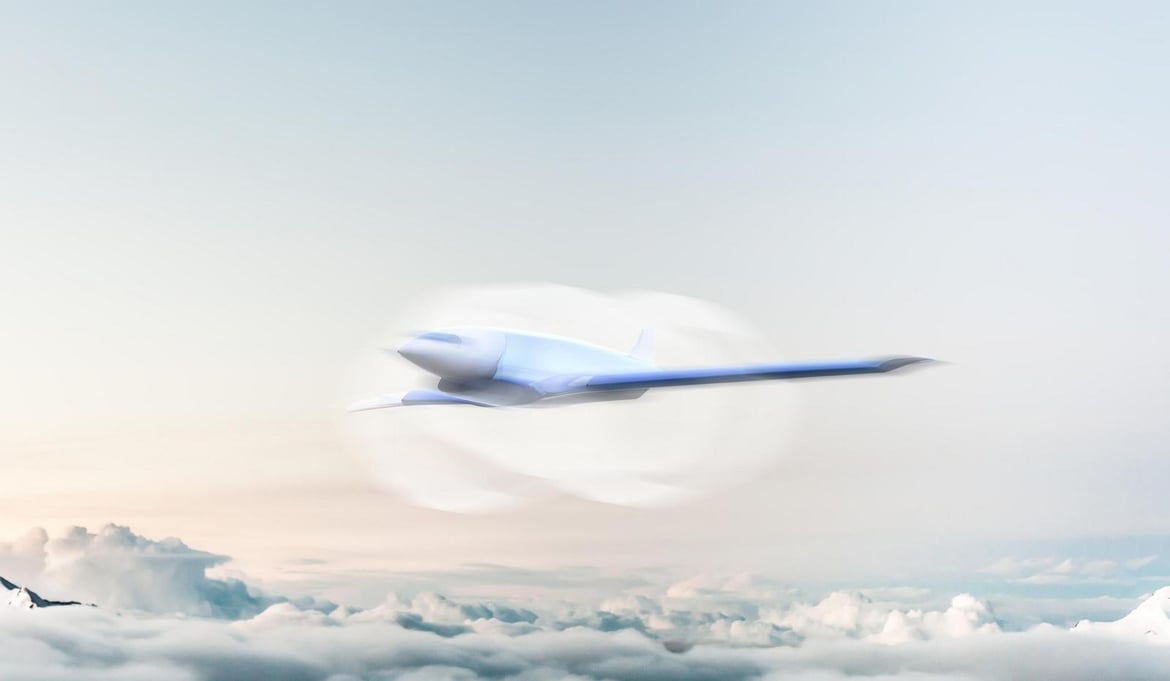
The Antipode is one of those rare aviation concepts that makes even the legendary Concorde seem almost quaint. Conceived by Canadian industrial designer Charles Bombardier in collaboration with Abhishek Roy of Lunatic Koncepts, the aircraft is imagined as a private hypersonic jet capable of flying from New York to Dubai in just 22 minutes. For perspective, the Concorde’s transatlantic runs took about three and a half hours, and today’s fastest commercial flights between the two cities stretch to nearly 12 hours. If it were possible to build, the Antipode would redefine the meaning of long-haul travel.

At its heart, the Antipode is designed to cruise at an astonishing Mach 24, or roughly 12 times the speed of the Concorde, as reported by Forbes. That translates to about 25,000 kilometers per hour. It would carry up to 10 passengers and cover distances as far as 12,430 miles in under an hour, reaching antipodal points on the globe faster than any aircraft in history. “I wanted to create an aircraft concept capable of reaching its antipode as fast as possible,” Bombardier explained when unveiling the design. The aircraft’s small passenger capacity reflects its positioning as a luxury business jet, a craft for speed over seating volume.

One of the defining innovations in the Antipode concept is its proposed use of an aerodynamic phenomenon called long penetration mode, or LPM. The idea, introduced to Bombardier by engineer Joseph Hazeltine, involves channeling supersonic air through a nozzle at the aircraft’s nose, creating a counterflow of air that can cool the surface temperature and help muffle the sonic boom. This is critical, as at Mach 5 and above the heat generated from aeroheating can reach nearly 980 degrees Celsius. “LPM could help reduce heat, but it would not eliminate all of it,” Bombardier admitted, acknowledging that advanced heat-resistant materials would still be essential.

The Antipode’s takeoff would involve rocket boosters mounted to its wings, giving it enough thrust to reach 40,000 feet and Mach 5 before the boosters detach and return to base, much like Blue Origin’s reusable rocket stages. From there, a scramjet engine would ignite, burning atmospheric oxygen to avoid the weight of onboard oxidizers, and accelerate the craft to Mach 24. This is the same type of propulsion tested by the U.S. military in 2013, though no manned scramjet has yet flown, and nothing close to Antipode’s envisioned speed has been achieved.

Compared with the Concorde, which was limited by sonic boom regulations and could only reach Mach 2, the Antipode’s ambitions sound like science fiction. Yet Bombardier sees value in proposing such a radical leap. “It’s all about innovation. Share your idea, and it opens up a door for other designers to build on it,” he said. Whether it ever leaves the drawing board or not, the Antipode stands as a symbol of how far imagination can push the boundaries of flight. Sadly, we’ve heard very little about the concept over the last nine years since all major news publications covered it.