Imagine boarding a private jet where the seats rotate to face one another, walls slide around to create different rooms, and a meeting can take place in a dedicated conference suite before you head to the bar for a drink. Now imagine that the aircraft itself can change the shape of its wings to suit the speed at which it is flying. That is the idea behind Epsylon, a Russian supersonic business jet concept that combines variable-sweep wings with an unusually ambitious luxury cabin featuring 20 passenger chairs, a meeting room, a lounge, a bar, and even a shower. With a proposed top speed of Mach 3, it would be more than three times as fast as the Bombardier Global 8000, the world’s fastest private jet at Mach 0.95, and even faster than the legendary Concorde, which zipped across the Atlantic at Mach 2. At that speed, the Epsylon could cover the distance from Miami to San Francisco in a little over an hour.

Designed by Filipp Avakyan of the St. Petersburg-based Asgard design agency, Epsylon began as a master’s degree project exploring a different approach to private aviation. With aerodynamic consultation from Mikhail Lebedev of Baltic State Technical University, the concept looks beyond simply getting wealthy passengers to their destinations faster. Instead, it imagines an aircraft that can transform both its exterior and interior, making the journey itself a more flexible and comfortable experience.

Wings that change with speed, and a cabin that changes with its passengers
The most unusual feature of Epsylon’s exterior is its proposed variable-sweep wing arrangement. The wings would adopt a less-swept position during take-off and landing before moving backwards for supersonic cruising. The idea is to accommodate the different aerodynamic requirements of flying at relatively low speeds and travelling faster than the speed of sound. The arrangement is reminiscent of military aircraft such as the F-14 Tomcat, although incorporating such a mechanism into a modern business jet would bring considerable weight and engineering complexity. Two engines mounted towards the rear of the fuselage are visible in the renderings, but their manufacturer and specifications have not been disclosed.
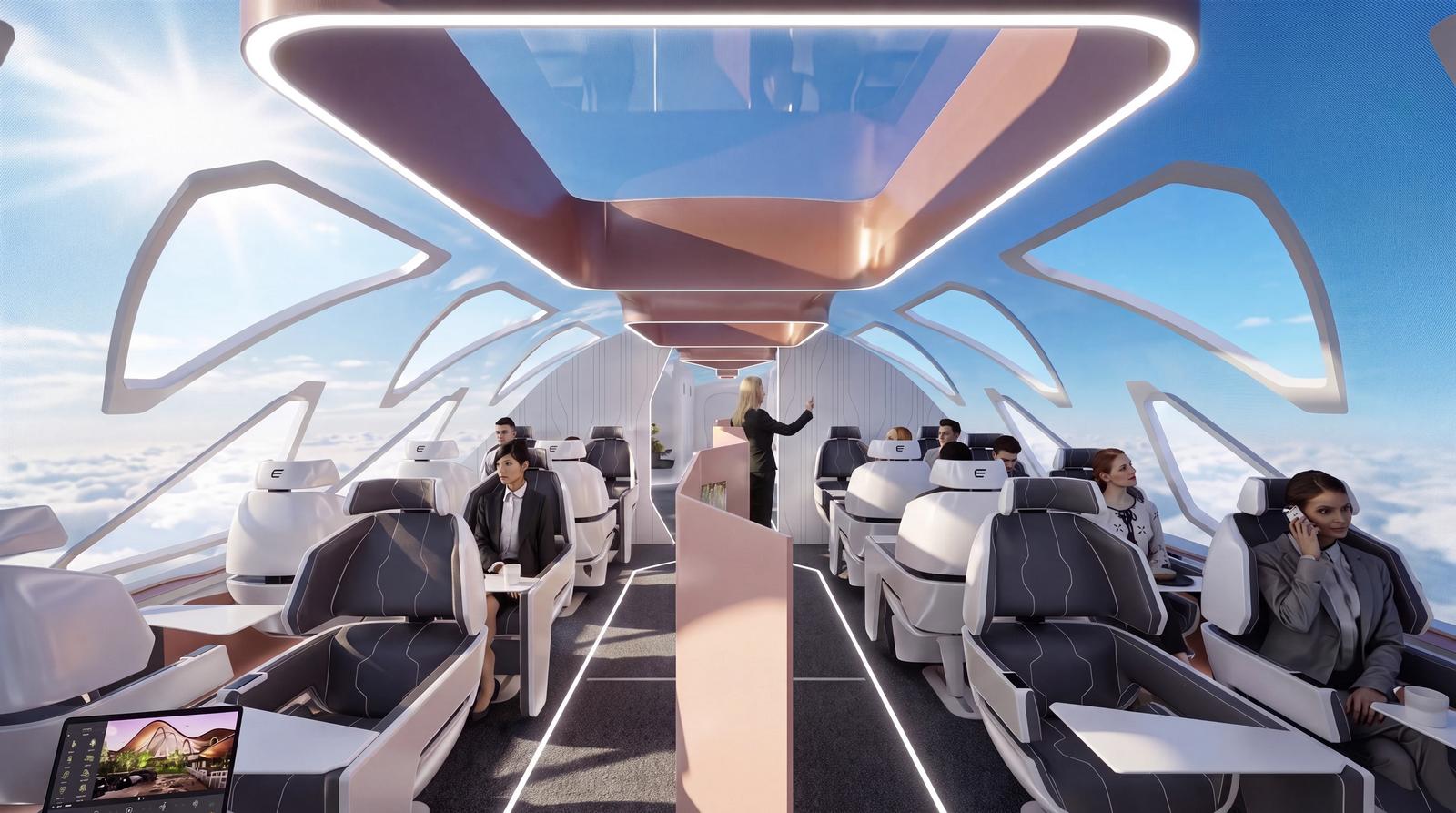

The real showpiece, however, is inside. The published cabin floor plan depicts 20 individual passenger chairs, although this is not an officially confirmed maximum capacity. There are also two cockpit positions and four additional seats designated for personnel. Rather than placing passengers in conventional fixed seating arrangements, Avakyan proposes chairs mounted on pedestals that can rotate through 360 degrees and slide along a horizontal axis. Folding tables extend across passengers’ laps, with upright panels that appear to provide a degree of privacy, effectively turning individual seats into compact workspaces.

Movable partitions are another important part of the design. Running along guides integrated into the floor, these dividers would incorporate LED panels and allow passengers to change the cabin layout depending on their needs. They could separate working and resting areas or be moved aside to create a more open social environment.

There is also a dedicated conference room with opposing upholstered benches and a central table, meaning passengers would not have to rearrange the main cabin every time they wanted to hold a meeting. Farther forward, the renderings show a lounge with sofas, freestanding chairs, tables and a dedicated bar area. The floor plan also identifies a shower and toilet compartment, a separate toilet and a wardrobe towards the rear. Interestingly, no dedicated bedroom or fully flat sleeping arrangement is shown.

A futuristic flying lounge
Epsylon’s cabin design also takes an unusual approach to windows. Small triangular physical windows would be complemented by panoramic digital displays across sections of the walls and ceiling, creating the impression of a much larger view of the surrounding sky. Passengers could also adjust the displays to change the cabin’s visual atmosphere.

The interior uses white seat shells, dark upholstery, rose-coloured surfaces and illuminated floor detailing, while the cockpit adopts a darker anthracite finish with holographic flight information displays. It looks closer to a futuristic hotel lounge than a traditional executive aircraft.

The proposed fuselage measures approximately 25.8 metres in cabin length, 6.2 meters in width and 5.4 meters in height. However, Epsylon remains a design concept, with no confirmed manufacturer, engine specifications, price, cruising speed, range or first-flight schedule.

The supersonic jet has an estimated range to 12,000 kms (about 7500 miles) and a top speed of Mach 3, equivalent to approximately 2,300 mph, thanks to which it could theoretically cover the 3,450-mile journey between New York and London in just around 90 minutes, compared with roughly seven hours on a conventional commercial flight.

What makes the project interesting is that its ambitions extend beyond supersonic travel. While most aircraft designers concentrate on making journeys faster, Epsylon imagines changing what passengers can do with that time. Its wings would adapt to the demands of flight, while its cabin would adapt to the people inside it.