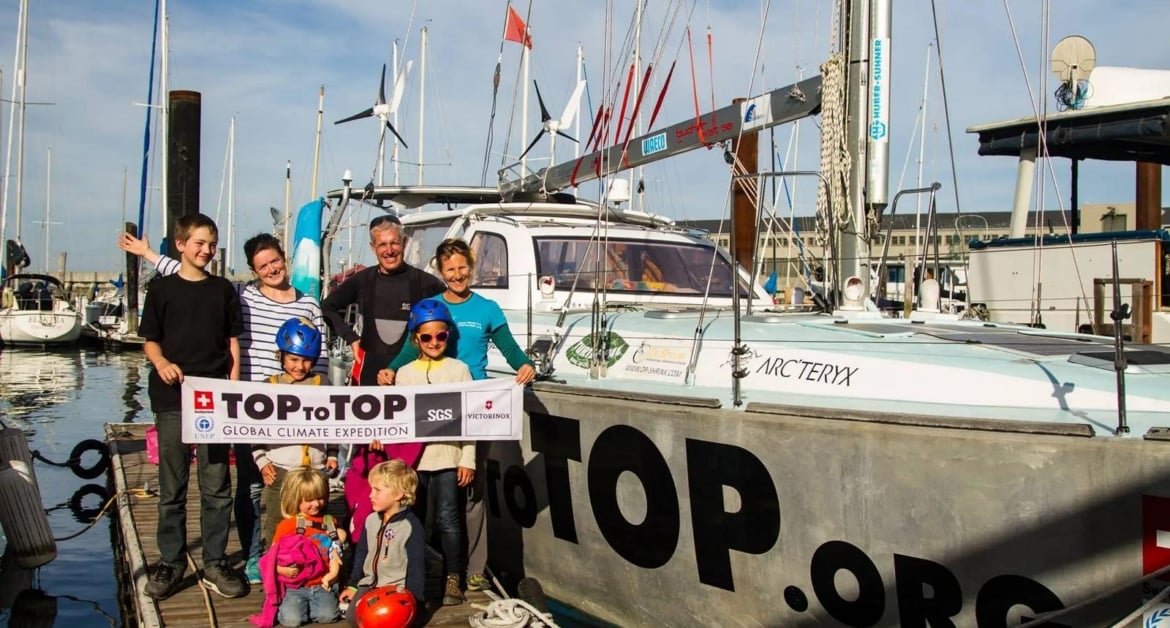
Renting a luxury superyacht for a few weeks is one thing. Owning a megayacht for a few years is another. Then there is a third category altogether, the Schwörer family from Switzerland, who have made life at sea their normal for the past quarter century. Very little of the world remains untouched by their sailboat, Pachamama, which, as the vessel behind the ambitious TOPtoTOP Global Climate Expedition, has covered more than 132,000 nautical miles while circumnavigating the globe.
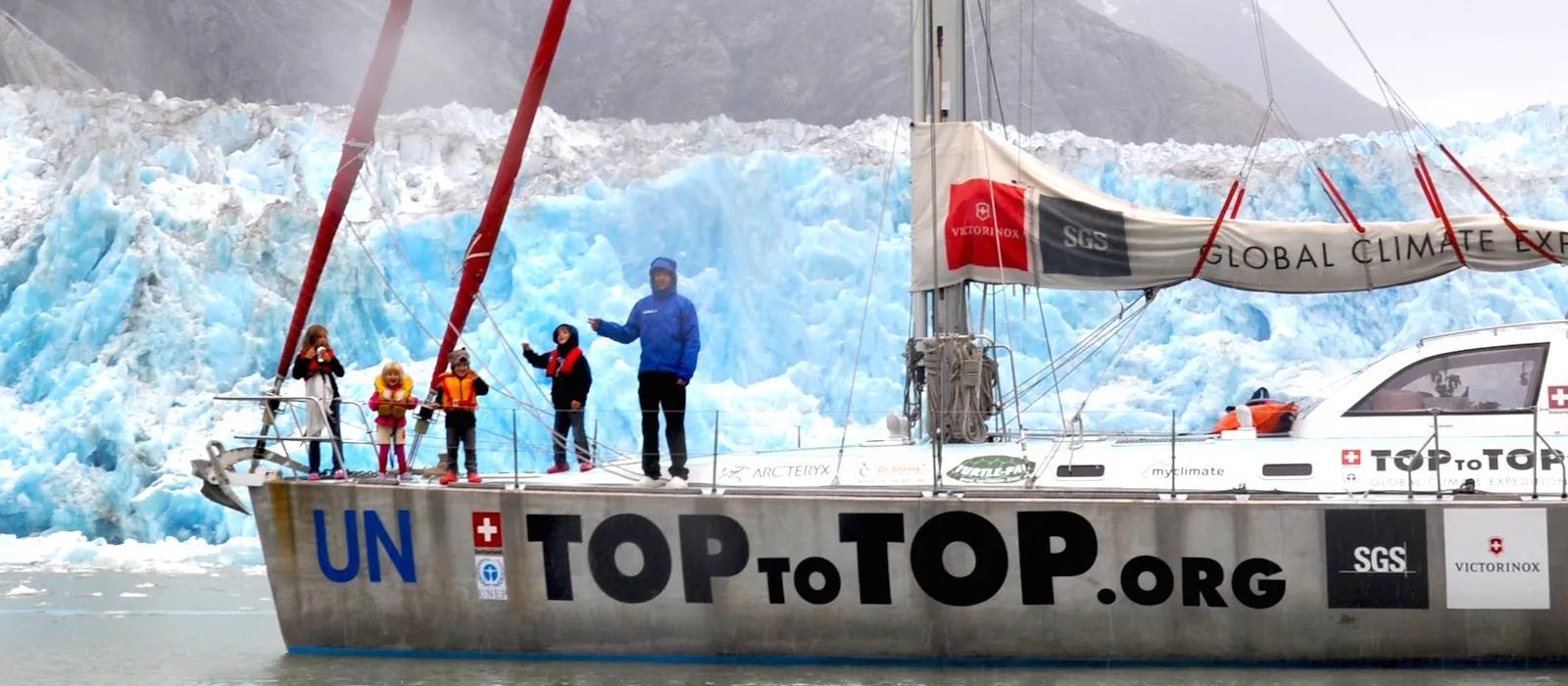
Sabine and Dario Schwörer and their six children have spent their lives sailing, working, learning, and living in just 20 square meters of space. For 25 years, Pachamama has served not only as their home, but also as a research platform for universities and scientists, and an unconventional classroom for the Schwörer children. The mission began in the heart and mind of Dario, a Swiss mountain guide and climatologist who saw glaciers and mountain environments changing in the Alps. He was joined by his wife, Sabine, and together they founded TOPtoTOP with the goal of becoming the first expedition to connect all climate zones by crossing the seven seas and reaching the highest peaks on each of the seven continents.

Their nonprofit, TOPtoTOP, was incorporated in Wangs-Pizol, Switzerland, in 1999, with what was originally meant to be a four-year goal. More than two decades later, the mission has grown into something much larger. Today, the family has visited more than 100 countries and educated thousands of students about climate change. While their mission is certainly applaud-worthy, it is their life as an example that deserves special mention. They are not just talking the talk. They are quite literally walking the walk when they get off the boat. Pachamama is not a lifestyle accessory enjoyed in summer or a prop for an off-the-grid YouTube video. It is their home, their children’s classroom, a lab, a mode of transport, and everything domestic and beyond. Let’s take a closer look at what living as a seafaring Schwörer really looks like.

Meet Pachamama-
Pachamama, meaning Mother Earth, is a 50-foot aluminum sloop designed by Bernard Nivelt. It can operate sustainably and autonomously, with maximum safety in some of the toughest marine environments. Inside, the vessel has a large anchor locker with generous storage space, two double cabins with showers and bathrooms, plenty of additional storage, a large kitchen for the family and guests, and a salon with a table that seats 10 people. The cockpit, too, has a table for seven people and two storage lockers. Pachamama is not just a boat. It is their home, and in the remotest corners of the world, it is also their lifeboat. That is why she is equipped to keep the family safe in the middle of nowhere.

The vessel runs on a 62-horsepower Nanni diesel engine and is supported by nine solar panels, two wind generators, and a vast collection of spare parts for almost everything on board. If something breaks, the fix often has to be found on the boat itself. To navigate in pitch darkness and fog, the family relies on radar to detect other vessels and land. To stay connected with the world, SSB radio and satellite phones allow them to send emails, receive weather reports, and make calls using satellites or long-range radio waves. In short, they have almost everything they need within that 20-square-meter world, except perhaps privacy.

Six kids, six birthplaces
Unlike most families who rush to the same hospital for childbirth, the Schwörer children were born in six different places. Salina, the oldest, was born in Chile, Andri in Patagonia, Noé in Australia, Alegra in Singapore, Mia in Switzerland, and Vital in Iceland. In Chile, Dario, who is now 57, had taken a midwife course and cut the umbilical cord with a Swiss Army knife. Later, when the family needed a passport in Santiago, the Swiss ambassador connected them with Victorinox, which eventually became a sponsor. For these six children, Pachamama was not a vacation home. It was life itself. They were trained in seamanship, responsibility, risk-reading, and public speaking. They also learned family values and the art of coexisting in very little space.

One of the family’s simplest rules was to make peace every night before going to sleep. At sea, especially in an emergency, everyone must pull together because there is no room for conflict. Sabine once joked that when she is angry with the children, she cannot send them very far, only to the anchor, which is the closest thing to a private place on board. Today, the children are not just passengers in their parents’ story. They are helping expand the TOPtoTOP mission. The family now has a 35-foot steel sister ship, Naomi, restored and equipped with safety gear under Noé, who has completed his captain’s exam. Noé, Salina, Andri, and Alegra are now taking leading roles in the Save the Arctic campaign.

Image – Youtube / Yamaha Music Europe
Managing passions at sea
Sabine shared Dario’s love for the sea, but she also had a deep passion for the piano. With salt air as her permanent surroundings, having a traditional piano on board was nearly impossible. Dario did his best and promised Sabine she would still be able to play. So whenever they docked, whether in a remote Arctic village or a city in South America, he would go looking for a piano. Over the years, Sabine played in monasteries, schools, community centers, and even the private homes of strangers.

That passion eventually found its way back onto Pachamama. In November 2025, Yamaha released a short documentary about the family, featuring a Clavinova CSP-275PE installed on the boat for Sabine. Unlike a traditional piano, the digital instrument was better suited to life at sea. It was a small addition, but one that centered the family emotionally. When Pachamama recently underwent a major refit at the Nogva shipyard in Norway after an engine failure near Svalbard, the piano in their living room helped keep the family grounded while their home was literally being taken apart and put back together.

Challenges faced
According to FAZ, the worst catastrophe faced by Pachamama and the family aboard was a collision with a container in the Pacific. The damage was serious enough that fishermen in Patagonia later had to weld the hull. In another frightening incident, an Icelandic storm ripped Pachamama from its moorings and badly damaged the vessel, with rescue forces involved.

But not every challenge comes as a dramatic calamity. Sometimes, hardship looks like going nine months without a supermarket run or spending 59 days without seeing land. Then there is the question of schooling. Most of the children’s primary education happened aboard Pachamama, followed by a patchwork of boat-schooling, volunteer teachers, public schools in different countries, Swiss schooling, Norwegian classrooms, and online learning. The children have studied in places including Australia, Singapore, Nepal, South Africa, St. Helena, Brazil, Trinidad, Colombia, Panama, Hawaii, Alaska, Canada, California, Massachusetts, Bermuda, the Azores, Iceland, and Norway.

Evidently, when you are at sea for 25 years and counting, the trials and tribulations are not limited to water and marine life. They also include parenting, schooling, repairs, finances, fatigue, and the ordinary complications of life, even when Dario and Sabine have kept their existence deliberately uncomplicated and focused on one mission. The family has reached hundreds of thousands of students in more than 100 countries, collected tons of garbage, and gathered DNA and microplastic samples for scientific work. Their mission looks far from over, but the story of their work deserves to travel much farther.