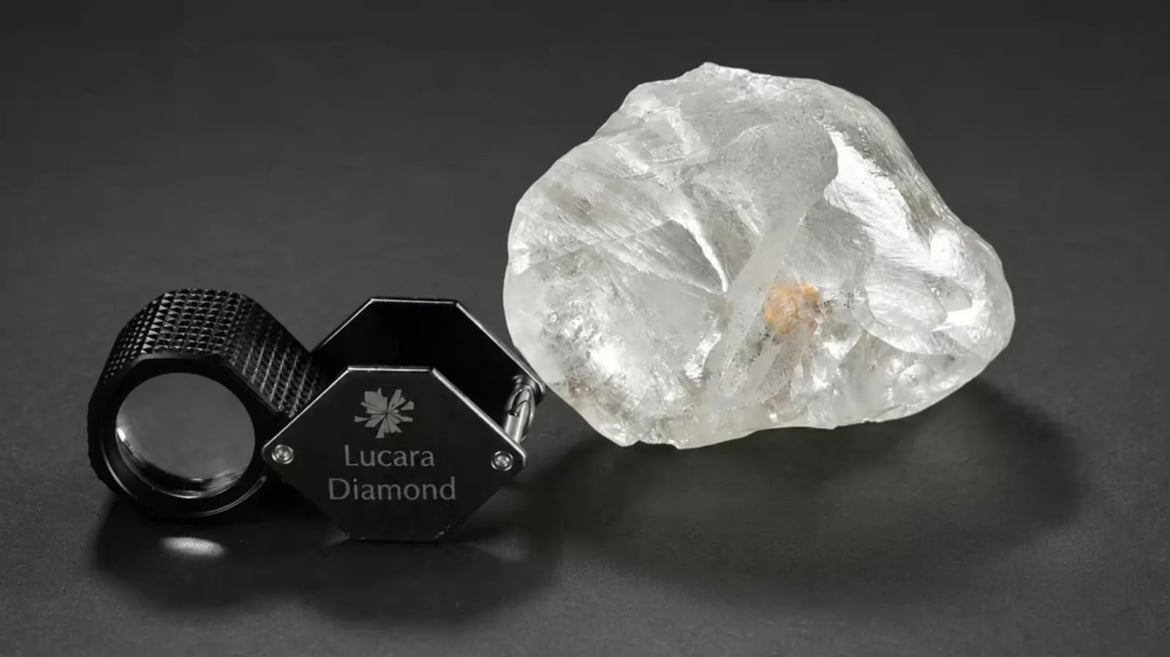
In fewer than 15 years of operation, the Karowe mine in Botswana has recovered its 10th diamond weighing more than 1,000 carats. Lucara says it is the only diamond mine in history to have recovered ten diamonds exceeding 1,000 carats. The latest discovery initially weighed a whopping 1,305.4 carats, as announced by Lucara Diamond Corp. The rough measured 79.9 x 34.1 x 51.9mm and weighed approximately 261 grams before cleaning. After cleaning, the company reported a revised weight of 1,303 carats and described it as a D-color, Type IIa white diamond.

The 2.4-carat reduction was inconsequential as Lucara’s later description elevated the stone from “white” to a D-color, Type IIa colossus, reported Vogue. It stands as the fifth-largest rough diamond recovered from the Karowe mine, following stunning discoveries such as the 2,488-carat Motswedi, an unnamed 2,036-carat stone, the 1,758-carat Sewelô, and an unnamed 1,476-carat stone.

While it is easy to imagine Lucara’s euphoria over its foresight, I, for one, feel for De Beers’ massive miscalculation. The diamond giant discovered the AK6 kimberlite pipe around 1970 but deemed it uneconomic because conventional sampling indicated limited potential for large stones. De Beers’ loss became Lucara’s gain. The Canadian company acquired a 70.268 percent interest in the asset from De Beers in 2009 for approximately $49 million and secured full ownership in 2010. This was followed by an increasing number of finds of ultra-large Type IIa diamonds, the chemically purest diamond type.

Advanced technology made the intact recovery of these historic finds possible, and it quickly paid for itself. Karowe’s X-ray transmission (XRT) sorting equipment was instrumental in recovering these exceptionally large stones intact. Lucara reportedly spent between $50 million and $60 million redesigning the plant around XRT technology, and on the very first weekend the system went live in 2015, it recovered a 269-carat diamond that later sold for approximately $20 million. Interestingly, Karowe’s open-pit mining is scheduled to conclude in the fourth quarter of 2026. It will then focus on underground operations targeting the highest-value portion of the Karowe orebody. Full-scale underground production is scheduled for the first half of 2028, and the list of Karowe’s top dazzlers will likely welcome even more mammoth recoveries. Karowe translates to “precious stone” in the local Sesarwa language, a name chosen well before the mine became synonymous with some of the largest diamonds in modern history. Clearly, there is plenty in a name!