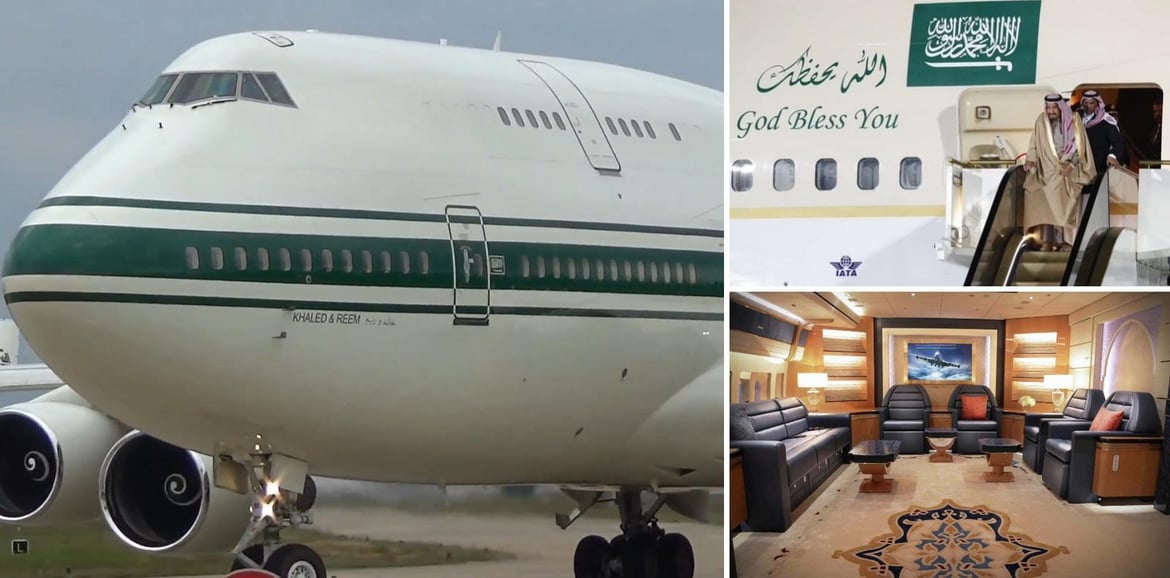
King Salman bin Abdulaziz arrived on the French Riviera in the summer of 2015 seeking relief from the searing Riyadh heat, descending into Nice aboard two private Boeing 747 jets that underscored the scale of his annual migration to Europe. The monarch did not choose a hotel for his stay. Instead, he retreated to the Saudi royal family’s private estate overlooking the shore in Vallauris, the modernist Château de l’Horizon, also known as Château de l’Aurore.

This striking seafront villa was completed in 1932 by American architect Barry Dierks for the actress Maxine Elliott. It stretches along the rocks above Mirandole beach with long white stucco volumes, arcaded galleries, and a plan designed so that most rooms open directly toward the horizon.

The property once featured a dramatic rectangular pool running the length of the façade and a grand stairway leading to the sea. Its glamorous history includes Prince Aly Khan’s purchase in 1948 and the lavish 1949 reception for Rita Hayworth, where attendants famously scented the pool with eau de cologne and floated floral initials on the water. The Saudi royals acquired the residence in 1979, and it became their preferred summer base in the Mediterranean.

For King Salman’s arrival, the surrounding towns braced for an influx of staff, security and logistics. His close circle stayed at the villa while the broader entourage occupied hundreds of rooms in the great hotels of Cannes and Cap d’Antibes. French outlets estimated around four hundred rooms were booked in the palaces along the Croisette for roughly seven hundred people, with forty more rooms taken in Cap d’Antibes for about seventy members of the extended group. The deployment echoed the seasonal migrations of past decades, when the Riviera became a temporary extension of the Saudi court.

What unfolded next, however, became one of the most debated episodes of the season. The villa sits above Plage de la Mirandole, a public beach that is part of France’s protected maritime domain. Days before the king arrived, the Alpes Maritimes prefecture issued an order temporarily restricting access to the shore adjoining the royal property.

The beach was closed and navigation was banned within a three-hundred-meter zone in front of the villa. The closure was justified on security grounds and was framed as necessary for the protection of a sitting head of state. Fixed security posts were established along the coastal path. Reporting at the time described seven to eight officers rotating at each fixed point in continuous shifts, supported by mobile patrols on land and police boats at sea.

The tension escalated when temporary works were discovered at the interface between the property and the shore. Workers had installed a concrete base on the sand as the foundation for a private elevator that would give the king direct access to the beach, as reported by Le Monde.

They also added a metal walkway over the rocks to improve circulation between the villa and the waterline. Initial questions about authorization quickly turned into a public debate when images of the works circulated online. Authorities eventually regularized the modifications on the strict condition that every installation be removed at the end of the visit. Even with that guarantee, the idea of a private lift built on public land became a symbol of the wider controversy.

Local reaction was immediate. Jean Noël Falcou, an opposition councilor in Vallauris, launched an online petition condemning what he described as the privatisation of a public beach. The petition soared past one hundred thousand signatures within days and ultimately reached between one hundred thirty thousand and one hundred fifty thousand as national media amplified the story. Protesters, beachgoers, and residents framed the closure as a collision between public rights and the demands of VIP security. Many argued that the beach should remain open regardless of who occupied the villa above it.

Scenes of barricades, patrol boats, and heavy police presence contrasted sharply with the tranquil image that usually surrounds Riviera summer retreats. The dispute became a national talking point and placed the king’s holiday under sustained scrutiny. Faced with public pressure, high-visibility controversy, and mounting logistical complications, King Salman cut short what was meant to be a three-week vacation, leaving after just a week. The two 747s that brought him to France became the aircraft that carried him to Morocco ahead of schedule. What began as a quiet escape from the desert heat ended as a lesson in the limits of privacy, privilege, and protocol when a private holiday intersects with France’s deeply held commitment to public access along its shores.