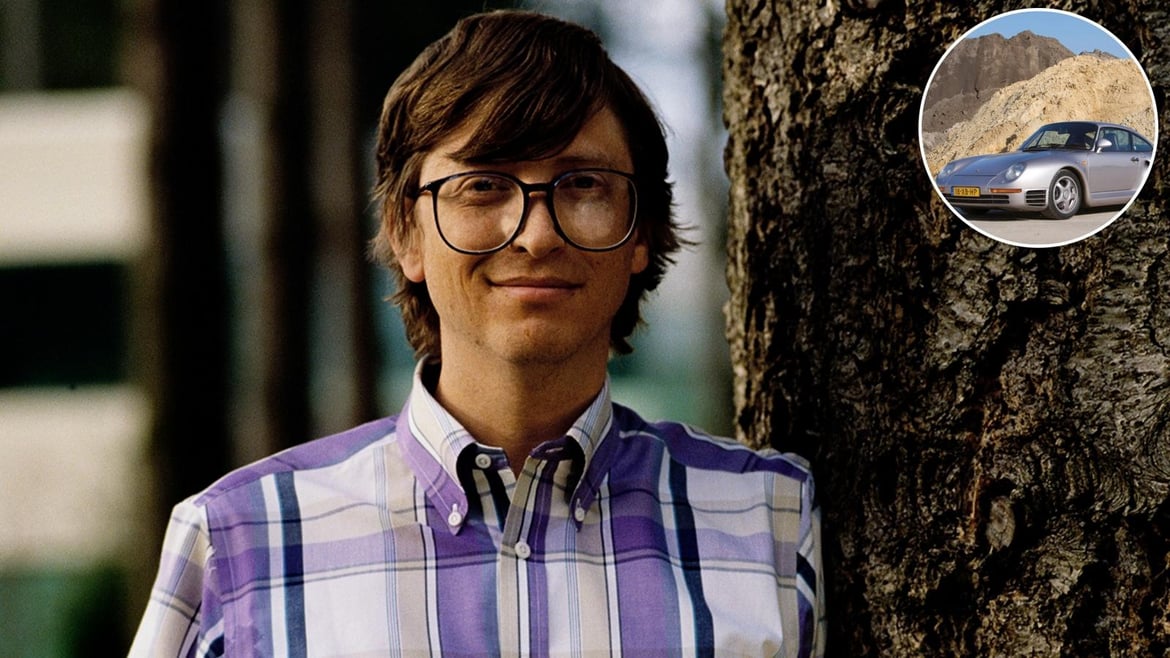
Bill Gates bought a Porsche 959 that the United States government would not let him drive, then watched it sit for 4,745 days in a damp Seattle warehouse while it quietly accumulated storage fees and mechanical risk. At $28 a day inside a Port of Seattle Foreign-Trade Zone, one of the most advanced cars of the 1980s aged in coastal air, its twin turbos, hydraulics, and early digital brain frozen in time. Most owners would have written it off as an expensive lesson. Gates waited, paid the bills, won the legal fight, and when the doors finally opened, he did not discard the car. He sent it to a tuner and effectively reinvented it.

By the time the “Show or Display” exemption became law in 1999, Gates had secured the right to keep the 959 on American soil and drive it in limited fashion. What he had not secured was automatic compliance with the Environmental Protection Agency and California emissions standards. The European-spec 959 had never been engineered for U.S. smog rules. Before it could legally touch public tarmac, it first had to survive the consequences of a thirteen-year automotive coma.

The anatomy of a 13-year automotive coma
The Porsche 959 was not an analog sledgehammer that tolerated neglect. In 1986, it was effectively a road-legal prototype. Its Porsche-Steuer Kupplung all-wheel-drive system used computer-controlled hydraulics and a multi-plate clutch to vary torque front to rear in real time. Its hydro-pneumatic suspension adjusted ride height and damping electronically. Bosch Motronic engine management orchestrated sequential turbochargers with software that was revolutionary for its era. Magnesium engine cases and hollow magnesium wheels added exotic materials that demand care.

Leave that ecosystem untouched for over a decade, and deterioration begins in the shadows. Hydraulic seals harden, and accumulators lose charge. Brake and clutch fluids absorb moisture. Electrical connectors corrode at their pins while aging capacitors inside control units slowly degrade. Magnesium, especially in salty coastal air, is prone to oxidation. Internal engine components that once relied on regular heat cycles and lubrication face the risk of surface corrosion after years of silence.

The roughly $133,000 Gates paid in storage was the visible expense. The greater cost was the mechanical debt accruing inside a hyper-complex drivetrain designed to think, adapt, and move continuously. Few cars are as ill-suited to prolonged dormancy as a 959 because its brilliance depends on hydraulics and electronics that stay healthy only when exercised.

The federalization paradox and the Canepa solution
Winning the right to own the car was only half the story. The factory 959 lacked catalytic converters, did not read oxygen sensors in a US-compliant way, and was mapped for European standards, as pointed out by Autoweek. Porsche was not about to supply retrofit kits for a handful of formerly impounded hypercars. The task fell to Bruce Canepa, the racer and Porsche authority who had championed the lobbying effort from the beginning. Working out of his Scotts Valley, California, workshop, he had become the quiet oracle for 959s, combining race driver instincts with a surgical approach to restoration and reengineering.

What followed was not a cosmetic restoration but a ground-up re-engineering. The cars were stripped to the tub. To satisfy emissions requirements, Canepa replaced the antiquated sequential turbochargers, known for dramatic 1980s lag, with modern parallel BorgWarner units. He fabricated equal-length stainless-steel headers, installed modern catalytic converters, added knock sensors, and integrated contemporary MoTeC engine management in place of the aging factory electronics.

The irony is irresistible. In the 1980s, American emissions laws often dulled the performance of European exotics. In the case of the 959, achieving compliance demanded modernization that unlocked hidden potential. The Generation I upgrade lifted output from 444 horsepower to roughly 576 horsepower while meeting US standards. Later evolutions climbed further still.

Gates’s 959 did not simply wake up after 4,745 days of dormancy. It emerged faster, cleaner, and more reliable than when it left Germany. The warehouse years were an expensive holding pattern, yet they set the stage for a rare outcome in automotive history. Instead of abandoning a stranded icon, Gates financed its second act, transforming a bureaucratic stalemate into a more formidable version of Porsche’s original technological statement.