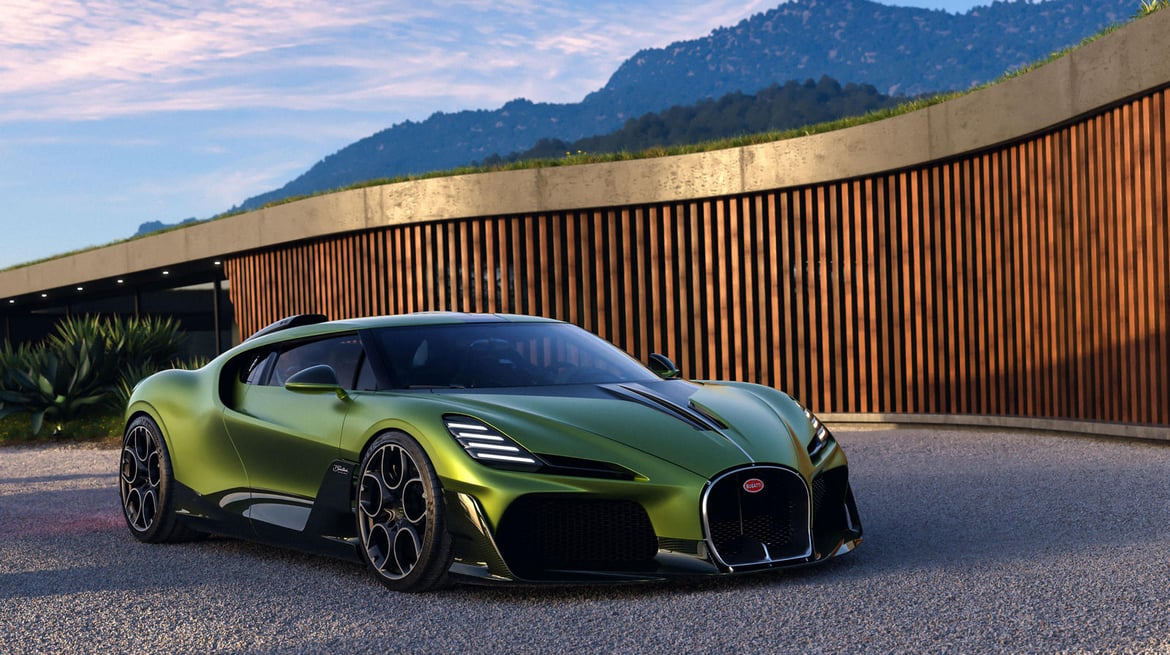
Behold the Bugatti Brouillard, the first creation from the French hypercar maker’s new Solitaire division, an ultra-exclusive program that will produce no more than two entirely unique cars each year. Revealed ahead of its public debut at Monterey Car Week, the Brouillard is a one-of-one coupe built on the carbon fiber core of the open-top Mistral but with almost every exterior panel redesigned. Power comes from Bugatti’s 8.0-liter quad-turbocharged W16 engine producing 1,578 horsepower, paired with a seven-speed dual-clutch transmission. This configuration makes it one of the last models to carry the legendary W16 before Bugatti’s next-generation V16 hybrid era begins.

The proportions are more dramatic than the Mistral, with a lengthened front section, a glass canopy roof, and elongated milled-from-solid air intake trumpets. At the rear, a fixed wing sits above X-shaped taillights, one of the few components carried over from the roadster. The central spine runs from the nose, over the roof, and into the cabin, a modern echo of the sculptural dorsal seam of the 1930s Type 57 SC Atlantic.

The Solitaire vision
Solitaire elevates personalization to the level of creation. While Bugatti’s Sur Mesure program allows for extensive customization, Solitaire enables the buyer to reshape bodywork, reimagine proportions, and choose entirely bespoke materials. Each commission will be crafted in Molsheim, the same Alsatian estate where Bugatti was founded and where every car is still hand-built. This place-based connection reinforces the notion that a Solitaire model is more than transport. It is a commissioned work of art.

Bugatti has not released the price of the Brouillard, but the brand’s last modern one-off, La Voiture Noire, in 2019, sold for €11 million before tax (roughly $18 million). That car was also an homage to the Atlantic, but the Brouillard comes with a clearer coachbuilt brief and serves as a more radical departure from existing models. Solitaire clients are purchasing singularity, and the investment reflects the cost of designing, engineering, and building a unique car from the ground up.

Heritage in form and craft
The Brouillard’s name means “fog” in French and was also the name of Ettore Bugatti’s favorite horse. The connection is more than symbolic. Ettore was a lifelong horseman and often described his cars as “pur sang,” or thoroughbreds. He bred horses on the Molsheim grounds and even designed stable doors they could open with their noses. His brother Rembrandt created the “Dancing Elephant” sculpture that adorned the Type 41 Royale radiator, one of the most famous examples of animal-inspired artistry in automotive history.

This equestrian influence appears throughout Brouillard’s design. The bodywork avoids sharp lines, favoring smooth, reflective surfaces that suggest the muscle tone of a trained horse.

The interior features equine silhouettes embroidered into the seats and door panels, made from tartan fabric woven with ethically sourced horsehair. The gear selector is machined from aluminum and set under glass, containing a hand-crafted sculpture of the horse for which the car is named. Even the alloy wheels carry horseshoe-shaped details.

Coachbuilding then and now
The Brouillard also revives a lineage of in-house coachbuilding that began in the 1930s when Jean Bugatti designed and built bodies like the Type 57 SC Atlantic entirely under the marque’s control. The Atlantic’s distinctive spine was both a structural necessity and a design flourish, a philosophy echoed in the Brouillard’s continuous central line. Just as those early Bugattis were shaped for individual clients, Solitaire cars are modern expressions of the same ethos, crafted to reflect the vision of a single patron.

A thoroughbred for the future
As the first Solitaire build, the Brouillard sets the tone for what will follow. It merges contemporary performance with traditional craftsmanship, offering a bespoke farewell to the W16 era while looking ahead to the possibilities of the V16 Tourbillon platform. It is at once a celebration of Bugatti’s past and a declaration of its future, shaped by the same values that Ettore Bugatti instilled in his earliest creations. In the Brouillard, the idea of the thoroughbred returns to the road, alive in form, in story, and in the place where it all began.