The Bugatti Type 41 Royale was not merely a luxury automobile that missed its sales targets. It was a machine built with such towering ambition that it misjudged the very world it was meant to dominate. Ettore Bugatti did not intend to sell cars to the wealthy. He intended to sell power, symbolism, and supremacy to kings. What he created instead was a rolling monument to a vanishing order, one so extravagant and so mistimed that not a single member of its intended audience ever took ownership.
This was not a quiet commercial disappointment buried in balance sheets. It was a public contradiction. A car conceived as the ultimate possession for monarchs failed to enter a single royal garage. In that gap between intention and outcome lies one of the most compelling stories in automotive history, because the Royale did not fail due to a lack of brilliance. It failed because it was too faithful to an idea of the world that was already slipping away.

A throne on wheels for a shrinking audience
Ettore Bugatti’s vision was rooted in the social hierarchy of the 1920s, where kings, aristocrats, and industrial dynasties still defined taste and influence. Luxury carmakers like Rolls-Royce and Duesenberg were already competing for elite clientele, but Bugatti chose a different path. He aimed higher, not incrementally but absolutely, by creating a car that would render even the finest Rolls-Royce almost ordinary.

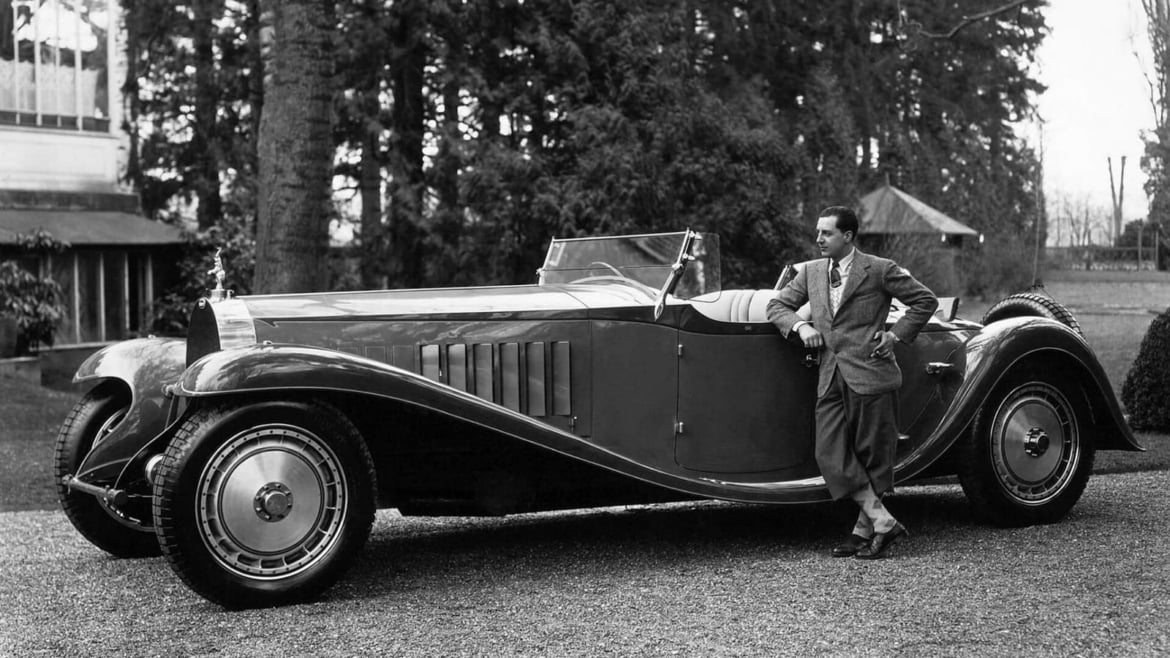
The result was staggering in both scale and intent. Stretching over six meters in length with a wheelbase of 4.3 meters, powered by a colossal 12.8-liter inline eight-cylinder engine, and engineered with the kind of mechanical depth more commonly associated with aviation, the Royale was less an automobile and more an assertion. It was designed to be seen, to be recognized instantly, and to project authority without explanation. It was, in every sense, a throne on wheels.

The price that broke its own promise
If the engineering made a statement, the price turned that statement into a provocation. When the Royale was introduced, it carried a price tag of at least 100,000 Reichsmarks, with commonly cited figures of around $30,000 for the chassis and roughly $40,000 for a completed car, depending on coachwork. That placed it far beyond anything else on the market.

Even the most prestigious automobiles of the era suddenly looked attainable by comparison. A Rolls-Royce Phantom, already considered the pinnacle of luxury, sat in a completely different financial universe. The Royale was not just the most expensive car available. It was the most expensive by a vast margin, a deliberate escalation that turned luxury into spectacle.

At a time when wealth still existed, but confidence was beginning to fracture, such pricing did more than limit demand. It sent a message that the car was not meant to be purchased in the usual sense. It was meant to be claimed by those who stood above ordinary measures of value. The problem was that by the time it was ready, very few people were willing or able to play that role.

The royal clients who never arrived
There was a moment when this audacious vision seemed within reach. King Alfonso XIII of Spain emerged as the most promising early prospect, and contemporary reports suggested he might become the first owner of a Royale. That possibility alone reveals how seriously the project was taken at the time. This was not an abstract fantasy but a calculated attempt to secure royal endorsement.
History intervened with brutal timing. Alfonso XIII left Spain in 1931 as the monarchy collapsed, and with his departure went one of Bugatti’s most credible buyers. Other potential royal clients, including European monarchs navigating political instability and financial caution, never stepped forward. The car had been designed for a class that was no longer in a position to indulge in such visible extravagance.

When exclusivity becomes isolation
The Royale’s failure cannot be explained by economics alone, although the Great Depression made its already staggering price politically and socially untenable. The deeper issue lay in Bugatti’s own philosophy. Ettore Bugatti did not want just wealthy customers. He wanted the right kind of wealthy individuals whose status aligned with his vision of prestige.

That selectiveness turned exclusivity into isolation. The car was not only prohibitively expensive but also enormous, complex, and impossible to ignore in an era when discretion had become increasingly valuable. For monarchs facing uncertain futures, such a conspicuous symbol of excess risked becoming a liability rather than an asset.

In the end, the buyers who did step forward were not kings but industrialists and private figures. Armand Esders, a Parisian magnate, became one of the first owners, commissioning a roadster famously built without headlights because he had no intention of driving at night. It was a detail that captured the spirit of the Royale perfectly, a kind of luxury that existed beyond practicality, but also beyond the realities of its time.

The paradox that created a legend
Only six Royales were completed, and only a handful were sold. None went to the monarchs they were designed to impress. By any conventional metric, the project was a failure. Yet that very failure transformed the Royale into something far more enduring than a successful product line.
If Bugatti had filled royal garages across Europe, the Royale might be remembered as the ultimate luxury car of its era. Instead, it became a symbol of overreach and imagination, a machine whose story carries more weight than its production numbers ever could. It represents a moment when engineering ambition collided with historical change, capturing the precise instant when old hierarchies began to give way to a different kind of world.

That legacy continues to surface in unexpected ways. During the Monaco Historic Grand Prix, Prince Albert II took a ceremonial lap around the Circuit de Monaco seated in a Bugatti Royale, a quiet but powerful reminder of the car’s enduring aura. The example seen in Monaco is the famed Coupé Napoléon, often referred to as the Coupé du Patron, which served as Ettore Bugatti’s personal car for years before passing into the hands of the Schlumpf brothers in 1963. Today it stands as the centerpiece of the Mulhouse collection, a position that feels entirely appropriate for a car that was always meant to sit above everything else.

The irony remains irresistible. The Royale failed because it was too royal, too expensive, too visible, and too tied to a world that was already fading. Yet in that failure, it achieved something far more elusive than commercial success. It became a legend, not because it fulfilled its purpose, but because it revealed how fragile that purpose had always been.