The story of the superyacht Dubai does not begin in the glittering marinas of the Gulf, but in the fractured ambitions of a different royal household. Originally commissioned by Prince Jefri Bolkiah and partially built in Germany, the project stalled and drifted into uncertainty before being acquired and completed under the direction of the Government of Dubai. What emerged in 2006 was not merely a yacht, but a floating statement of scale and intent, one that carried the unmistakable imprint of Dubai’s appetite for spectacle and control.

It is within this context of ambition and reinvention that one of the most revealing episodes of the yacht’s construction took place. As recounted by Kostis Antonopoulos, the former managing director of Platinum Yachts, in an interview with Boat International, the vessel’s digital systems were deliberately subjected to an external cyberattack during development. What followed was not a minor breach or a theoretical vulnerability, but a full compromise of the system in just thirty minutes, a result that reframed the entire understanding of security on board.

When confidence collides with reality
The decision to invite a cybersecurity firm to attack the yacht’s systems was not an act of recklessness, but a calculated move rooted in a deeper understanding of risk. Superyachts of this scale are no longer isolated mechanical entities, as they operate as highly networked environments that integrate navigation systems, communications infrastructure, surveillance layers, and guest services into a single digital ecosystem. Any weakness in this chain does not remain contained, as it can cascade across systems that govern everything from route planning to onboard privacy.

What Antonopoulos exposed through this exercise was the gap between assumed security and actual resilience. The system, which likely appeared robust under conventional testing, failed almost immediately under adversarial conditions. This was not a matter of obscure exploits or prolonged effort, but a demonstration that the architecture itself had not been hardened against real-world attack scenarios. By forcing the system to confront a genuine threat in a controlled environment, the project team gained something far more valuable than reassurance, as they gained clarity.

Why a superyacht cannot afford digital weakness
The importance of digital security on a vessel like Dubai extends far beyond technical integrity, as it intersects directly with privacy, safety, and geopolitical sensitivity. A superyacht owned by Mohammed bin Rashid Al Maktoum, the current ruler of Dubai, is not merely a private residence at sea, but a moving asset that carries high-profile individuals, confidential conversations, and strategic mobility. A compromised network could expose routes, communications, or onboard activities, creating vulnerabilities that extend well beyond inconvenience.

This is why ethical hacking, or controlled penetration testing, becomes essential rather than optional. By allowing experts to break the system before malicious actors attempt the same, designers are forced to confront weaknesses without the consequences of real-world exploitation. In the case of the $500 million megayacht Dubai, the rapid breach prompted a fundamental redesign of the yacht’s digital infrastructure, ensuring that security was not treated as a feature but as a foundation.

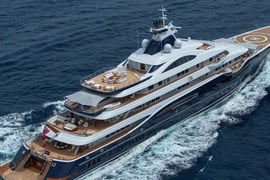
Today, Dubai remains one of the largest yachts ever built, stretching over 160 meters (about 531 feet) with a volume exceeding 12,000 gross tons and the capacity to host up to 72 guests alongside a substantial crew of 115 members. The naval architecture was done by Blohm & Voss GmbH, while the exterior design was penned by Winch Design.

Her interiors are famously opulent, its amenities expansive, and its presence unmistakable. Yet behind the polished surfaces lies a quieter achievement, as the yacht stands as a reminder that even the most extravagant creations are only as strong as the systems that protect them, and that true luxury in the modern age includes the discipline to test, expose, and rebuild before anyone else has the chance.