Few private assets illustrate the scale of billionaire travel quite like Mark Zuckerberg’s 387-foot superyacht, Launchpad. Since taking delivery of the Feadship-built vessel in early 2024, the Meta founder’s floating residence has logged nearly 100,000 kilometers (about 62,000 miles), a distance that exceeds twice the Earth’s circumference. Along the way, the yacht has consumed an estimated 5.3 million liters, or roughly 1.4 million gallons, of diesel, underscoring just how enormous the operating footprint of a modern megayacht can be.

AIS tracking data estimates that Launchpad has burned approximately €5.7 million (about $6.5 million) worth of fuel and produced around 14,300 tonnes of carbon dioxide during its voyages, according to a report by Il Messaggero. While yachts of this size are frequently repositioned without their owners onboard for maintenance, crew rotations, or seasonal preparations, the numbers still offer a rare glimpse into the extraordinary scale of operating one of the world’s largest private vessels.

A floating palace built for global exploration
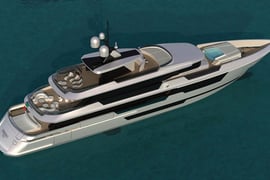
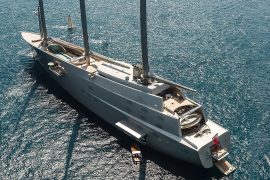
Built by Dutch shipyard Feadship and delivered in 2024, Launchpad measures 118 meters (387 feet) in length, stretches 16.3 meters across the beam, and displaces roughly 5,528 gross tons. It accommodates up to 26 guests in 13 cabins, attended by a crew of approximately 49, a ratio of nearly two crew members for every guest.

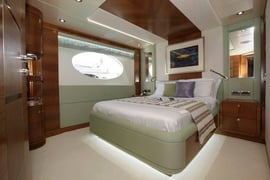
The amenities rival those of a luxury resort. There is a swimming pool, a deck Jacuzzi, cinema, spa, sauna, hammam, massage rooms, gym, beauty salon, beach club, elevator, owner’s study, helipad with an enclosed helicopter hangar, custom limousine tender, ski boat, and one of the yacht’s signature design elements, a fully enclosed pod-like observation lounge. Feadship describes the yacht as “classically balanced yet edgy and innovative,” a philosophy reflected in its striking profile.

From Caribbean waters to the Arctic
Launchpad began its maiden voyage by sailing through Gibraltar before arriving in St. Maarten in the Caribbean, kicking off a succession of transoceanic crossings. One of Zuckerberg’s best-documented family trips came in June 2024, when he, his wife Priscilla Chan, their three children, and other relatives celebrated Father’s Day and his father Edward Zuckerberg’s 70th birthday aboard the yacht in Mallorca. Reports described balloons, festive decorations, a giant Launchpad sign, and even an inflatable unicorn, while Zuckerberg shared moments from the celebration on social media.

The yacht later crossed the Pacific toward Tahiti and Hawaii, reportedly remaining on standby while Zuckerberg surfed elsewhere, illustrating how vessels of this size often function as pre-positioned private resorts rather than continuously occupied homes. It also visited Norway, Svalbard, and the Galápagos, with some stops drawing environmental criticism. In Bodø, one observer remarked that the yacht “takes up half the harbor,” while protests in Svalbard highlighted growing tensions over luxury tourism in fragile ecosystems.

On May 26, 2026, Launchpad transited Seattle’s Ballard Locks into Lake Union, where an employee reportedly called it the largest yacht to pass through in 14 years. Coincidentally, the arrival came on the same day Meta announced roughly 1,400 local layoffs, creating an uncomfortable visual contrast that fueled public discussion before the yacht continued toward southeastern Alaska. According to AIS data, the vessel is currently in Alaska.

The staggering numbers behind Launchpad
Powering Launchpad are four MTU 20-cylinder diesel engines producing a combined 20,900 horsepower, supported by four additional generators. The yacht reaches 24 knots at full power, cruises comfortably at 16 knots, and can still achieve nearly 20 knots while running on only two engines. Its tanks hold about 423,700 liters of fuel, enough to cost an estimated $830,000 to fill in one go, while its range extends to roughly 6,000 nautical miles.

The environmental figures are equally striking. The estimated 14,300 tonnes of carbon dioxide attributed to the yacht’s operations equal the annual carbon footprint of roughly 813 average Americans, or about 1,050 Americans based on territorial emissions. It also corresponds to nearly 3,100 years of driving for a typical passenger car. Those numbers sit awkwardly beside Meta’s pledge to reach net zero across its entire value chain by 2030, a target the company’s AI build-out is making harder to hit. Meta’s net emissions hit 8.2 million tonnes of carbon dioxide equivalent in 2024, and shareholder group As You Sow calculates that direct emissions from its data centre energy use have climbed 223 percent since 2019.

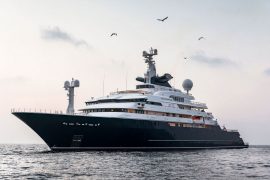
Those calculations likely understate the full impact because Launchpad is commonly accompanied by large support vessels, first Wingman and now U-81, both more than 200 feet long and capable of carrying helicopters, tenders, toys, equipment, and additional crew. Their fuel consumption is separate, meaning the carbon footprint of Zuckerberg’s wider yachting operation is almost certainly even larger than the headline figures suggest.