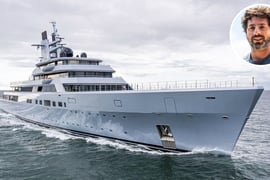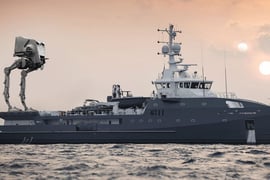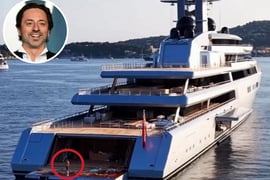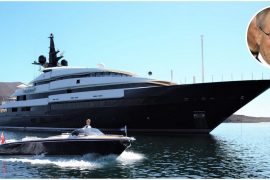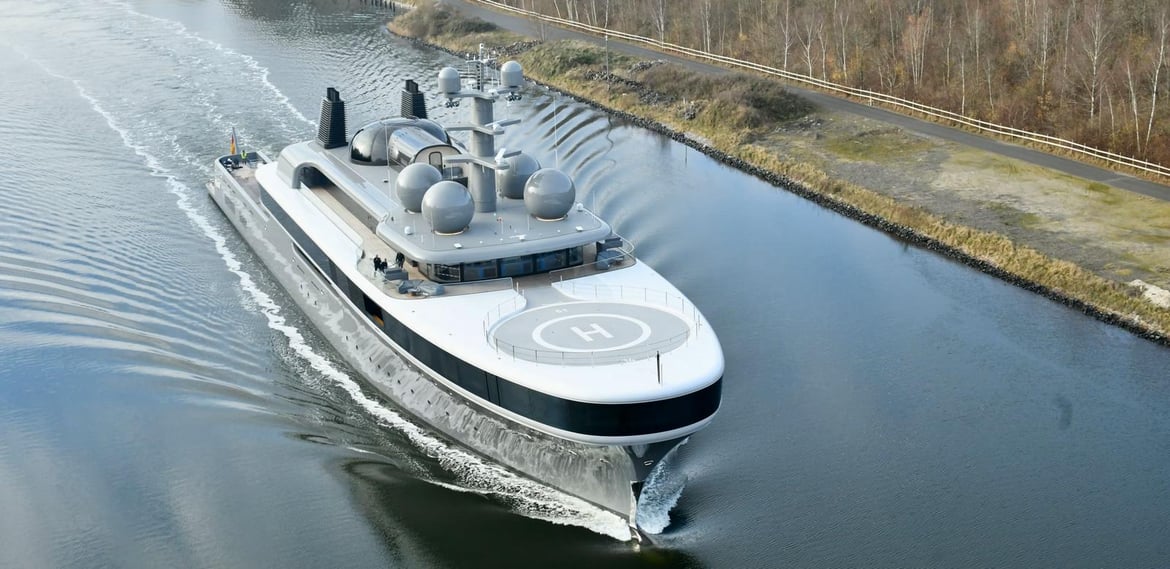
Lürssen fuel cell superyacht Project Cosmos has now entered sea trials in the Baltic Sea after almost three years of construction. The 375-foot (about 114 meters) vessel was launched only a few months ago and has moved from shipyard halls to open water, where her systems are now being tested at full scale. Cosmos left Schacht Audorf early in the morning and slipped into the Kiel Canal just after nine, heading toward Kiel with an almost silent presence, as reported by Kieler Nachrichten.

Witnesses reported only the sound of water along the hull and a soft hum from the pods as she passed. For a yacht of this size, the lack of smoke, mechanical rumble, and vibration is unusual. It is the first visible sign that something different is happening on board.

The superyacht was commissioned by Japanese fashion billionaire Yusaku Maezawa, who founded Zozotown and is known for collecting art and pursuing ambitious challenges. His profile fits the concept behind Cosmos. This is a vessel built for ideas rather than parties. Maezawa has visited the International Space Station and has announced his interest in future lunar missions. His choice of designer reflects the same mindset.

Renowned Australian industrial designer Marc Newson shaped the yacht inside and out. Newson has long worked at the top end of industrial design and is also known for his involvement with Apple, bringing a smooth, rounded design language into technology products. On Cosmos, his style is immediately visible in the sweeping exterior lines and large continuous areas of glazing.

These glass surfaces are not included only for appearance. They are part of what is being measured at sea. The yacht carries a private study under a glass dome high on the upper deck and a rounded observation pod forward beneath the helipad. During trials, engineers are watching how noise travels in these spaces, how the hull flexes when turning or running at speed, and how vibration levels feel inside a room made mostly of glass. The yard wants to understand how well acoustic insulation works when machinery is quiet but constantly active. The goal is comfort at a level that feels more like a library than an engine room.
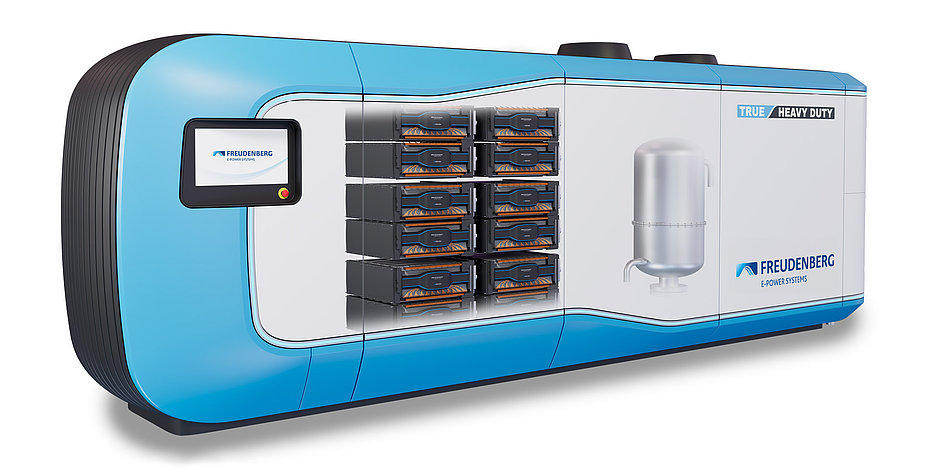
Under the decks, a methanol-to-hydrogen system built by Freudenberg e Power Systems feeds a set of PEM fuel cell stacks with roughly 1 megawatt of output. Rather than storing hydrogen directly, the yacht carries liquid bio-methanol in tanks low in the double bottom. A reformer cracks the methanol into hydrogen and carbon dioxide on demand. Hydrogen enters the fuel cells, and carbon dioxide is released overboard.
The fuel cells supply electricity to a shared power bus that connects to MTU generators, batteries, and two 360-degree azipods under the stern. In slow cruising mode, Cosmos can move at about 7 knots for close to 1000 nautical miles without emissions. At anchor, she can operate for around 15 days with no generator running.

These early Baltic trials are where Lürssen, Freudenberg, and class surveyors gather data on the propulsion system and its integration into a yacht this large. If results match expectations, Cosmos could become the blueprint for future low-emission superyachts. Delivery is expected in 2026.