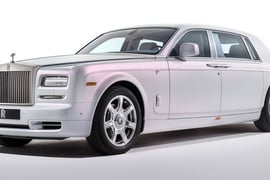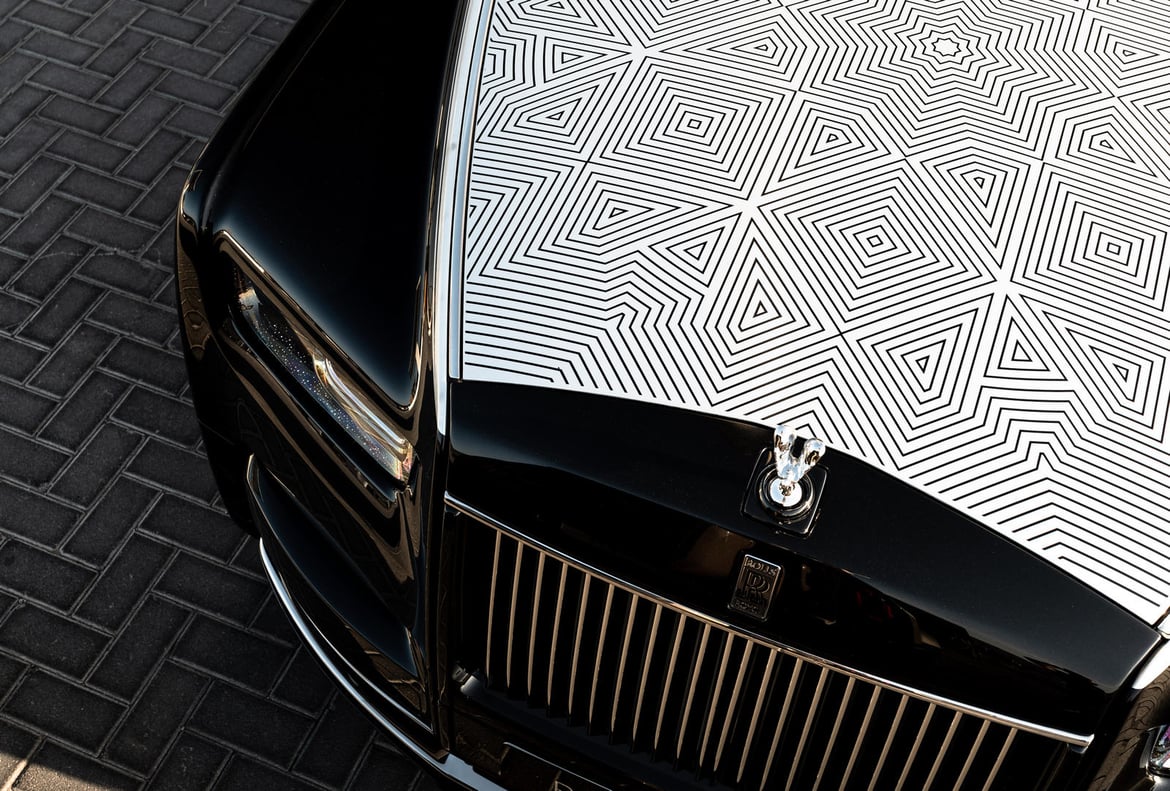
It takes real confidence to fire a laser at the hood of a Rolls-Royce. Understandably, it then takes five years of development to make sure you don’t ruin it, and it achieves the perfection deserving of the Spirit of Ecstasy. With the one-off Phantom Arabesque, Rolls-Royce has introduced laser engraving to a production hood for the first time, a technique that required five years of development by the company’s Exterior Surface Centre.

The inspiration comes from mashrabiya, the traditional Arabian latticework found throughout Middle Eastern architecture. These geometric screens historically provided privacy while allowing light and air to flow through buildings. For this bespoke Phantom, artisans translated that ancient craft into automotive form through a patented process that reveals contrasting paint layers beneath the surface.

Creating this unique paint job demands precision measured in microns. The bonnet receives a dark base coat, several clear protective layers, and then a lighter top finish. Technicians then engrave the mashrabiya pattern between 145 and 190 microns deep, exposing the darker shade below. Each engraved section undergoes meticulous hand-sanding to achieve a sculptural quality. Unlike applied decals or wraps, this method integrates the design within the paint itself.

The technique draws from sgraffito, an Italian art form where artists scratch through plaster to reveal different colors underneath. Rolls-Royce adapted this centuries-old concept, adjusting laser velocity and intensity to create subtle variations as light moves across the hood’s surface.

Finished in Diamond Black and Silver with a mashrabiya-inspired coachline, illuminated grille, and matching interiors with embroidered headrests and illuminated tread plates, the Phantom Arabesque is headed to a Middle Eastern collector. This commission shows how companies like Rolls-Royce are using technical innovation to reinterpret cultural heritage, for one-off builds that stand out from the crowd. Fitting for a Rolls-Royce, and fitting for the customer, just as the company would have it.