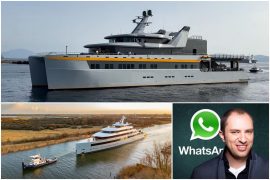
For most billionaires, a superyacht is the ultimate escape from work. For Google co-founder Sergey Brin, it appears to be an extension of the office. His 466-foot (142-meter) Lürssen megayacht Dragonfly features an entire deck dedicated to business, making it one of the most unusual workspaces ever built at sea. Instead of reserving every level for leisure, the yacht devotes significant space to productivity, allowing Brin to stay connected wherever he cruises.

Delivered by German shipbuilder Lürssen in 2024, Dragonfly is currently the seventh-largest yacht ever built by the yard, surpassing the 141.96-meter Scheherazade. Designed by Germán Frers, with interiors and exterior social areas by Nauta Yachts, the vessel was created with timeless styling rather than passing trends. Crisp profile lines, suspended aft decks and expansive outdoor spaces give the yacht a commanding presence, as pointed out by the Superyacht Times, while many of its most impressive features remain hidden within its vast 9,408 GT superstructure.

A floating headquarters for one of the world’s busiest billionaires
The defining feature of Dragonfly is its dedicated business deck. According to Lürssen, it houses a large private office alongside a gym, games room and a concealed helicopter hangar. While most superyachts dedicate entire decks to wellness or entertainment, Dragonfly is organized around work, with leisure spaces supporting what is effectively a floating corporate headquarters.
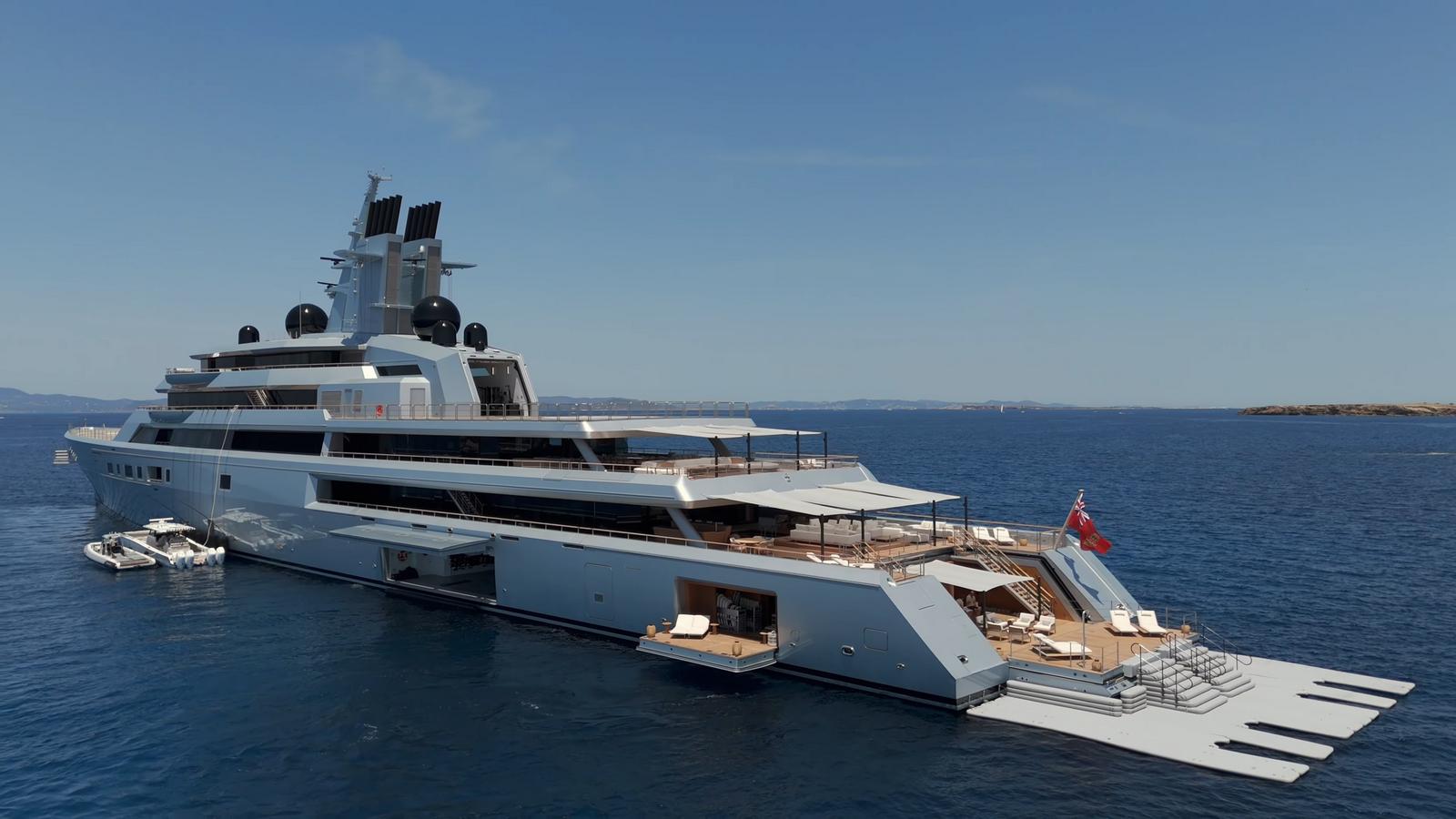
Lürssen has never disclosed the dimensions of the office, but based on the yacht’s proportions, it is estimated to span roughly 70 to 110 square meters (750 to 1,180 square feet). That would make it several times larger than the corner office occupied by many Fortune 500 chief executives. When the office, gym, games room, helicopter facilities, circulation areas and technical spaces are considered together, the entire business deck is estimated to exceed 1,000 square meters, underscoring just how much importance was placed on creating a functional workplace at sea.

The helicopter hangar also plays an important role in the concept. Hidden inside the superstructure to preserve the yacht’s sleek profile, it allows passengers to arrive or depart without relying on ports, tenders or lengthy road transfers. For someone overseeing global investments, artificial intelligence projects and philanthropic initiatives, the ability to fly directly to a yacht-based office is as practical as it is luxurious.

The yacht’s engineering complements that philosophy. Dragonfly uses Lürssen’s diesel-electric hybrid propulsion concept, combining two diesel engines, controllable-pitch propellers, PTI/PTO units and an electric azimuth pod drive. The system was designed to improve efficiency and provide flexible worldwide cruising. While Lürssen has not specifically promoted it as an office feature, electric operating modes can reasonably be expected to reduce machinery noise and vibration, creating a quieter environment for meetings, video calls and focused work.

Built for a billionaire who thrives on work
The yacht reflects the mindset of its owner. Brin stepped back from Google’s day-to-day operations in 2019 but returned to an active role after the rapid acceleration of artificial intelligence following the arrival of ChatGPT. He has since become deeply involved in Google’s AI efforts, with company leaders describing him as someone who regularly works alongside engineers, reviews model development and even writes code.

His attitude toward work has been equally direct. In a widely reported 2025 internal memo, Brin described 60 hours a week as the “sweet spot of productivity” and encouraged employees to spend every weekday in the office, arguing that the race toward artificial general intelligence demanded extraordinary commitment. Later that year, he remarked that retirement had left him feeling less sharp and admitted that staying retired would have been a mistake.

Today, Brin is ranked by Forbes as the world’s third-richest person, with an estimated net worth of $266 billion. His extraordinary wealth certainly affords him every luxury imaginable, yet Dragonfly suggests that even while cruising aboard one of the world’s largest private yachts, work remains at the center of his routine. Rather than serving solely as a private retreat, the vessel has become a floating headquarters designed for a billionaire who seemingly never clocks out.