In business aviation, the most meaningful shifts rarely arrive wrapped in dramatic new silhouettes or radical performance claims, but instead emerge through carefully considered evolutions that quietly reset expectations from the inside out. With the Praetor 500E and 600E, Embraer is refining an already competitive platform while introducing a piece of cabin technology that could have a ripple effect far beyond the super-midsize category. These enhanced variants build on the Praetor 500 and 600 that entered service in 2019, yet the defining update this time is not range or thrust, but a 42-inch digital surface embedded into the cabin wall.

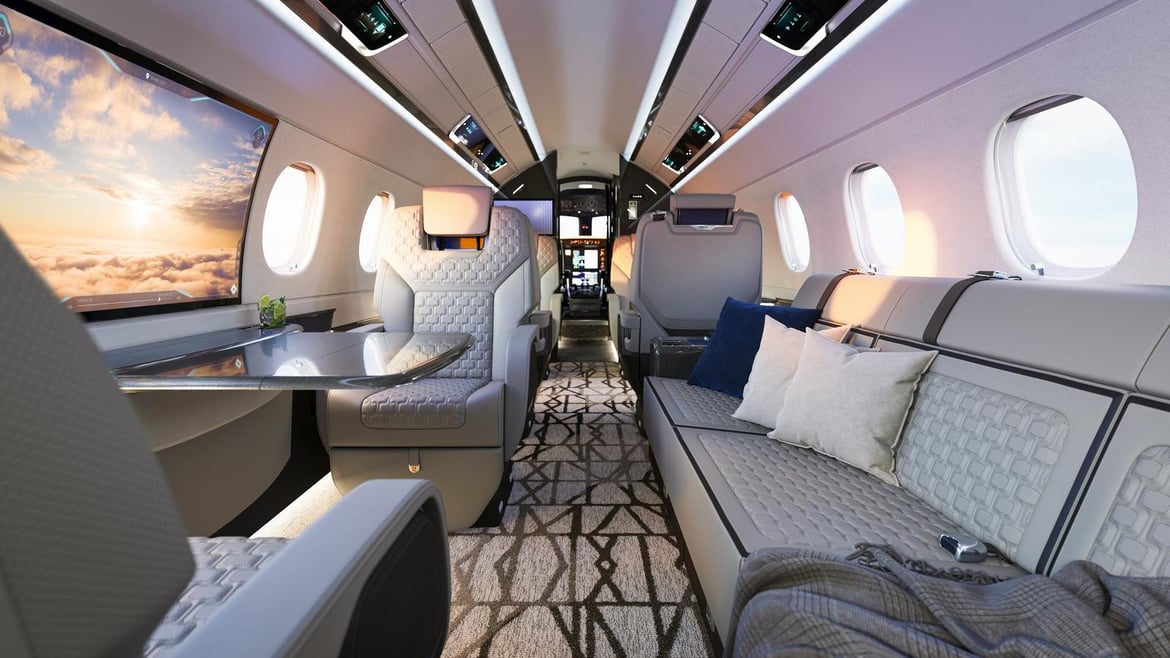
That surface is the optional Smart Window on the 600E, a curved 4K OLED touchscreen molded into the left sidewall opposite the divan, and it represents one of the boldest reinterpretations of cabin architecture in this class. Designed as what Embraer describes as a very large personal electronic device, the display streams films, mirrors passenger devices, hosts video conferences, shows flight data, and most compellingly delivers live feeds from three external cameras. Select the left-side camera and the wingtip appears exactly where your eye expects it, preserving spatial realism and avoiding the artificial feel of a generic video wall.

Engineers even explored a transparent OLED panel before abandoning the idea because sunlight compromised image quality, a detail that underscores how aggressively the concept was pursued. Jay Beever, vice president of design, calls it the genesis of industry-changing technology that others will attempt to follow. During demonstration flights, the once-overlooked middle seat on the divan quickly becomes the most coveted position because it faces the Smart Window.

The Smart Window sits at the center of a broader digital overhaul. A new Cabin Management System allows passengers to control lighting, temperature, airflow, shades, entertainment, and seat functions through a dedicated smartphone app, seat-mounted touch panels, overhead controls, or optional voice commands.

Traditional twist air vents have been replaced by digitally controlled slats integrated into the system, while Bluetooth audio, a cabin-wide sound platform, and both wired and wireless charging are embedded into the layout, giving the 600E the feel of a networked smart environment rather than a conventional business jet interior.

Performance remains steady, with the 500E offering roughly 3,340 nautical miles of range and the 600E extending to about 4,020 nautical miles, while accommodating 9 and up to 12 passengers, respectively, and increasing maximum payload capability by around 15 percent. The cabin retains its six-foot-tall flat-floor design, generous windows, stone flooring in the entry and lavatory, and redesigned overhead panels that free up approximately 1.5 inches of additional headroom, subtly enhancing the sense of openness.

Deliveries are targeted for the first quarter of 2029, with list prices of approximately $21.6 million for the 500E and $25.8 million for the 600E, signaling that Embraer’s bet in the super-midsize segment is less about chasing incremental range gains and more about redefining how passengers experience space at altitude.