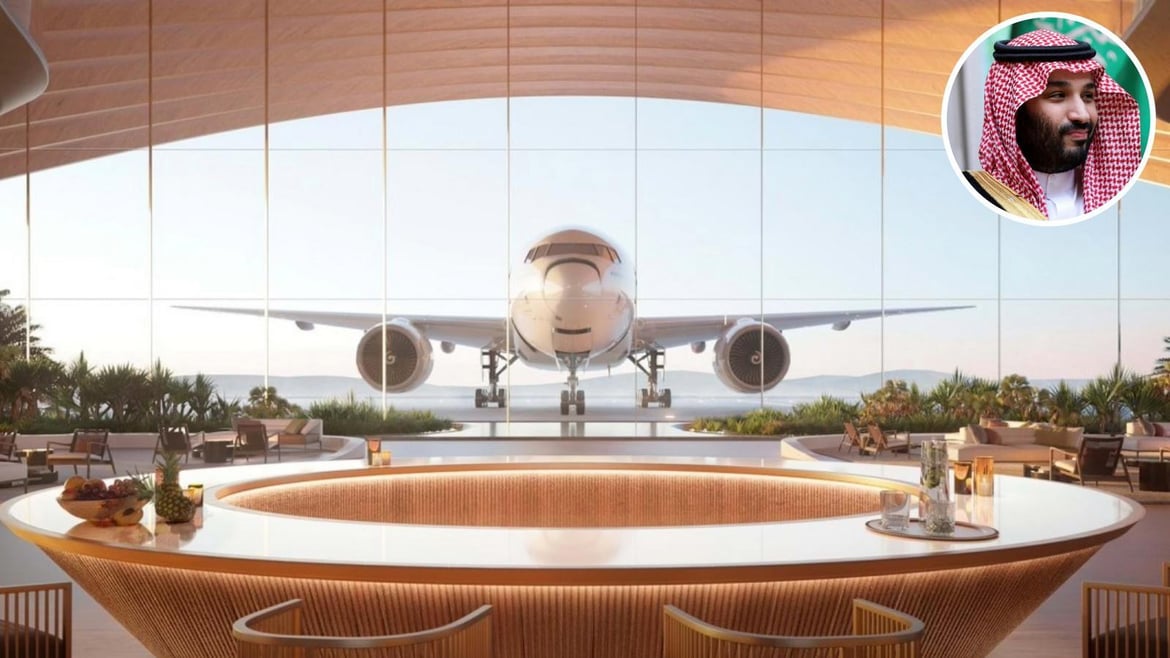
Crown Prince Mohammed bin Salman is pushing ahead with one of the most aggressive aviation expansions of the decade, even as some of his most famous mega-projects like THE LINE and Trojena are quietly being scaled back. While parts of NEOM’s original vision are being reshaped, the Crown Prince is more energized than ever about aviation and is launching three new airlines. These additions will sit alongside Saudia, Riyadh Air, flynas, and flyadeal. If all three debut as planned, Saudi Arabia will have at least seven active carriers built to feed the tourism engine of Vision 2030.

The strategy is simple on the surface but ambitious in scale. The new airlines are tools to support giga-projects like NEOM, Qiddiya, Diriyah, and the Red Sea resorts. These destinations only work if millions of people can reach them directly. Saudi Arabia wants 150 million visitors each year by 2030, which is roughly double what the Kingdom welcomed before Vision 2030. The aviation sector is being recast as a sovereign asset rather than a transportation service.

At the core of this is King Salman International Airport in Riyadh, which is targeting 120 million passengers by 2030 and as many as 185 million by 2050. The aim is to position Saudi Arabia next to Dubai and Doha as one of the leading aviation hubs in the world. Fahd Hamidaddin, CEO of the Saudi Tourism Authority, summed it up at the Cityscape Global conference when he said that a successful national airline builds a destination and noted that two airlines are already established, with three more coming.

All of this is crucial for NEOM, the $500 billion smart city stretching about 460 kilometers (around 285 miles) along the Red Sea. It includes THE LINE, Oxagon, Trojena and the luxury island of Sindalah. Some of these projects have seen adjustments to timelines and scope, but the aviation plan is moving at full speed. The new airlines are expected to connect NEOM’s future airports to Riyadh, Dubai, Istanbul, Cairo and key European cities. The goal is to turn NEOM into a standalone hub with global reach rather than a distant outpost that depends on connecting flights.

The first of the new carriers is the Dammam low-cost airline that will serve the Eastern Province. Based at King Fahd International Airport, it is a joint venture led by Air Arabia with Saudi partners Nesma Group and KUN Investment Holding. It won the General Authority of Civil Aviation tender in July 2025. By 2030, it plans to operate around 45 narrow-body aircraft, almost certainly from the A320 and A321 family. It will fly 24 domestic routes and 57 international routes and aims to carry about 10 million passengers a year. It will also create around 2,400 direct jobs in the region. This carrier is meant to be the everyday solution for the Eastern Province. It will serve Aramco workers, expats in Dhahran, families traveling for weekend breaks, and budget pilgrims. It also symbolizes a rare moment of foreign operational involvement, which shows a willingness to prioritize capability over pure national branding.

The second airline will be based in Medina and focused entirely on religious tourism. Jeddah currently handles most Hajj and Umrah traffic, but Saudi Arabia wants to distribute the demand more efficiently as visitor numbers rise. This discount carrier will allow pilgrims from Muslim-majority countries to fly directly into Medina without routing through Jeddah and then transferring onto high-speed rail. It is designed for the value-conscious segment of the pilgrimage market as the Kingdom aims to reach about 30 million Hajj and Umrah visitors a year by 2030. The lifestyle angle is clear. It offers a simpler and more convenient way for families to complete a spiritual journey without luxury price tags.

The third airline is the intentional mystery. Officials reveal very little, only that it will complement Saudia and Riyadh Air and serve the broader tourism system rather than focus on domestic shuttles. Industry observers believe it could be a boutique airline linking giga-project airports such as Red Sea International, NEOM, Amaala, and AlUla with key regional hubs including Dubai, Doha, and Cairo. Another possibility is a hybrid model that sits between low cost and full service. Its role would be to funnel high-spending travelers into destinations like Qiddiya, Diriyah, and Sindalah without stretching the existing carriers. The unspoken understanding is that this airline is the flexible one that can be adapted to whichever mega-project advances fastest.
Even with project adjustments on the ground, Saudi Arabia is accelerating in the air. For MBS, the fastest path to global tourism influence begins with building the carriers that will carry the world into the Kingdom.