Saudi Crown Prince Mohammed bin Salman’s The Line may have scaled down to a fraction of its original promise, but its impact has traveled much farther than the Saudi desert. Even in its compromised form, the project has done something rare. It has reminded architects and planners elsewhere that infrastructure can still be imagined at a civilizational scale. One of the clearest echoes of that thinking is now emerging in a speculative high-speed rail proposal that would redraw how northern Britain and Ireland relate to each other.

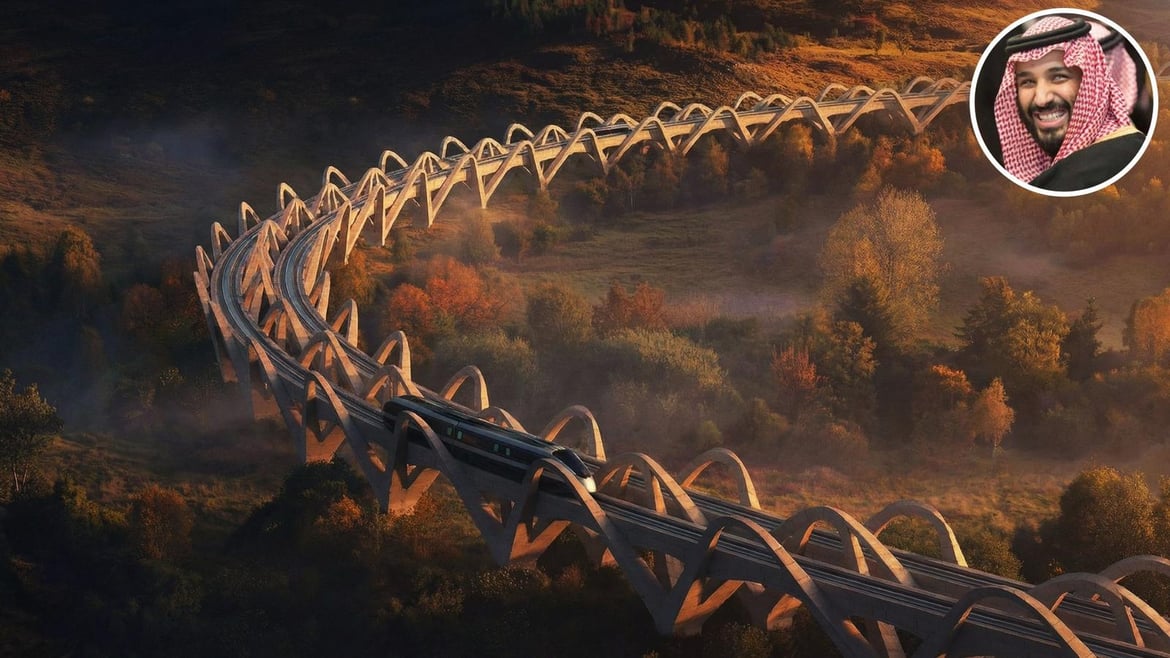
The concept, known as the Northern Loop, is the work of RIBA president Chris Williamson and is intentionally framed as a manifesto rather than a build-ready scheme. It proposes a raised, high-speed rail system linking Glasgow, Edinburgh, Newcastle, Leeds, Manchester, Liverpool, Bangor, Dublin, and Belfast into a single, connected urban network of roughly 10 million people. Trains would run every five minutes at speeds of up to 300 mph, placing all nine cities within about 90 minutes of one another, as reported by The B1M. The idea is not convenience for its own sake, but proximity as economic policy.

Williamson has been unusually direct about where the thinking comes from. “Maybe I have been too influenced by the scale, the vision and the ambition of The Line in Saudi Arabia,” he says, pointing to several years spent working on high-speed stations designed to run alongside Neom’s 170-kilometer-long city. That admission is central to understanding the project. The Northern Loop does not borrow The Line’s form, but it borrows its confidence. It assumes that infrastructure can lead, rather than follow, social and economic change.

Neom’s official pitch describes The Line as a 170-kilometer (about 106 miles) linear city designed for up to a million residents, with no cars and an end-to-end transit time of around twenty minutes via high-speed rail. Whether that vision survives intact is still an open question. What matters more is the underlying premise. In Neom, transport, energy, housing, and economic life are treated as parts of a single system. The Northern Loop adopts the same logic, applying it to an existing geography rather than a blank slate.

This shared DNA is most visible in how the Loop treats infrastructure. It is not presented as just a railway. Running alongside the tracks would be a continuous energy corridor designed to collect and redistribute power from onshore and offshore wind, supplemented by small modular nuclear reactors at key nodes. Like Neom’s promise of fully clean energy, the Loop folds power generation and distribution directly into its core structure.

Where the proposal breaks decisively from traditional high-speed rail is in its geometry and its politics. Conventional systems tend to run like spines, reinforcing the dominance of a single capital by pulling regional cities toward it. The Northern Loop is a circle. It is explicitly designed to reduce dependence on London and to make the north of Britain and Ireland function as a polycentric global city rather than a set of competing regional outposts.

Britain’s existing high-speed rail project has become synonymous with delays, cost overruns, and diminished ambition. Against that backdrop, Williamson is not offering a rival scheme so much as a reminder of what infrastructure once represented. “Architects once published manifestos,” he says. “They were not always right, but they inspired, provoked and set out ideas they believed in.” The Northern Loop belongs firmly in that tradition. It may never be built, but like The Line at its most ambitious, it forces a larger question back onto the table. What would happen if the country dared to think big again?