The latest masterpiece spawned out of the partnership between Jacob & Co. and Bugatti has been revealed ahead of this year’s Watches and Wonders, and it is easy to misread at first glance. The Bugatti Tourbillon Sapphire Crystal is not a new movement or a clean-sheet concept watch. It is something more precise and, in many ways, more interesting. This is the most transparent and most theatrical execution yet of the Bugatti Tourbillon introduced in 2024, a material evolution that fundamentally changes how the watch is experienced rather than how it is engineered.

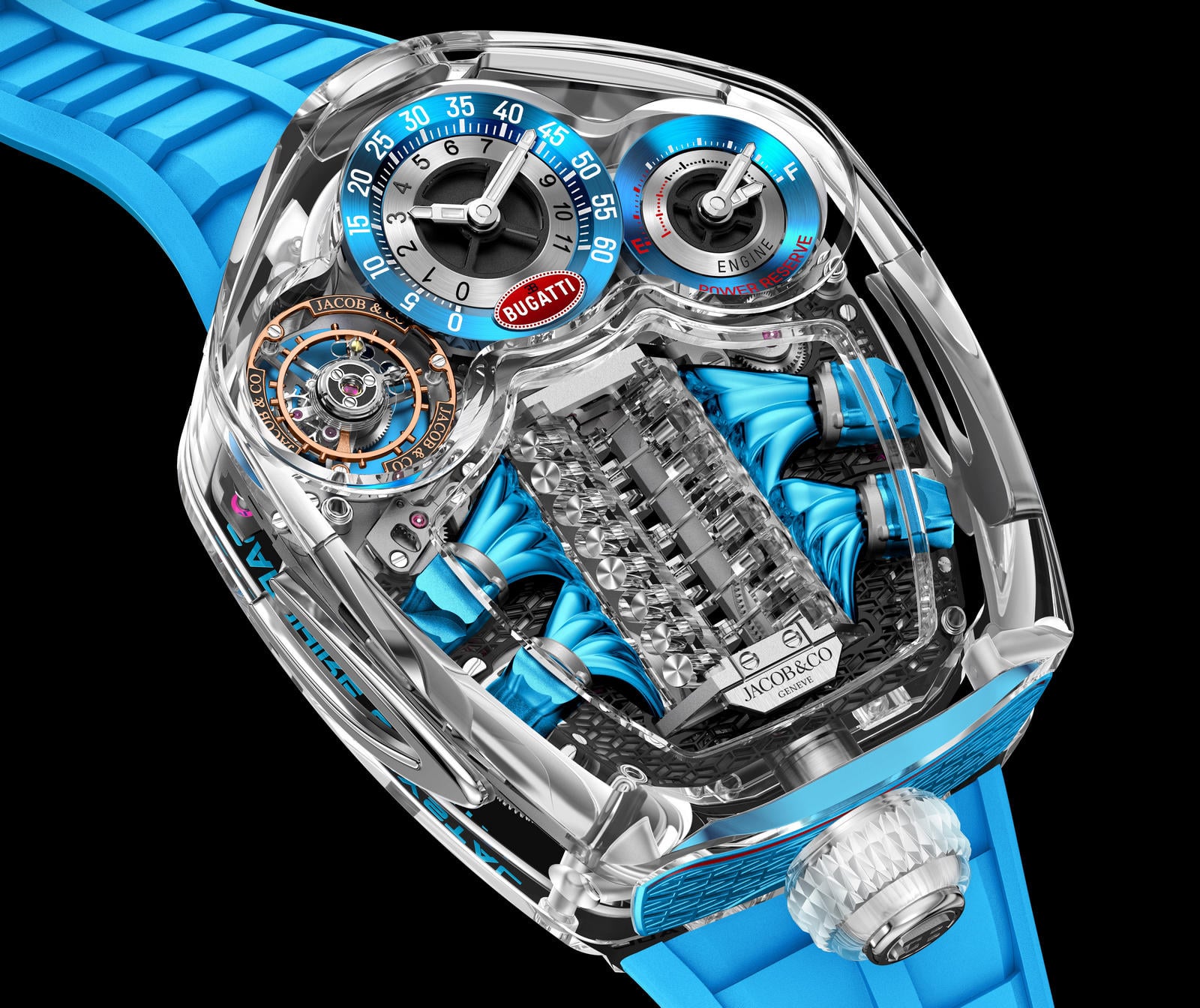
That distinction matters because the headline change is not mechanical innovation but material transformation. Where the original Bugatti Tourbillon arrived in black PVD titanium with sapphire windows, this version removes opacity altogether. The entire case is now rendered in sapphire crystal, turning the watch into a fully exposed stage for every Bugatti reference and every moving component inside. The effect is immediate and uncompromising, as the horseshoe grille motif, side-window architecture, and tail-light detailing are no longer hinted at but fully revealed from every angle.
The shift also repositions the watch within the Jacob & Co. and Bugatti collaboration. Earlier sapphire executions during the Chiron era leaned heavily into spectacle for its own sake. Here, sapphire feels more conceptually aligned with the Bugatti Tourbillon hypercar itself, a machine defined by mechanical honesty and visible engineering. Since a transparent car remains impractical, the watch becomes the medium where that idea is taken to its logical extreme.

Rarity reinforces that shift in tone. The first series consists of just two pieces, one in watchmaker’s signature green and the other in a soft baby blue favored by Jacob Arabo. That level of exclusivity sets it apart even within the already rarefied Bugatti Tourbillon lineup and gives it the character of a statement piece rather than a production model.

Mechanically, the watch retains the formidable architecture of the original. The hand-wound caliber JCAM55 comprises 557 components and delivers an 80-hour power reserve. Its complication stack is where the timepiece asserts itself as more than a visual exercise. A 30-second flying tourbillon anchors the left side of the display, spinning at twice the speed of a conventional tourbillon and reinforcing the brand’s fixation on motion and performance. At the center, jumping retrograde hours and retrograde minutes are laid out like a hypercar dashboard, with the hour hand snapping into place and the minute hand advancing in discrete steps, echoing the logic of automotive instrumentation.
The centerpiece remains the V16 engine block automaton, a direct response to Bugatti’s shift from the Chiron’s W16 to the new Tourbillon era V16. Carved from transparent sapphire and featuring 16 titanium pistons driven by a single crankshaft, it transforms the watch into a kinetic sculpture. Activated via the crown, it runs a 20-second animation sequence that mimics the firing rhythm of a real engine.
One of the more overlooked technical details is the dual power reserve system. The watch separately tracks the energy available for the movement and the automaton, with the latter capable of 20 full animation cycles on a full wind. That level of separation underscores how seriously the automaton is treated, not as a decorative flourish but as a system with its own energy logic and user interaction.
The case itself is a story of material science as much as design. Machined from blocks of lab-grown corundum, each case requires more than 800 hours of work, a reflection of sapphire’s extreme hardness and fragility during shaping. At 55 by 44 mm, it is imposing, sculptural, and unapologetically impractical, a deliberate choice that aligns with its role as a collector’s object rather than an everyday watch.
At a price of $1.2 million, the Bugatti Tourbillon Sapphire Crystal does not attempt to outdo previous Jacob and Bugatti sapphire pieces on sheer cost. Instead, it refines the narrative. Where the Baguette version emphasized gem setting and surface richness, this watch pursues transparency and mechanical exposure. It is less about ornament and more about revelation, an X-ray view into the V16 concept that defines Bugatti’s current era.
Seen in that light, the watch becomes more than an accessory to a hypercar. It is a parallel expression of the same idea, a piece of horology that mirrors a machine already influenced by watchmaking itself, bridging the gap between two worlds that increasingly speak the same mechanical language.