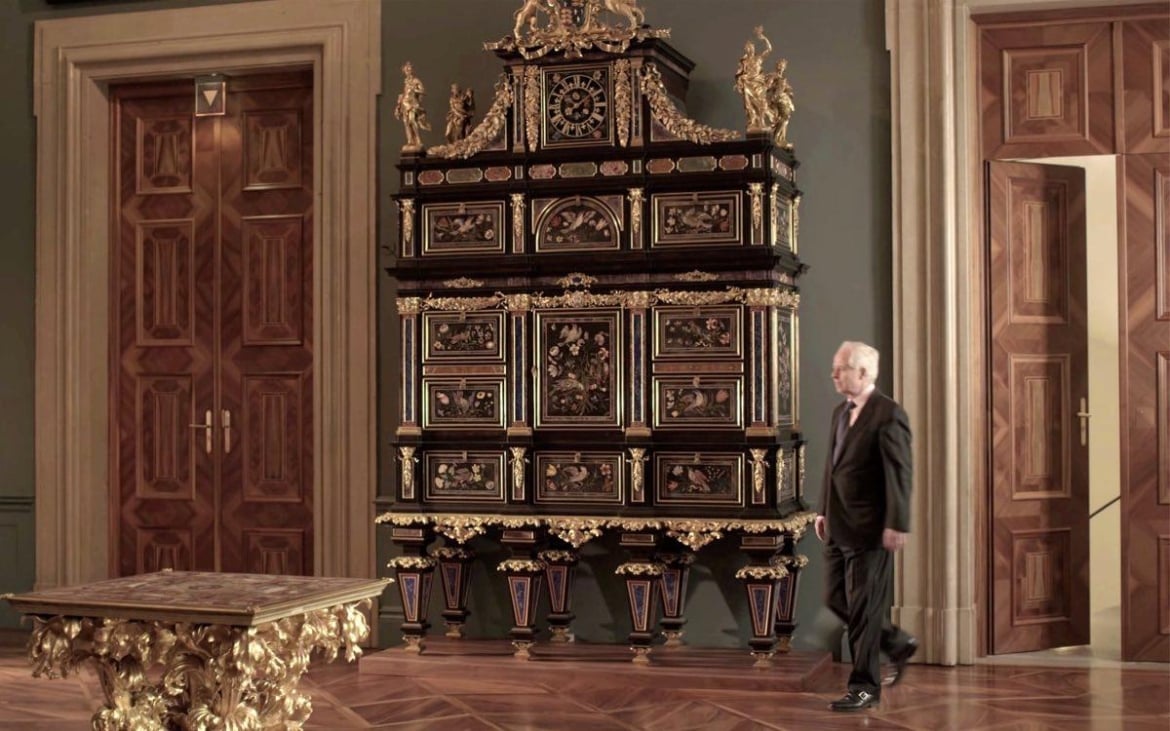
The young can often surprise you, and Henry Somerset, 3rd Duke of Beaufort, did exactly that in 1726 when, at just 19, he commissioned what would go on to become one of the most expensive pieces of furniture ever sold. The Badminton Cabinet, which stands nearly 12 feet high and about 7 feet wide, was acquired in 2004 for Prince Hans-Adam II of Liechtenstein at a Christie’s auction for an astonishing $36 million. It is not merely a masterpiece of cabinetry, but a dazzling union of several art forms, combining sculpture, gilt bronze, clockmaking, and the painterly beauty of hardstone work. No fewer than 30 craftsmen are believed to have worked on it over five or six years to bring the monumental object to life.

More than 300 years later, this Florentine marvel still astonishes not only for its artistry but also for its extraordinary materials, from lapis lazuli, agate, and Sicilian red and green jasper to chalcedony, amethyst quartz, and other superb hardstones. The cabinet features a clock, a gilded Beaufort coat of arms, 10 cedar-lined drawers, and an ornamental universe of birds, flowers, lion masks, grotesques, satyrs, and bronze figures representing the Four Seasons. In story terms, it is almost a portable baroque palace façade disguised as storage. It is a true icon of human imagination turned into tangible reality, and perhaps even more mind-boggling than the idea itself is the flawless execution.
That execution was carried out in the Grand Ducal workshops of the Medici in Florence, then among the greatest centers of luxury craftsmanship in Europe. The gilded bronze figures of the Four Seasons that crown the piece are the work of bronze-maker Girolamo Ticciati.

The cabinet, the largest piece of furniture produced by the Grand Ducal workshops during the Baroque period, remained at Badminton House until 1990. Interestingly, this historic Gloucestershire estate is the same home where the sport of badminton was later invented and named. The cabinet then passed to Barbara Piasecka Johnson, before entering the collection of Prince Hans-Adam II of Liechtenstein in 2004. Its journey, from an aristocratic English house to a billionaire heiress and then to a ruling princely collection, says everything about the level of wealth, taste, and power associated with it.

It had already set a furniture auction record in 1990 before smashing that record again in 2004, which only strengthened its status as a legend long before the hammer fell that second time. As there can never be a second Badminton Cabinet, its value today, adjusted for inflation alone, would likely cross the $60 million mark. It is easy to see why Johan Kraeftner admitted he “tried to bid as fast as I could” to secure it. The object truly transcends the boundaries of furniture. Adding yet another layer to its story, original shipping papers and contemporary drawings survived in the Badminton archive, and Christie’s said they were discovered by Queen Mary while she was staying at Badminton House during World War II.

As for Kraeftner, he wanted to give the object d’art the royal treatment it deserved, not simply by displaying it, but by building an entire room around it. That feels fitting, because the Badminton Cabinet was never meant to be treated like furniture alone. It was conceived as a monument to craftsmanship, wealth, and imagination, and nearly three centuries later, it still commands exactly that reverence. Today, the Badminton Cabinet has found a home as the crown jewel of Liechtenstein, The Princely Collections in Vienna, Austria.