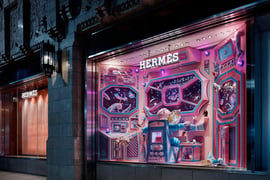
Hermès has unveiled a striking new stand-alone store in Beijing’s Sanlitun, drenched in tradition, design, and culture. Opened on April 2, 2026, it is the fourth Hermès store to grace the capital since 1997 and notably the house’s first stand-alone store in Beijing. The new destination sparks a conversation between local cultural heritage and the creative spirit of Hermès, drawing inspiration from the vast former imperial palace complex, the Forbidden City, which served as the ceremonial and political center of China for nearly five centuries under the Ming and Qing dynasties.

The Hermès store will not only be known for what lies inside, but also for how it appears from the outside. The five-story glass building is wrapped in rose-pink and terracotta ceramic tiles, while the façade, designed by Parisian architecture firm RDAI in collaboration with Mamou-Mani Architects, functions like a semi-transparent veil. This lantern of a building allows ample natural light to illuminate the wonderful world of Hermès indoors. The metal screen, nicknamed “the birdcage,” is said to nod to Beijing’s historic bird-walking culture. That is only the first encounter with the city’s long and layered history, something visitors continue to experience at various points across the store’s five floors.

The store is adorned with elements that take cues from the Forbidden City’s curved glazed ceramic rooflines, sunlit colors, and layered materiality. The project’s color range is based on old Chinese paintings, while the open-plan layout lends the interiors a sense of grandeur.

One of the standout features is the majestic stone staircase that spirals upward, its design reflecting the arched forms and woven motifs that animate the façade. As one moves higher, each level changes in mood, materials, and merchandise, making the store feel less like a boutique and more like a carefully choreographed journey.

More importantly, the immersive new space is designed to showcase the full breadth of the house’s sixteen métiers. Hermès has clearly divided the floors among its many worlds. The opening level houses silk, equestrian, and fashion jewelry, while higher up come ready-to-wear, intimate fitting rooms, and a private salon.

Beyond that are spaces for home, leather goods, watches, and jewelry, framed by wood marquetry, peony-engraved lacquer, and ceramic brick walls arranged in an H pattern. Fresh greenery crowns the landscaped terrace on the upper level, where the large private salon adds another layer of exclusivity. In my opinion, Hermès has smartly arranged the store floor by floor with all the things one may need to buy first before finally making it to the top and getting closer to that Birkin they have been eyeing.

As appealing as the Forbidden City influences are, there is also a strong contemporary art touch. Works from the Émile Hermès collection and the Hermès Collection of Contemporary Photographs feature in the space, while commissioned pieces by local artists bring further depth. These include a hanging installation of handcrafted ceramic petals and marble roundels by Chinese artist Liu Jianhua. A special selection of objects, including travel luggage, unique timepieces, silk scarves, and leather goods featuring the Parade en Fanfare design by Chinese artist Tong Ren, also forms part of the grand new store