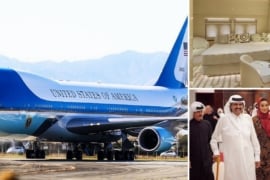
Boeing’s long-delayed next-generation Air Force One program appears to have reached a crucial turning point. The aerospace giant has confirmed that the first of the two VC-25B presidential aircraft is expected to begin flight testing in 2027, an important milestone that keeps the highly specialized jets on track for their planned delivery in 2028. For a program that has endured years of delays, engineering challenges and soaring costs, the start of flight tests will represent the first real demonstration that the extensively modified aircraft are nearing operational readiness.

The announcement comes as Boeing continues to work through a program that has grown from a $3.9 billion fixed-price contract awarded in 2018 to a project now costing the company more than $5 billion, with Boeing absorbing nearly $2 billion in overruns. Despite the financial hit, Boeing Defense, Space & Security CEO Steve Parker said the company remains confident in its revised schedule and revealed that the first aircraft will begin testing next year before both presidential jets are handed over in 2028, as reported by Defense News.

The most sophisticated Boeing 747 ever built
Although the VC-25B begins life as a Boeing 747-8 Intercontinental, the finished aircraft bears little resemblance to a commercial airliner. The two airframes were originally built for Russia’s Transaero Airlines before the carrier collapsed, leaving the aircraft in storage until the U.S. Air Force acquired them and Boeing began an extensive conversion program in San Antonio, Texas.

The objective extends far beyond transporting the president. The VC-25B is designed to function as a flying White House, allowing the commander in chief to continue leading the country during military crises or when ground communications are disrupted. To achieve that, Boeing is fitting the aircraft with secure communications capable of handling information at the highest classification levels, military avionics, an integrated self-defense suite, a highly redundant electrical network and extensive electromagnetic hardening. The aircraft will also feature autonomous boarding stairs, a self-contained baggage loading system, dedicated work and rest areas, medical facilities and communications intended to closely mirror those available inside the White House.

Earlier program requirements envisioned at least 70 simultaneous voice or data connections, two secure video conferences running at the same time and communications spanning everything from unclassified material to Top Secret/Sensitive Compartmented Information. Even those ambitious specifications have continued evolving as the communications architecture has been modernized.

At approximately 250 feet long with a wingspan of 224 feet, the VC-25B will also benefit from more efficient General Electric GEnx engines than the CF6 powerplants used on today’s presidential aircraft. One notable difference, however, is that the new fleet is not expected to retain the aerial refueling capability of the existing VC-25As, a feature removed to reduce costs while still preserving enough range for virtually all presidential missions.

Testing begins while the current fleet carries the mission
Before the first post-conversion flight can take place next year, Boeing must complete an extensive series of ground evaluations, including electrical power-up, hydraulic and pneumatic checks, engine runs, environmental control testing, software integration, secure communications validation and taxi trials. The initial flight will not technically be the aircraft’s maiden voyage, as both airframes flew years ago as standard 747-8s. Instead, it will be their first flight in full VC-25B configuration following years of structural, electrical and mission-system modifications.

That first sortie will examine handling qualities, flight controls, engines, fuel systems, electrical generation, pressurization, avionics and the interaction of the aircraft’s newly installed systems. A much longer certification campaign will follow, validating everything from secure satellite communications and defensive systems to emergency procedures, electromagnetic compatibility and operational requirements before the aircraft can enter presidential service.

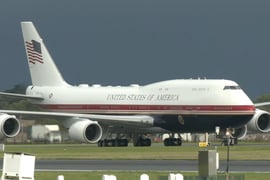
Till then, the aging VC-25A fleet will continue to shoulder the presidential airlift missions. Introduced in 1990 during the administration of President George H.W. Bush, the modified Boeing 747-200 aircraft remain among the world’s most capable government transports, despite their age.

Bridging the gap is a separate Boeing 747-8 donated by Qatar, which entered service as an interim VC-25B bridge aircraft after being accepted by the United States in 2025. The aircraft has already undergone a year-long modification program and has transported the President of the United States on an international trip. However, unlike the older VC-25As, it is not believed to possess the same full suite of missile detection and countermeasure systems.

The bridge aircraft is expected to return to Boeing’s facility in Texas in the coming weeks for another round of upgrades aimed at strengthening its defensive capabilities, allowing it to continue supporting presidential travel while the permanent VC-25B fleet moves through flight testing and final certification ahead of its targeted 2028 debut.