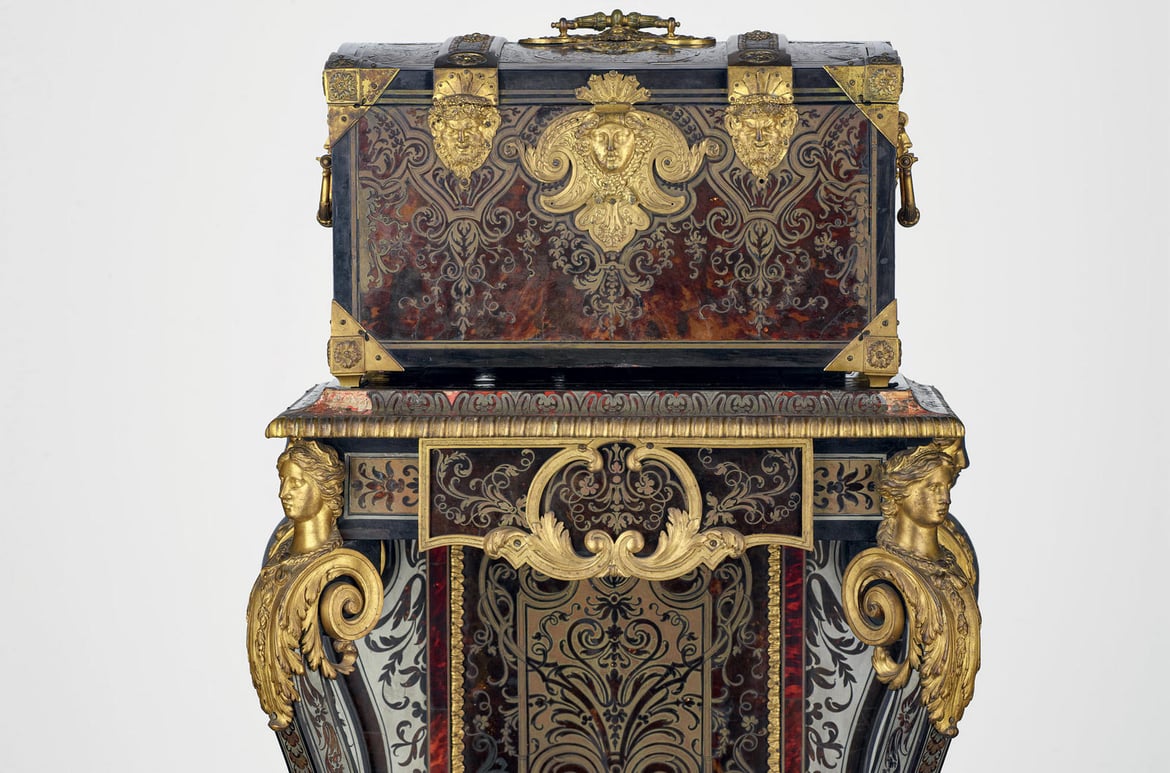
In today’s art world, we have collectors, billionaires, auctions, and artists. But in the Louis XIV period, one of the most priceless creations emerged from the powerful creator-client relationship between Augustus II “the Strong” and André-Charles Boulle. Augustus, the King of Poland, was said to be strong enough to snap horseshoes with his bare hands, yet he was equally obsessed with delicate beauty. Simple luxury would never have been enough for him. He wanted art that meant something, not only to himself but to everyone who saw it.
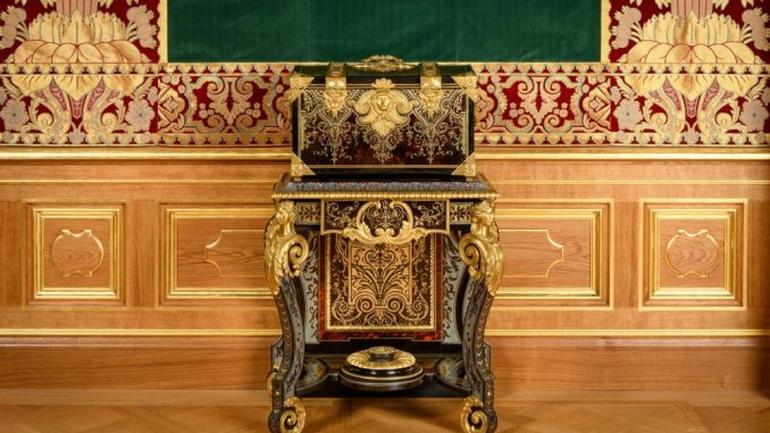
It had to be ornate and ostentatious, proof that his court could rival, if not outshine, Versailles. Augustus did not collect French luxury simply because it was beautiful; he wanted Dresden to speak the same grand visual language as Versailles, and pieces like this, likely acquired in Paris through his trusted agent Raymond Leplat, helped turn that ambition into a political statement of taste, power, and international prestige.

The magician who made this possible was André-Charles Boulle, the man who turned furniture into a high-stakes feat of engineering inside his workshops at the Louvre. Dubbed a master of the king’s metal, he guarded every ounce of gilt-bronze and tortoiseshell that went into his masterpieces with near-obsessive control.
But Boulle was never just a cabinetmaker. He was entrusted with shaping the luxury image of late Louis XIV France itself. His furniture for Versailles helped define elite taste far beyond France, which is exactly why a coffer-on-stand by Boulle was never ordinary furniture. It embodied royal vision, political ambition, and theatrical luxury. Today, the piece made for Augustus the Strong survives in Dresden, in Saxony, in the Kunstgewerbemuseum, shared Open Edition.

Where a chest became court theater-
A coffer is, at its core, simply a chest, the ancestor of the monogrammed trunks and luxury storage pieces that still tempt modern collectors. But the coffer in question was many things at once, brilliance, expertise, theater, and architecture in one extraordinary object. Standing approximately 115.5 cm, or just under four feet high, the rectangular chest was less a practical container and more a court spectacle, thanks to its exceptional materials and treatments. The object demanded tireless labor and a deep command of cabinetmaking, marquetry assembly, bronze work, surface finishing, and interior fitting.
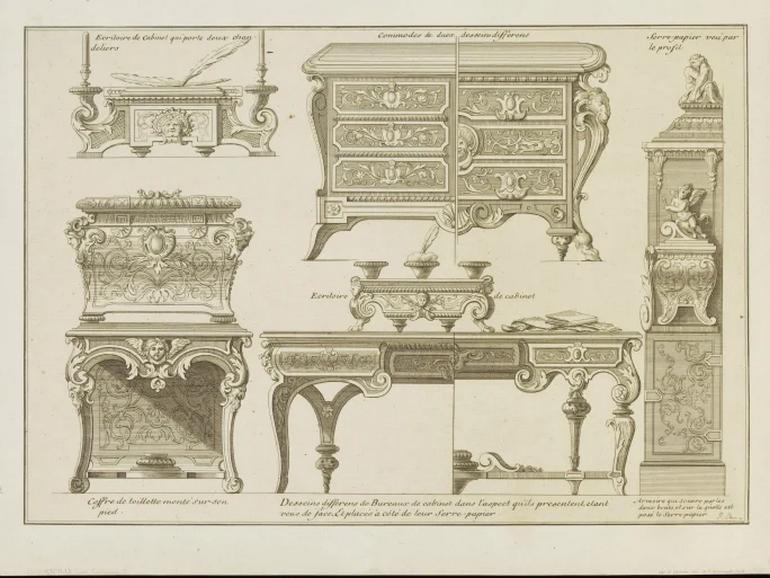
The image reveals a structure sheathed in tortoiseshell and brass marquetry, the classic Boulle première partie technique. It also shows gilt-bronze mounts reinforcing the corners, hinges, escutcheons, and lid crest. The side drop handles suggest that the chest was designed to be moved, though certainly not casually. The mask on the front of the coffer lid is likely a representation of Bacchus or Apollo, watching over anyone daring enough to open the box. It becomes the literal face of power placed over the lock plate.
The stand is, in itself, breathtaking and accounts for half the drama of the entire piece. Far more than a sculptural support, it rises with scrolling legs that carry the upper section on gilt-bronze female caryatid-like forms, almost like guardians of the treasure above. A closer look at the central panel reveals dense arabesque marquetry framed by red tortoiseshell, adding yet another layer of richness to an object that already seems determined to overwhelm the eye.

The Dresden collection preserves a related pair of four-legged coffers, one reversing the marquetry relationship of the other. In every inch of the coffer and stand, André-Charles Boulle’s mastery is unmistakable, which makes the comparison all the more tantalizing; faced with two extraordinary interpretations of luxury, which one is better?