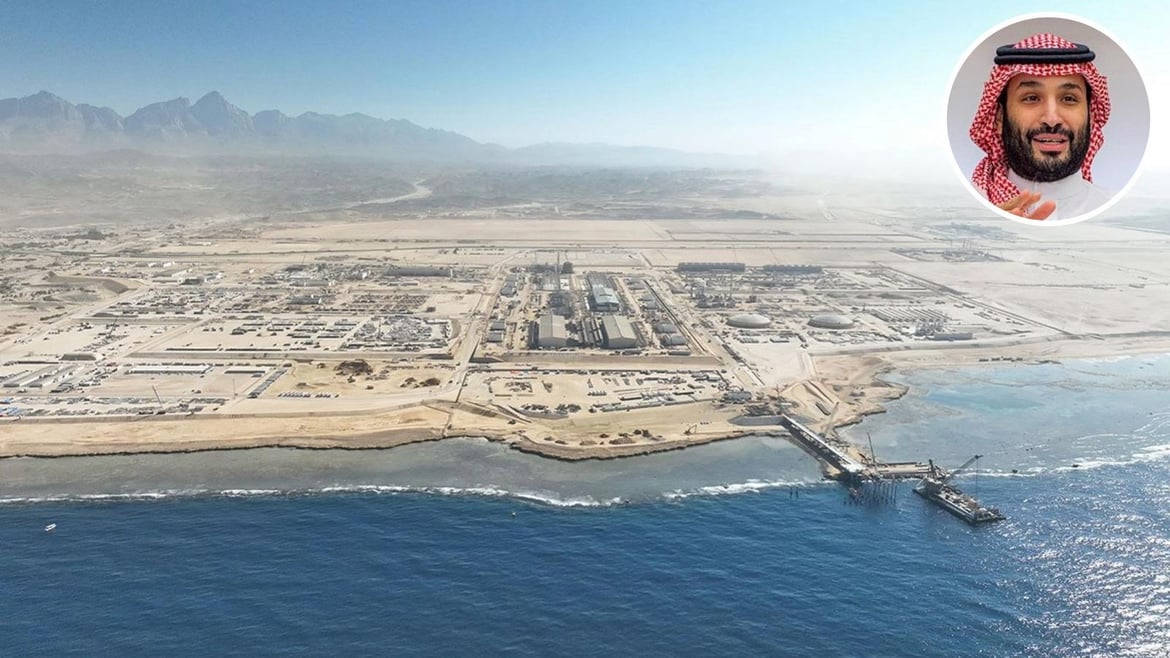
Saudi Crown Prince Mohammed bin Salman is building something so large that it barely fits into familiar frames of reference. On Saudi Arabia’s Red Sea coast, inside NEOM, a green power complex is nearing completion that spans more than 300 square kilometers (about 116 sq. miles). That makes it roughly 1.7 times the size of Washington D.C. According to the NEOM Green Hydrogen Company, construction across the site is now about 90 percent complete

The project sits inside Oxagon, NEOM’s industrial port zone, a place designed to merge heavy industry with global logistics. While much of the attention around NEOM is consumed by The Line and its futuristic urban ambitions, Oxagon is where the kingdom’s economic strategy becomes concrete. This is where ships dock, factories operate, and energy is produced at a scale intended for global markets. Often cited at around $8.4 billion, the project is built around a single, high-stakes idea. Roughly four gigawatts of dedicated wind and solar power are being constructed specifically to feed a massive hydrogen production system. That renewable electricity will drive electrolyzers that split water into hydrogen and oxygen, producing green hydrogen without carbon emissions.

At full capacity, the target is up to 600 tonnes of green hydrogen per day. In industry shorthand, that is usually framed as roughly 1.2 million tonnes of green ammonia per year. Ammonia matters because it is hydrogen’s most practical export form, stable enough to be shipped across oceans and converted back at the destination. This is not a pilot project or a proof of concept. It is an export-scale industrial system designed to compete globally.

Calling it a single power plant misses the point. What is being built is a giga-scale energy ecosystem that combines renewable generation, grid infrastructure, electrolysis, storage, and chemical processing into one integrated footprint. Wind farms, solar fields, transmission networks, and ammonia facilities all operate as parts of the same machine. The scale is deliberate, meant to overwhelm one of green hydrogen’s biggest problems: cost.
The political framing has been equally deliberate. Mohammed bin Salman has described Oxagon as a catalyst for economic growth and diversity, while also protecting the environment and creating jobs. The message is clear. This is about decarbonization, but it is also about ensuring Saudi Arabia remains an energy power even as oil’s dominance slowly erodes.

There is, however, an important caveat attached to that 90% completion figure. In mega-projects, the most difficult phase often begins after construction appears largely finished. Commissioning is where systems must run together reliably. Electrolyzers need stable power, storage systems must behave predictably, ammonia synthesis demands precise controls, and safety systems have no margin for error.

So, the project’s near completion does not mean hydrogen is already flowing. What it does mean is that Saudi Arabia has pushed green hydrogen out of concept decks and into physical reality. A green power complex larger than Washington D.C. is no longer theoretical. It is standing on the Red Sea coast, waiting for the hardest part to begin.