The Boeing 747 that once carried Qatari royalty across continents is now on the verge of entering American service in a role it was never originally designed for, a stopgap Air Force One built out of urgency rather than ideology. What makes this aircraft remarkable is not just the politics surrounding its transfer or the speed at which it has been modified, but the decision at the heart of the program to leave its luxurious royal interior largely intact. This is not a stripped-down military conversion. It is, by design, a preservation project wrapped around a classified transformation.

The United States Air Force has spent roughly $400 million preparing the jet for presidential duty, yet the most visible elements of that spending are not visible at all, as reported the WSJ. Instead of gutting the aircraft and rebuilding it around mission-specific layouts, officials chose to retain much of the original royal interior, accepting a level of opulence that stands in sharp contrast to the restrained, utilitarian philosophy of the existing Air Force One fleet.

A palace that refused to disappear
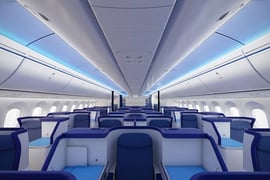
A surprising amount of the aircraft’s original layout has survived the transition. The jet still reads like a private residence rather than a government platform, anchored by a master bedroom positioned in the nose beneath the cockpit, accompanied by a guest suite, two full bathrooms with showers, and a network of nine additional lavatories distributed across the cabin.

A private office remains in place, capable of doubling as a dining room for small meetings, while five galleys are spread throughout the aircraft to support long-haul operations.

The broader spatial logic has also been preserved. Multiple lounges stretch across both decks, connected by a central staircase that turns vertical movement into part of the experience rather than a necessity. The upper-deck hump has been shaped into a living room, reinforcing the sense that this is a home in the sky, while the rear of the aircraft retains a modest business-class section that feels almost incidental compared to the rest of the layout.

Passenger density was never the priority here, and it shows, with only a handful of traditional seating rows and vast amounts of space dedicated to comfort, circulation, and hosting.

The design language reinforces that identity. Rather than overt extravagance, the interiors lean into a softer, modern palette built from sycamore and African wakapou woods, layered with stone finishes, wool and silk textiles, and natural leathers.

At the same time, there is no shortage of spectacle, with oversized recliners and couches, wood paneling, more than forty televisions including ten large screens, and a full suite of entertainment systems supported by Blu-ray players, live broadcasting capability, and onboard connectivity. The result is an aircraft that feels curated rather than engineered, closer to a private estate than a machine built for governance.

Invisible systems, visible restraint
Where the transformation becomes serious is in the layers passengers will never see. The Air Force’s focus has been on embedding secure communications, hardened defense systems, and the infrastructure required for the president to operate as commander in chief from the air. The aircraft has undergone extensive counterintelligence sweeps to eliminate any possibility of surveillance or compromise, a process carried out with the full weight of U.S. security agencies.

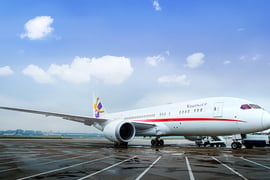
The visible changes are almost understated by comparison. Arabic-language signage has been removed, American presidential insignia has been added, and the exterior is being repainted into a red, white, and blue livery selected for its symbolic clarity. Beyond that, the furniture, layout, and overall atmosphere remain largely untouched, a deliberate decision driven by time and complexity. Rebuilding the interior would have required new certifications, new suppliers, and months if not years of additional delay, something the program could not afford.

Compromise at 40,000 feet
That urgency has produced a series of compromises that quietly define the aircraft’s role. The jet carries fewer refrigerators than the current Air Force One, which means it cannot match the same level of onboard food independence. In practice, that shifts part of the logistical burden to accompanying aircraft, often heavy transports that move supplies and equipment ahead of presidential travel.
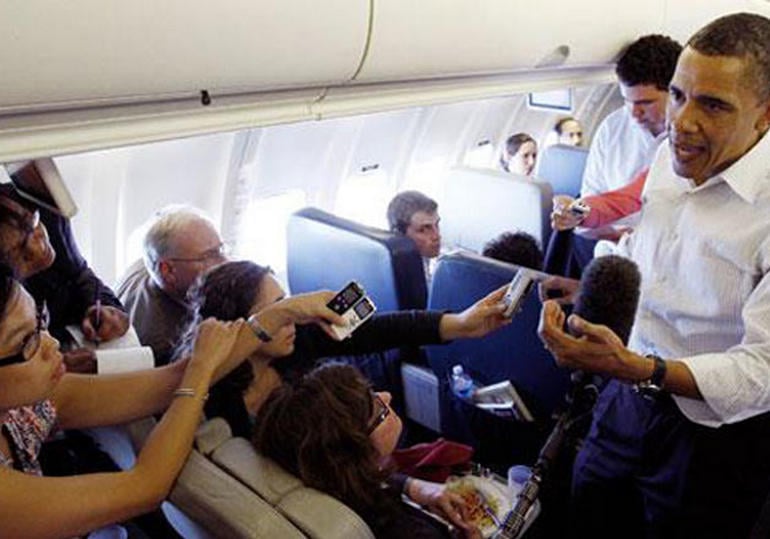
Inside the cabin, the trade-offs are even more visible. The aircraft does not feature a dedicated press compartment, with media seating instead separated from staff areas by a heavy curtain, a solution that feels almost improvised but reflects the decision to avoid structural redesign. The jet is also limited in other ways, with only one set of integrated air stairs and no capability to perform certain ceremonial missions due to door size constraints that were left unchanged.

And yet, for all these limitations, the aircraft achieves what it was meant to do. At roughly 250 feet in length, it will be the longest passenger aircraft ever to serve in the Air Force One role, and it arrives at a moment when delays to the permanent replacement program have forced the United States to think pragmatically. What emerges is a machine that embodies contradiction, a royal residence fused with a military command center, where sofas remain untouched while walls are left unbuilt, and where the urgency of geopolitics has quietly allowed a palace to keep flying.