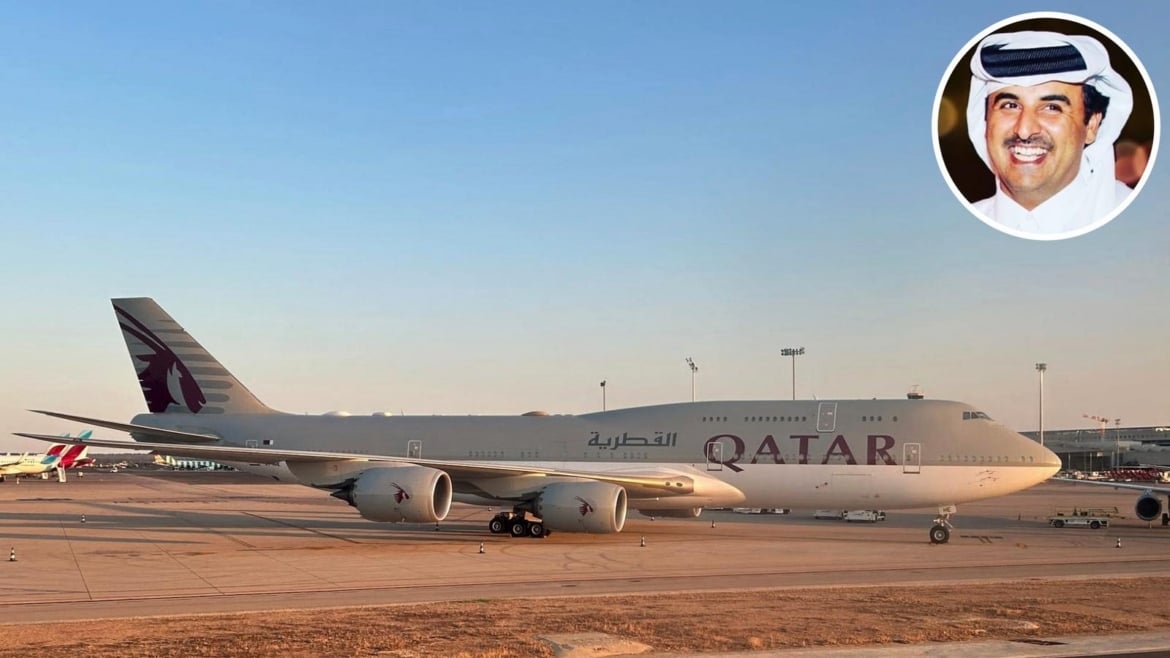
The arrival of Qatar’s enormous Boeing 747-8 BBJ at Palma de Mallorca Airport in Spain was the kind of aviation spectacle that is difficult to ignore. Operated by Qatar Amiri Flight and linked to the country’s ruling family, the private jumbo touched down on Sunday as Mallorca prepared for one of the biggest celestial events in years, adding an extraordinary layer of luxury to an already headline-making summer on the island.
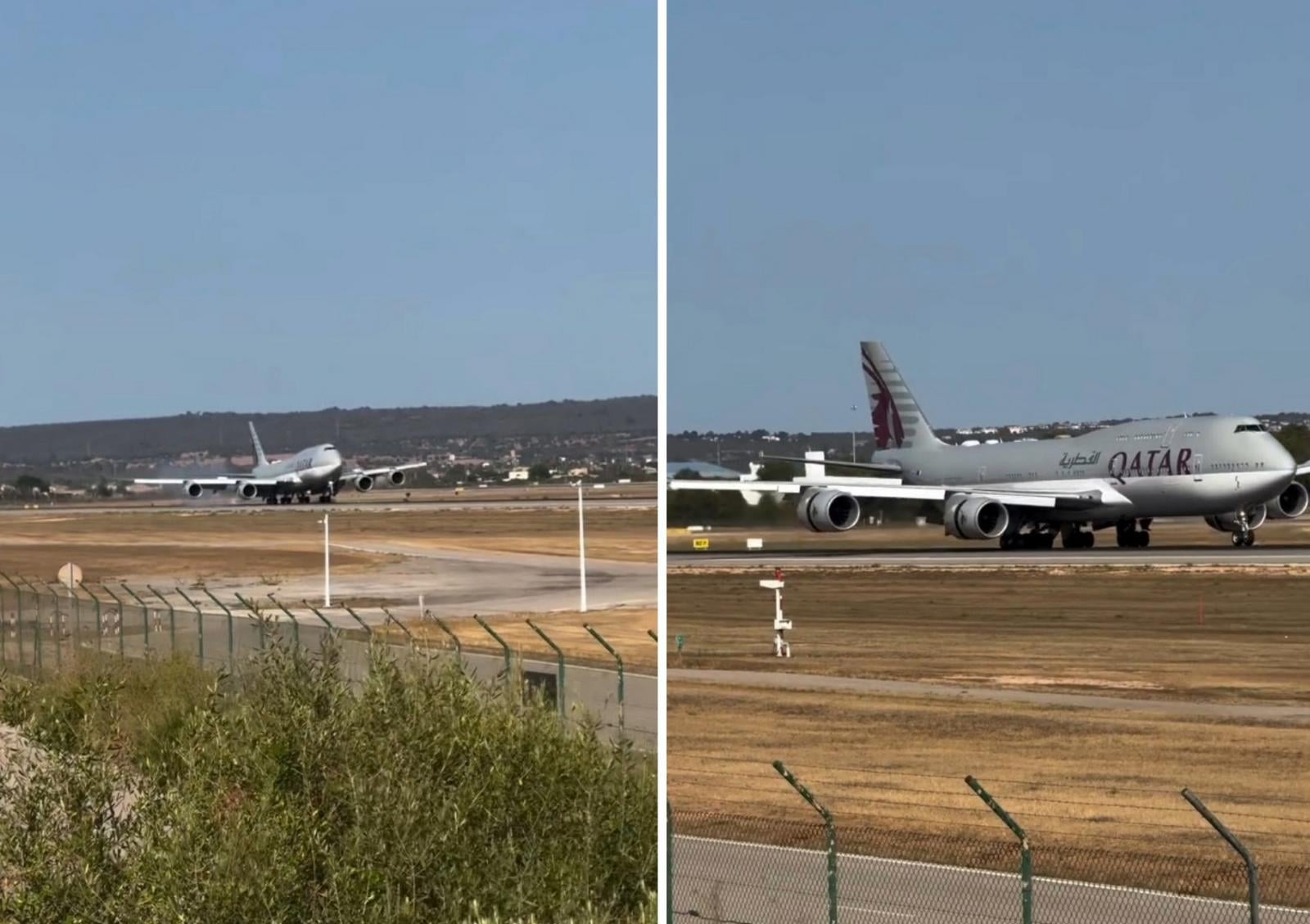
The landing of the massive aircraft triggered a painstaking inspection of the airport’s runway and surrounding movement areas. The airport teams had to check the surfaces used by the giant jet for loose debris, foreign objects or anything else that could threaten subsequent aircraft, as reported by OkDiario. The sweep was especially important given the 747-8’s enormous wingspan and four powerful engines, whose airflow can displace gravel, dirt, asphalt fragments or other loose material near the pavement edges. Teams also checked taxiway shoulders, turning areas and other sections where the jumbo’s engines and landing gear came close to the edges, ensuring that no debris remained that could be sucked into another aircraft’s engine, damage a tire or become a hazard to following traffic.

Why Qatar’s luxury 747 demands so much attention on the ground
Calling the aircraft simply “too big for the runway” would miss what makes its arrival so unusual. The 747-8 can weigh up to 442 metric tons, or roughly 975,000 pounds, at takeoff, yet its sheer width presents the greater operational challenge. Palma’s Runway 06L/24R is 45 meters wide, while the jumbo has a wingspan of 68.4 meters. With the aircraft centered on the runway, each wingtip naturally extends roughly 11.7 meters beyond the paved edge. That is normal for a Code F aircraft, but it leaves the outer engines and enormous wings unusually close to the shoulders, verges and adjoining terrain.

That proximity is one reason the inspection matters. The airport’s procedures for Code F aircraft call for the outer engines to remain at idle during taxiing where possible, helping reduce the risk of generating or ingesting foreign object debris. Loose gravel, stones, pieces of asphalt, metal fragments, baggage equipment, plastic, paper, dirt and vegetation can all become dangerous if they are blown onto an active movement area.

The 747-8’s four huge engines make this especially relevant. Their powerful airflow can move material sitting beside the pavement, potentially carrying it onto a runway or taxiway. The danger may not even be to the jumbo itself. A small piece of debris that causes no problem for the 747 could later be sucked into the lower-mounted engine of another aircraft, strike a tire or be thrown against a fuselage.
The inspection therefore extends beyond the central strip of runway. Shoulders, pavement edges, curved taxiway junctions, apron entrances and turning points all matter when an aircraft this large moves through the airport.

Turning a 747-8 is an exercise in precision, too. Its nose gear, body gear and wing gear do not trace identical paths around a corner. The aircraft’s body landing gear can steer, but carefully planned oversteering is still required on sections of Palma’s Code F route so the main landing gear does not cut across the inside of a turn. That makes the aircraft’s ground movements almost as interesting as the landing itself.

And while the jumbo is often described through its staggering weight, the load is distributed across 16 main-gear tires and two nose tires. There is no indication that the aircraft caused pavement damage or experienced an overweight or hard landing. The post-operation sweep is better understood as a preventative safety measure designed to return the movement area to a clean condition for normal traffic.

A royal arrival timed for a rare celestial spectacle
There is another intriguing reason the timing of this particular arrival stands out. The Qatari royal family’s Mallorca stay coincides almost perfectly with the total solar eclipse taking place on August 12. Mallorca is among the privileged locations where totality can be seen, while the eclipse is not visible from Qatar. In Palma, totality occurs shortly after 8:30 PM local time and lasts for roughly 1 minute and 36 seconds.

That naturally raises the possibility that the family might have used its roughly $400 million 747 to travel from Doha to Mallorca specifically to experience the rare celestial event from the deck of Al Lusail, its approximately $500 million, 404-foot (123-meter) Lürssen superyacht. The yacht returned to the Mediterranean this summer following a major refit, making the combination of a private 747, a vast Mediterranean superyacht and a total eclipse almost impossibly extravagant.

There is no confirmation, however, that the Emir or any particular member of the royal family was aboard the aircraft. The 747 belongs to Qatar Amiri Flight and can be used by several members of the ruling family and senior officials. The scene on the apron at Son Sant Joan, though, was unmistakable. As the jet was guided to its stand, a full security cordon closed around it, with Aena fire crews, Policía Nacional officers and Guardia Civil units taking up positions on the tarmac. The aircraft was parked in a designated area away from the commercial gates, and the perimeter stayed in place while it sat there. Palma handles private jets by the hundred every August, but a deployment on that scale is reserved for arrivals of a very different order.
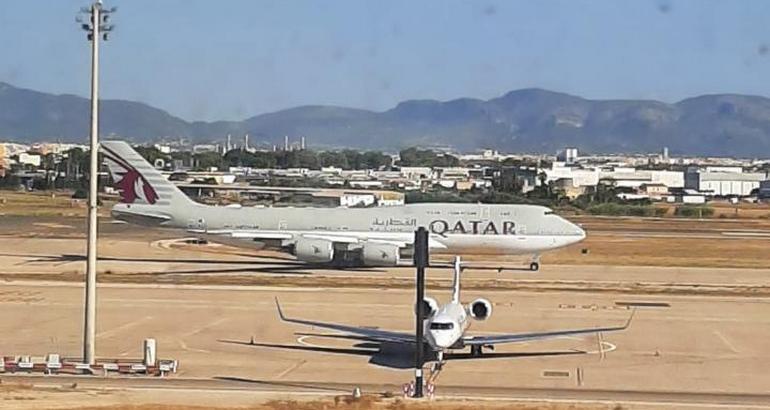
The aircraft itself is no stranger to Mallorca. The same 747-8, registered A7-HHE, was photographed at Palma last year. Its previous visit reportedly created significant challenges for air-traffic operations because the Code F aircraft could use only Runway 06L/24R and required a runway inspection for foreign objects after landing. Its presence also restricted the movement of other aircraft around the airport.

This year’s arrival once again demonstrated why a private aircraft of this scale can command an entire choreography on the ground. Aena firefighters, National Police and Civil Guard personnel were observed around the aircraft, while airport teams focused on the less glamorous but essential task of checking the surfaces it had just used.
For passengers, the sight of a gigantic royal 747 is the memorable part. For the airport, however, the real job begins after the engines fall silent. Every edge, turn, and stretch of pavement has to be left clean enough for the next aircraft, ensuring that one of the world’s most extravagant private jets can make its spectacular entrance without leaving behind a problem for everyone else.