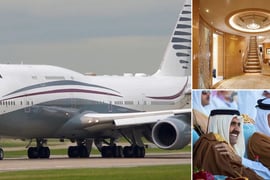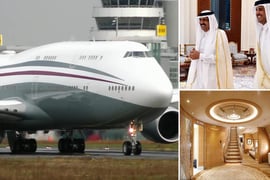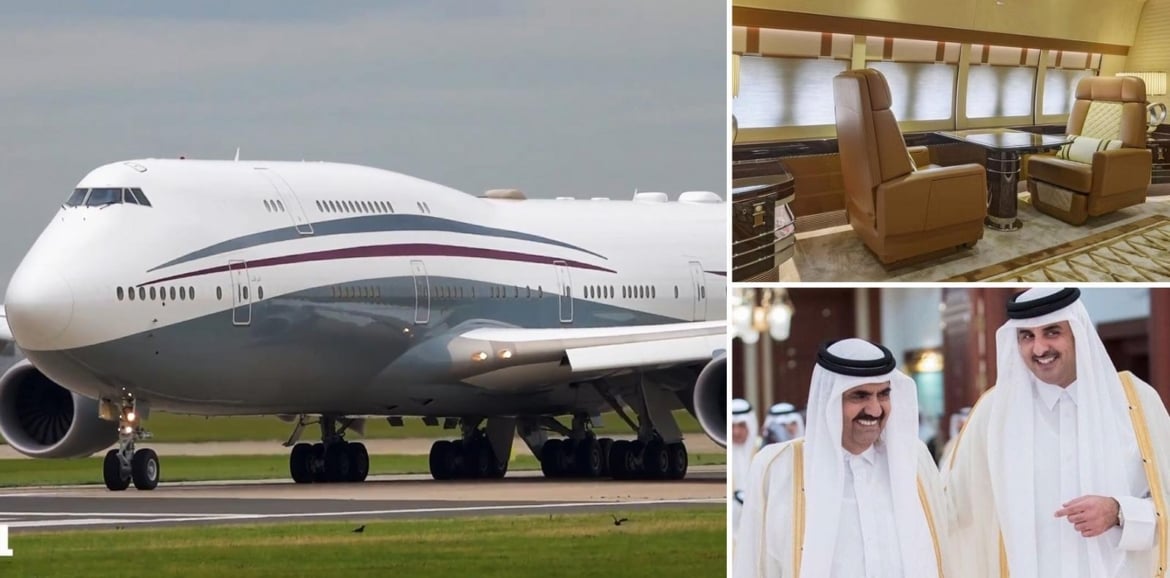
The Boeing 747-8 that once carried members of Qatar’s royal family across the globe will soon fly as America’s interim Air Force One, and despite the headlines about leather lounges and palace-like interiors, the United States Air Force did not spend hundreds of millions of dollars preserving luxury for the president. It spent that money making sure a foreign-owned flying mansion could be trusted at the center of American power.

The aircraft may still retain its oversized leather seats, plush sofas, polished wood finishes, faux library shelves, and the unmistakable atmosphere of a Gulf royal jet, but according to a Bloomberg report that cites William Bailey, the acting assistant secretary of the Air Force for acquisition, the USAF has now officially confirmed that roughly $400 million was spent converting the aircraft into what is internally known as the VC-25B Bridge aircraft. The money was not spent making the jet more glamorous. It was spent stripping it apart, sanitizing it, rebuilding it, and turning it into a secure presidential command platform capable of carrying the commander in chief during a crisis.

Before America could trust the palace, it had to dismantle it
The aircraft’s transformation accelerated in February 2025 when the Air Force launched what officials later described as a “full-court press” to field an interim presidential aircraft while Boeing’s delayed VC-25B program continued drifting toward a 2028 delivery. By May 2025, the Pentagon had accepted the Qatari Boeing 747-8, and almost immediately the aircraft was flown to an L3Harris facility in Texas for one of the most sensitive phases of the entire project.

According to Air Force officials speaking to The Wall Street Journal, the aircraft’s interior was taken apart so the government could ensure there were no hidden surveillance devices, embedded bugs, or compromised systems inside the former royal aircraft. That detail explains why the conversion became so expensive despite the jet still looking outwardly luxurious. The Air Force was not redesigning furniture. It was rebuilding trust.

L3Harris performed the majority of the modification work while Boeing provided engineering data and technical assistance as the original manufacturer of the 747-8 platform. The Air Force repeatedly emphasized that the core of the project centered around secure and resilient communications systems that would allow the president to run the country from the air if necessary. In practical terms, that means hardened mission communications, survivable command-and-control capabilities, self-protection systems, and a wider support architecture that transforms a VIP aircraft into an operational presidential asset.

Gen. Dale White, the four-star Air Force officer overseeing the effort, openly acknowledged that most of the interior was intentionally left alone because redesigning the cabin would have triggered expensive certification requirements and further delays. The decision was not indulgence. It was schedule management under pressure.

A royal jet with American compromises
That urgency explains why the aircraft still looks more like a billionaire’s private residence than a traditional military platform. The Alberto Pinto-designed interior was originally created for Qatar Amiri Flight and featured multiple lounges, bedrooms, decorative finishes, and yacht-like living spaces spread across the enormous 747-8 fuselage. The Air Force removed Arabic-language signage and royal artwork while adding American presidential insignia, but much of the visual identity remains unmistakably Qatari.
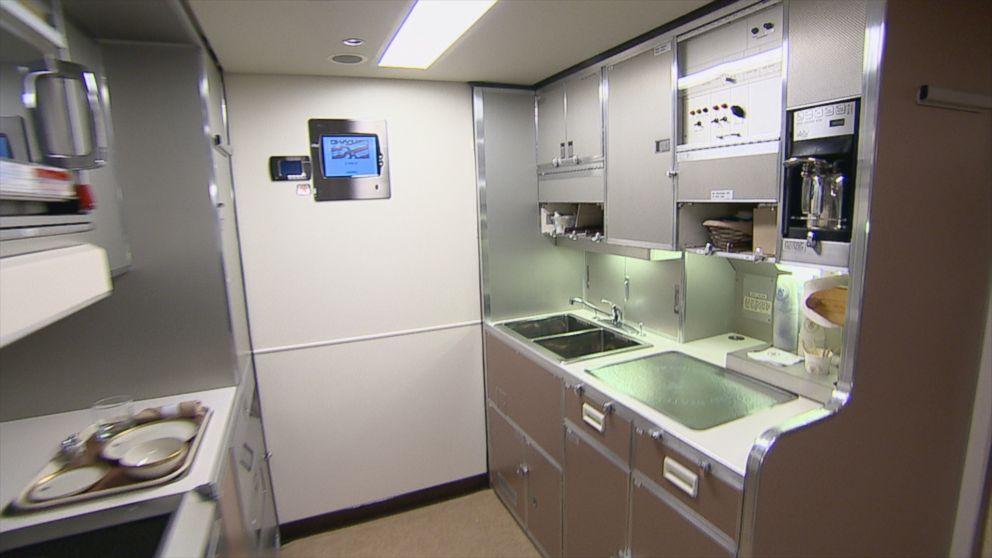
Yet behind the luxury, the aircraft is also a compromise machine. Unlike the current VC-25A fleet, the bridge aircraft has fewer refrigerators, only one set of integrated air stairs, and no dedicated press cabin separated by permanent walls. Media seating will instead be divided from staff areas by a heavy curtain. The aircraft also cannot perform “Golden Eagle” missions carrying the remains of former presidents because officials chose not to enlarge the rear doors during modification.

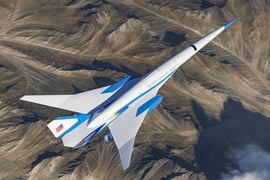
Those limitations reveal the real philosophy behind the program. The VC-25B Bridge aircraft was never intended to become the definitive future Air Force One. It exists to buy time while Boeing struggles to complete the permanent replacement fleet.

That makes the aircraft one of the strangest presidential platforms ever created. It is simultaneously a former royal palace, a rapidly assembled national security asset, and a very expensive stopgap born from the failure of America’s official Air Force One replacement timeline.
The modified 747 has already completed flight testing in Texas and is currently in paint as it prepares to enter service on July 4, marking the 250th anniversary of American independence.