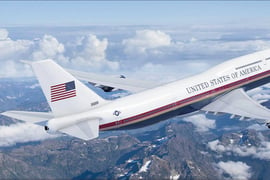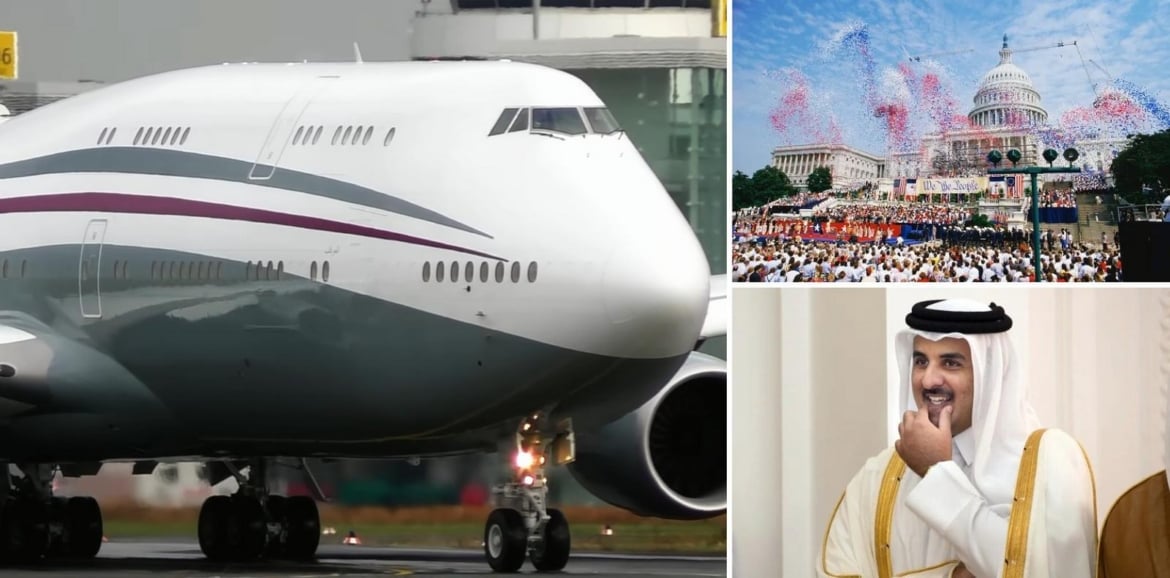
The Boeing 747 gifted by Qatar is now moving toward one of the most symbolically loaded aviation deadlines in modern American history. The aircraft that began life as a flying palace for Gulf royalty is expected to enter service as the interim Air Force One around July 4, 2026, placing its operational debut alongside the United States’ 250th Independence Day celebrations.

According to Reuters, the US Air Force will be ready to deploy the Qatar-gifted jet as the interim Air Force One on Independence Day. After months of accelerated modification work, flight testing, and security integration, the jet is reportedly now being painted in the new presidential color scheme that will define this unusual bridge era between the aging VC-25A fleet and the delayed next-generation VC-25Bs.

The timing alone makes the aircraft impossible to separate from the national stage around it. Air Force One has always existed somewhere between military platform and political theater, but this particular 747 arrives at a moment where symbolism is carrying unusual weight. The current presidential fleet dates back to the George H.W. Bush era and has become increasingly maintenance-heavy, while Boeing’s official replacement program has slipped years behind schedule with deliveries now expected in 2028.
Into that vacuum steps a pre-owned Boeing 747-8 once configured for royal travel, now repurposed as what the Air Force carefully calls a “bridge capability” intended to preserve a secure and reliable airborne command post while the larger modernization effort continues.
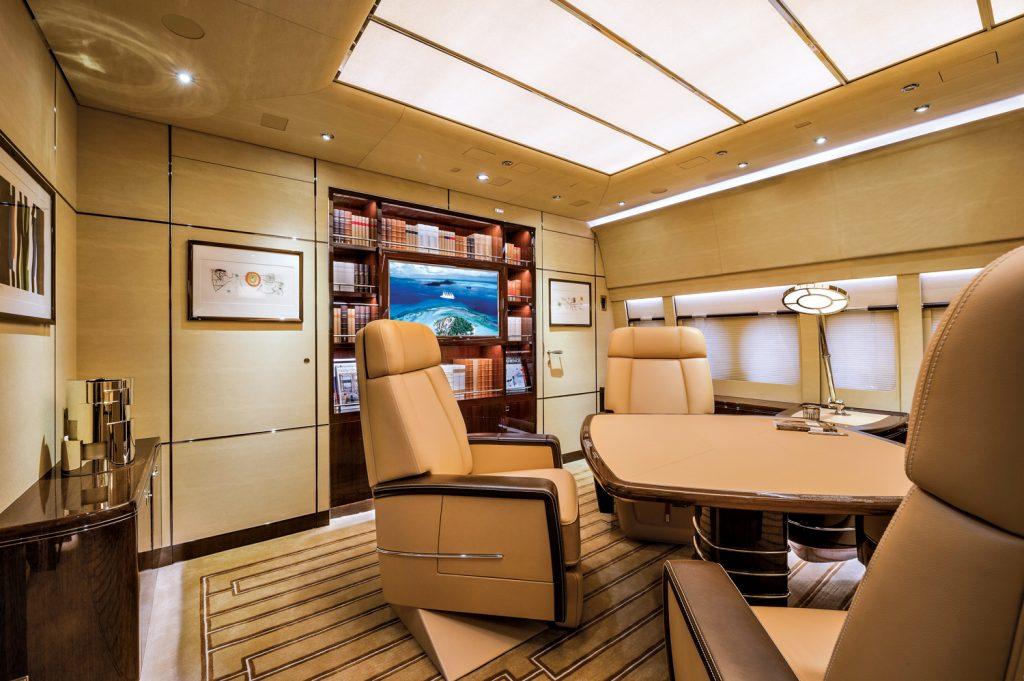
It matters because the Air Force has gone out of its way to frame the aircraft as a functional necessity rather than an exercise in presidential extravagance. Officials have consistently emphasized secure communications, survivability, continuity-of-government capability, and operational resilience rather than luxury. The aircraft reportedly has retained most of its royal luxurious interior, including the oversized leather seating, plush lounges, couches, and even faux library bookcases installed during its royal service life, but the real work reportedly happened beneath the surface.

Arabic-language signage and Qatari artwork were removed while engineers focused on integrating hardened communications systems, self-protection technology, secure mission infrastructure, and extensive technical assurance measures designed for a previously foreign-operated head-of-state aircraft.

That distinction is central to understanding this airplane. The conversion was not a cosmetic refresh. It was a missionization program compressed into an unusually aggressive timeline. Air Force officials reportedly launched what they described as a “full-court press” beginning in early 2025, concentrating only on the core capabilities required to safely support presidential operations.

The aircraft was stripped and examined for hidden surveillance risks before undergoing extensive modification and testing. Multiple government agencies were involved in developing procedures to neutralize technical hazards associated with a pre-owned foreign airframe, underscoring that this was as much a counterintelligence challenge as an aviation project.

The smartest decision may have been the simplest one. Rather than redesigning the entire cabin, the Air Force largely left the existing luxury interior intact. That choice saved enormous amounts of time in certification, engineering, and procurement. Custom interiors for sovereign aircraft are one of the most specialized corners of global aviation and the official VC-25B replacement effort itself suffered delays tied to contractor problems in that exact area. By retaining much of what already existed, officials avoided repeating one of the same industrial bottlenecks that slowed Boeing’s long-term presidential fleet program.

The result is an aircraft filled with contradictions. Inside, it reportedly feels more lavish than the current Air Force One fleet, carrying the atmosphere of royal long-haul luxury rather than the restrained utility traditionally associated with American presidential aircraft. Yet beneath the leather seating and polished surfaces sits a compromise platform shaped by speed and necessity.

The aircraft reportedly has fewer refrigerators than the current VC-25As, meaning support aircraft may still need to assist with presidential catering logistics on certain missions. It carries only one integrated air stair system and lacks a fully dedicated press cabin, with media seating separated by a thick curtain rather than permanent structural partitions. It also cannot perform “Golden Eagle” missions transporting the remains of a former president because the aircraft was not modified with the larger rear access capability required for that role.

That strange mixture of palace aesthetics and operational shortcuts gives the aircraft an almost transitional personality. It looks like a royal flagship but behaves in some ways like a rapidly adapted stopgap platform designed to buy time for a delayed modernization program. Even the operational rollout reflects that practical mindset.

There is no evidence the aircraft will receive a grand commissioning ceremony in the naval sense. Historically, presidential aircraft enter service through real-world operational use rather than theatrical christening events. The current VC-25As did exactly that in 1990 when George H.W. Bush simply folded their inaugural flight into an ordinary working presidential itinerary.

In many ways, this Boeing 747 represents the most revealing possible snapshot of modern presidential aviation. It is simultaneously a continuity-of-government asset, a flying command center, a compressed engineering solution, and a royal aircraft reimagined for American state service during one of the country’s most symbolic anniversaries.