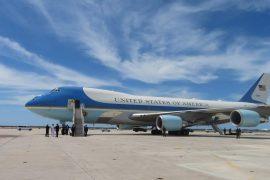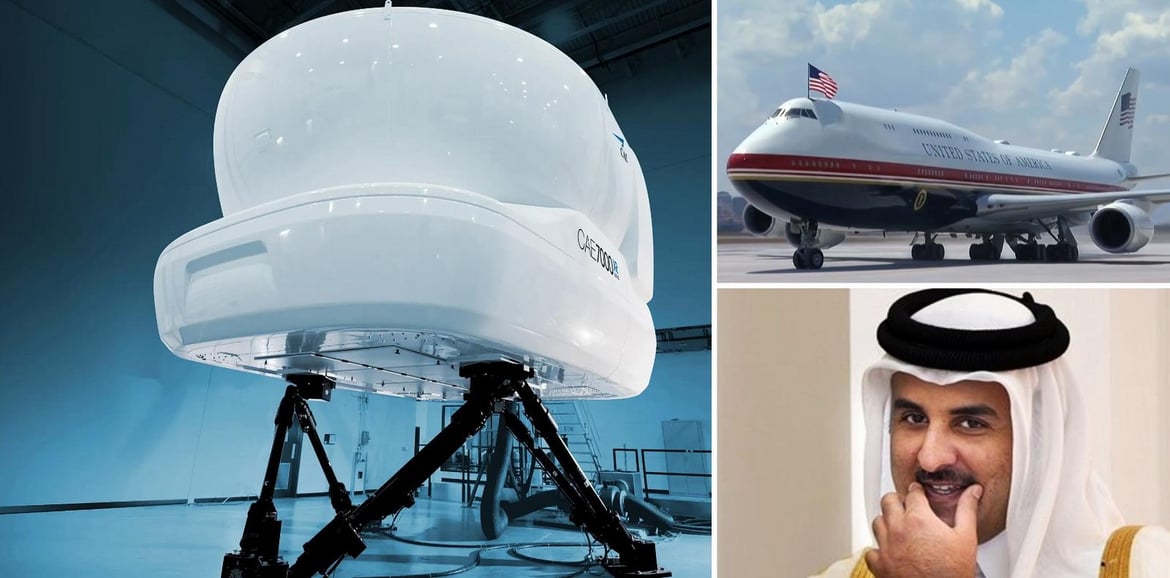
The US Air Force is spending $45.3 million on a sophisticated flight simulator for the Boeing 747-8i, a decision that says as much about the aircraft’s complexity as it does about the training required to operate the Bridge Air Force One and the service’s plans for its next generation of presidential jets. The need for a dedicated simulator might seem surprising when the Air Force already operates 747s, but its existing VC-25As are based on the much older 747-200B and belong to a very different era of aviation. The 747-8i may share the familiar silhouette and much of the underlying character of the iconic jumbo jet, yet its cockpit, systems, engines, and operating procedures have evolved considerably. For the crews expected to fly these aircraft, familiarity with one generation of 747 does not simply translate into qualification on another.

Under the new firm-fixed-price contract, CAE USA will acquire and install one Federal Aviation Administration Level D-qualified 747-8i full-flight simulator at Joint Base Andrews, Maryland, together with an initial logistics support package, as reported by Investing.com. The simulator will play an essential role in training pilots for not just the Qatar-donated 747 but the two future VC-25Bs, which are being built around the same 747-8i platform. Its arrival will give the Air Force a dedicated training environment at the home of its presidential airlift fleet, allowing crews to build proficiency without repeatedly taking operational aircraft away from their demanding duties.

Why a familiar 747 still needs a simulator
The difference becomes clearer when the aircraft are viewed side by side rather than simply by their shared name. The VC-25A traces its roots to the classic 747-200B design of the 1970s, while the 747-8i is a much newer development of the 747-400 that entered passenger service in 2012. The newer aircraft features a modernized flight deck, different engines, updated flight-management and navigation systems, revised flight controls and a range of electronic systems that pilots must learn to use properly.

Boeing deliberately preserved much of the 747’s familiar handling character, but that does not make the transition from the VC-25A a simple matter of climbing into another version of the same aircraft. The Air Force therefore needs a dedicated training pipeline for crews moving onto the 747-8i.

A simulator is particularly valuable because the most important emergencies are the ones that cannot responsibly be created in a real aircraft. Pilots can practice engine failures, rejected takeoffs, system malfunctions, severe weather, unstable approaches and other demanding situations while remaining safely on the ground. Instructors can introduce a problem at precisely the right moment, pause the scenario, reset the aircraft and run the exercise again until the crew has mastered its response. That level of repetition is difficult to achieve with an actual aircraft, where every training sortie consumes fuel, maintenance resources and valuable flight hours. It also means the real fleet can remain available for its operational mission rather than being routinely diverted for intensive training.

The Air Force has already used commercial resources to help bridge the 747-8i training gap, including an Atlas Air 747-8 freighter for initial training. The new simulator represents a shift toward a more permanent, in-house capability at Joint Base Andrews, reducing reliance on civilian aircraft and commercial simulator schedules. It will not only support initial qualification, but also the recurrent proficiency training that pilots need throughout their careers. That makes the system an important piece of the infrastructure surrounding the Qatar-donated 747 and the future VC-25Bs rather than a one-time training purchase.

The Qatar 747 offers a timely reminder
The importance of understanding every system on the aircraft was underscored by a recent incident involving the Qatar-donated 747-8i at Joint Base Andrews. An emergency inflatable evacuation slide was accidentally deployed while the aircraft was on the ground, a relatively minor mishap that nevertheless demonstrated how quickly an aircraft system can become an operational issue when activated unintentionally. The episode was hardly the kind of emergency that the new simulator is being purchased to reproduce, but it provided a timely reminder that operating a modern widebody aircraft involves a vast number of systems and procedures. For crews responsible for an aircraft with an exceptionally demanding mission, knowing how those systems behave is not something that can be left to experience alone.

The Level D simulator will provide a full-scale replica of the 747-8i flight deck alongside a motion platform, visual system, and simulated aircraft systems that allow pilots to experience the aircraft in a controlled environment. It can reproduce the feel and behavior of the aircraft closely enough to support demanding training without exposing the actual jet to unnecessary risk.

The $45.3 million contract also includes installation and initial logistics support, helping explain why the final figure is considerably higher than the price of simulator hardware alone. CAE USA’s role is therefore not simply to deliver a cockpit replica, but to establish a functioning training capability that can support the Air Force over time.

The investment arrives as the service prepares for the eventual introduction of the two VC-25Bs, making the timing particularly significant. Those aircraft will bring the 747-8i into the heart of the presidential airlift fleet, and their crews will need to be proficient on the platform before the jets become fully operational. By placing the simulator at Joint Base Andrews, the Air Force can train crews close to the aircraft while keeping the operational fleet available when it is needed. The $45.3 million purchase may look like an extraordinary price for a machine that never leaves the ground, but for an aircraft fleet where readiness and reliability are paramount, the simulator is arguably one of the most important aircraft the Air Force can have
.