For months, speculation centered on the idea that the Boeing 747-8 gifted by Qatar would eventually find a permanent home at the proposed presidential library in Miami. Instead, the museum’s star attraction is now expected to be a far older aircraft with a much deeper presidential legacy. The planned centerpiece will be SAM 29000, one of the two Boeing VC-25A aircraft that have served as Air Force One since the early 1990s, bringing nearly four decades of history under one roof.

That detail was revealed by Eric Trump in an interview, where he explained that the sprawling waterfront complex planned next to Miami’s Freedom Tower is intended to display the retired presidential aircraft at the base of the building, as reported by NBC News. The site is envisioned as a major tourist destination with academic partnerships involving nearby Miami-Dade College, while the aircraft itself is expected to become one of the library’s defining exhibits once it retires from government service.

A flying White House with nearly four decades of history
Although many people casually refer to it as “Reagan’s Air Force One,” the aircraft’s story is more nuanced. The replacement program for the aging Boeing 707 presidential fleet began during Ronald Reagan’s administration after the White House determined that the existing aircraft no longer offered the range, communications capability, or cabin space required for modern presidential travel. Boeing’s 747 beat the McDonnell Douglas DC-10 to win the competition in 1986.

However, Reagan never actually flew aboard either VC-25A as president. The first aircraft, SAM 28000, entered service under President George H.W. Bush in 1990, while SAM 29000 followed in March 1991. Even so, Nancy Reagan reportedly influenced the aircraft’s original interior design, which drew inspiration from the colors and character of the American Southwest.

The VC-25A is far more than a luxurious airliner. It functions as a fully operational White House in the sky, allowing the president to govern while airborne. Behind its familiar blue-and-white livery are a presidential suite with a private office, bedroom, dressing room, shower and lavatory, a conference and dining room, workspaces for senior advisers and the Secret Service, a press compartment, a medical facility capable of handling emergencies, crew rest areas, six lavatories, and two galleys that can prepare or serve around 100 meals at a time.

Equally important are the aircraft’s self-sufficiency features. Built-in front and rear air stairs, onboard baggage-loading equipment and aerial refueling capability allow it to operate from military bases or remote airfields without relying on local airport infrastructure. Under the skin, the transformation from a commercial Boeing 747 is equally dramatic. While a standard 747 contained roughly 585,000 feet of wiring, the VC-25A required approximately 1.26 million feet, about 239 miles, to support hardened electrical systems and secure communications. Over the decades, the aircraft has also received repeated technology upgrades, including prominent satellite communications fairings added during a major modernization completed around 2017.

The Qatar-donated Boeing 747’s long-term fate remains unclear
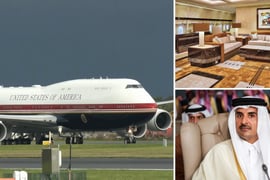
The clarification also suggests that the much newer Boeing 747-8 donated by Qatar is unlikely to become a museum exhibit anytime soon. The aircraft has since been transformed into the Bridge Air Force One, providing an interim presidential transport while the long-delayed VC-25B fleet remains under development.

Unlike the nearly 40-year-old VC-25A, the 747-8 still has decades of useful service life ahead of it. The Air Force has invested heavily in the platform by acquiring additional 747-8 aircraft for training and spare parts while building a dedicated maintenance and logistics network around the type. That makes it valuable not only as an executive transport but also as a backup presidential aircraft, a training platform, or a continuity asset should operational needs arise.

Its eventual replacement, the VC-25B, has become one of Boeing’s most challenging military aviation programs. Based on the Boeing 747-8 Intercontinental, the aircraft must be extensively modified into a secure airborne command center with hardened communications, defensive systems and specialized mission equipment. The project has suffered years of delays, supply-chain disruptions, engineering challenges and workforce shortages, pushing the expected delivery schedule well beyond its original target.

The Air Force is now aiming to receive the aircraft in 2028, while Boeing has said the first VC-25B is expected to begin test flights next year as development enters a crucial phase. The program’s cost has also climbed dramatically, with Boeing absorbing billions of dollars in charges on the fixed-price contract. Until those next-generation aircraft finally enter service, the veteran VC-25A fleet, including the future museum-bound SAM 29000, along with the Bridge Air Force One will continue to shoulder one of the world’s most demanding aviation missions.