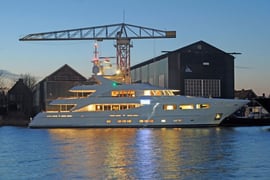
Take a long breath, because this is one of those climate comparisons that feels wrong the first time you hear it. Superyachts have become shorthand for climate excess. They are enormous, conspicuous, and easy to dislike. A single vessel can burn more fuel in an afternoon than most people will in a lifetime, and they exist purely for pleasure. They are regularly invoked as proof that the ultra-wealthy live by a different carbon rulebook. All of that is true. But when emissions are added up carefully, something far more ordinary ends up looking much bigger. We are talking about dog food.

The ingredients used to feed dogs in the UK are responsible for roughly 4.5 million tons of CO₂-equivalent emissions each year, per a report by The Guardian. That figure alone dwarfs the emissions from the world’s largest superyachts. In fact, UK dog food emits around 15 to 20 times more greenhouse gas than the biggest 300 superyachts on the planet combined. The shock is not that yachts are clean. It is that dog food is so easy to overlook.

Superyachts, in context
A large, fully crewed luxury superyacht typically emits about 7,000 tons of CO₂ per year. That figure assumes a vessel with multiple generators, hotel-style amenities, and frequent cruising between Mediterranean hotspots. Stack together the world’s top 300 yachts, and you arrive at roughly 285,000 tons of annual emissions, as pointed out by Fortune.

Those numbers are obscene at the individual level. One yacht can rival the annual footprint of hundreds of people. But climate impact is not decided by symbolism. It is decided by totals. When you compare those 285,000 tons to the 4.5 million tons associated with UK dog food ingredients, the scale flips. Britain’s dogs alone account for emissions equivalent to roughly 640 mega-yachts running year-round.

This does not mean yachts are suddenly defensible. It means that rarity limits their aggregate damage. There are only a few thousand superyachts in the world. There are millions of dogs, eating every day.

Why dog food adds up so fast
The first reason is structural. Dog food is dominated by meat, and meat is one of the most carbon-intensive foods humans produce. Livestock farming requires land to grow feed, fertilizer that releases nitrous oxide, and animals that emit methane. Every kilogram of beef or lamb carries a long tail of emissions before it ever reaches a bowl.

When you feed a dog a meat-rich diet, you are effectively adding another meat-eater to your household. Multiply that decision across millions of homes, and the emissions snowball. Studies comparing dog foods show just how extreme the spread can be. Beef-based dry diets can emit more than ten times the CO₂ per calorie of plant-based formulations, while also demanding vastly more land. The dog does not get larger. The footprint does.
The second reason is cultural. Modern pet food has been pulled into the same premium logic as human luxury goods. Marketing leans heavily on ideas of ancestral, wolf-like, and human-grade nutrition. The problem is that wolves are not driving global beef demand. People are.

When dog food relies on by-products and carcass trimmings, emissions are largely shared with an animal already raised for human consumption. When brands insist on prime cuts that humans could have eaten, they drive additional livestock production. Somewhere upstream, that means more animals, more feed, more land, and more methane. The branding looks natural. The climate math is anything but.

Superyachts earn their reputation because their emissions are concentrated and visible. Pushing hundreds of tons of hull through water requires enormous energy, and fuel burn rises steeply with speed. Owners like to move fast, and physics makes that expensive in carbon terms. Mark Zuckerberg’s $300 million Launchpad spewed 5,300 tons of CO₂ in the first 9 months of sailing alone, before going for yearly maintenance.

Even at anchor, the damage continues. Generators run constantly to power air conditioning, lighting, kitchens, entertainment systems, and crew spaces. Technical research treats this hotel load as a major share of annual energy use. The yacht becomes a floating diesel hotel, whether or not it is going anywhere.

The uncomfortable lesson here is not that superyachts have been unfairly criticized. It is that climate harm is often hidden inside everyday normality. We are quick to condemn the spectacular excesses of the ultra-rich, and slow to notice the cumulative impact of millions of ordinary choices. A stainless-steel bowl on a kitchen floor does not look like a climate problem. In aggregate, it very much is.