Owning a superyacht and maintaining a superyacht are two different things. Now there is a third angle, and a rather amusing one, taxing the superyacht itself. France tried exactly that in 2018, introducing a levy on large yachts in the hope that it would bring in almost $12 million annually. But desires and destinies are seldom on the same page, and in this case, they were not even in the same book. The tax failed spectacularly. Instead of delivering millions, it became the textbook example of fiscal disappointment and was nearly abolished on Wednesday, November 19, by the National Assembly.

The truth is that this highly contested measure generates not millions but 187 times less than originally projected. The number reveals the staggering gap between legislative ambition and real-world outcome, a measly $65,000 to nearly $80,000 a year, combined, from every large vessel over 30 meters (about 100 feet), reported Le Monde.

When you consider that these yachts cost tens or hundreds of millions, and their annual maintenance runs into the millions as well, a total national tax bill of $80,000 becomes almost comedic. Billionaires routinely spend that amount on a single design tweak, a piece of decorative art, or a minor AV upgrade on a flagship.

Money aside, the yachts themselves simply vanished from the French tax net. Large vessels over 30 meters or with engines above 750 kW did what mobile assets do best, they relocated. Owners simply shifted their yachts to foreign registries with friendlier regimes like Malta, the Cayman Islands, the UK, or Luxembourg. France was left with a microscopically small fleet of taxable yachts and a yacht tax that quickly became a punchline.

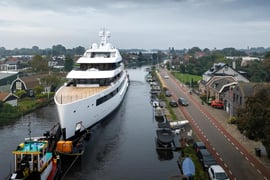
Take Bernard Arnault, for instance. His 101.5-meter superyacht Symphony, worth around $150 million, is held via a Maltese company linked to LVMH. If Symphony were actually French-registered, she would fall into the highest “70 meters and above, 1,500 kW and above” tier, owing roughly $215,000 a year. For Europe’s richest man, worth about $185 billion, that is just around 0.14 percent of the yacht’s value, the financial equivalent of a modest refit invoice or a barely noticeable line item in her vast operating budget. Even the much smaller $18 million yacht Paloma, owned by French billionaire Vincent Bolloré and carrying an estimated annual maintenance cost of $2 million, is registered under the Maltese flag. One way or another, the billionaires seem to have the last laugh, tax or no tax.