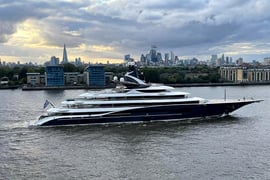
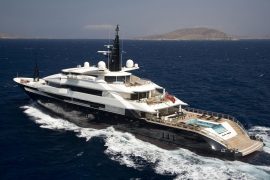
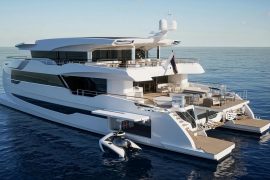
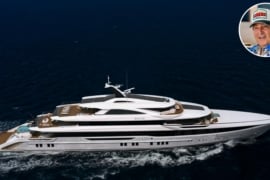
The 92.8-meter Oceanco superyacht Draak has entered sea trials in the Netherlands after one of the most ambitious large-yacht rebuilds in recent memory, marking the latest stage in the transformation of a vessel that has already lived several very different lives. Formerly known as Equanimity and later Tranquility, the yacht first arrived in 2014 as one of the defining guest-focused superyachts of her era, becoming the first yacht built to the Passenger Yacht Code and setting a new benchmark for carrying larger numbers of guests in full superyacht luxury.
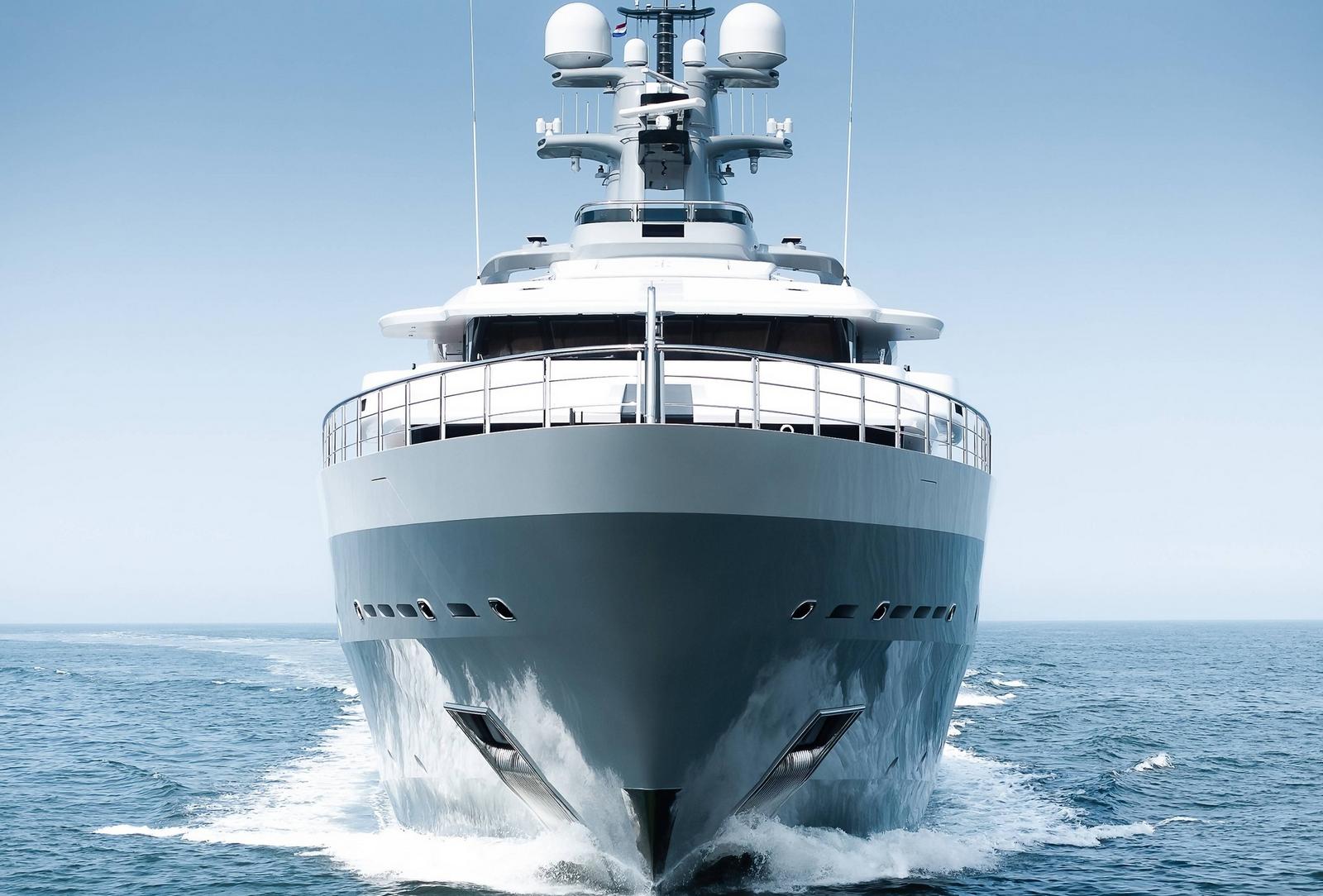
Now, more than a decade later, Draak has been almost completely reimagined. The yacht that once revolved around spa living, private leisure, and floating-palace indulgence has effectively become a highly specialized operational companion vessel for Gabe Newell’s 111-meter Oceanco flagship Leviathan. The shift is dramatic because this is not simply a cosmetic refit or a modernized interior refresh. Draak has moved from leisure-first to operations-first, with almost every major modification pointing toward expedition support, dive capability, logistics, and long-duration functionality at sea.

From floating palace to expedition support platform
The most visible change is the removal of the yacht’s upper deck aft helideck, which would once have been considered one of the defining luxury and utility features aboard a superyacht of this scale. In its place, Oceanco created additional clearance for a large operational tender deck fitted with heavy-duty C-davits on the main deck aft, while integrating a 12.6-ton jib crane above to handle tenders and heavy equipment, according to Superyachttimes. The decision says everything about Draak’s new purpose. Helicopter glamour has been sacrificed for working capability.

The stern has also been extensively redesigned. Oceanco extended the boarding platform by just over one meter while adding retractable fenders and swim stairs designed for safer tender transfers, diver movement, and repeated operational use around Leviathan. It is a less theatrical setup than a traditional beach club, though considerably more practical for a yacht expected to launch boats, recover divers, move gear, and operate continuously alongside another vessel.

Inside, the transformation becomes even clearer. The former beach club and spa have been converted into a fully equipped dive center complete with a decompression chamber, which immediately signals that this is no longer a casual leisure yacht carrying water toys for entertainment. A decompression chamber points toward serious dive operations, complex underwater programs, and a much more disciplined approach to safety and expedition support.

The main deck saloon has become a large crew mess, while the main saloon now incorporates a chef’s lab intended for smaller dining experiences shared by crew and guests. New adaptable cabins provide additional high-end accommodation capacity when needed, reinforcing the idea that Draak now exists to support personnel movement, operational flexibility, and extended expedition cycles. German interior outfitter Vedder handled the interior conversion while Azure Yacht Design & Naval Architecture returned alongside Oceanco for the naval architecture work.

Dan Morgan of YTMC described the rebuild as an effort to “re-engineer the yacht’s DNA,” which feels entirely accurate given the scale of the changes. Oceanco’s Edwin Schneider revealed that the shipyard effectively had to “open up the entire yacht,” explaining that the redesign required a major overhaul of ventilation systems, electrical infrastructure, and interconnected onboard systems. That matters because this was not a superficial rebuild hidden beneath fresh paint and new furniture. Draak was structurally and operationally rewritten.

Why sea trials matter for a yacht like draak
For a 2,951 GT vessel approaching 93 meters in length, sea trials involve far more than verifying engine performance and seaworthiness. Standard trials test propulsion, steering, generators, navigation systems, emergency systems, stabilizers, anchors, maneuvering behavior, fuel loads, vibration levels, and communication infrastructure, though Draak’s new role likely adds another layer of mission-specific testing.
The real challenge may not be outright performance but operational rhythm. The crew and shipyard will need to prove how efficiently Draak can launch and recover tenders, support dive teams, handle repeated crane operations, process equipment movement, accommodate rotating specialists, and sustain that tempo safely across varying sea conditions. Her decompression systems, crew logistics, electrical loads, ventilation requirements, alarms, and emergency response protocols all become part of the trial process.
That is because Leviathan itself is not simply another billionaire megayacht. The vessel forms part of Newell’s broader Inkfish ecosystem focused on marine exploration and scientific work at sea. Leviathan already carries laboratories, medical facilities, dive infrastructure, and advanced onboard systems intended to support long-range operations. Draak adds an entirely different layer to that ecosystem by functioning as the hands to Leviathan’s brain.
The yacht can carry additional crew, dive teams, tenders, specialists, technicians, and operational equipment while handling the wetter, louder, and more repetitive work that would otherwise interfere with life aboard Leviathan. She can stage dive operations ahead of the mothership, move gear between sites, support diver recovery, provide overflow accommodation, and reduce operational clutter aboard the primary vessel.
Newell has previously said that “yachts have great potential” as scientific platforms, and Draak’s rebuild finally gives that philosophy a visible operational form. She is not replacing dedicated research vessels such as Inkfish’s R/V Dagon or the upcoming RV6000, though she does make the broader expedition ecosystem more capable, more flexible, and far more sustainable for long-term ocean work.