When Ferrari quietly revealed the cabin of its first-ever EV this week, the reaction was swift and unusually sharp. The interior of the Luce, created in collaboration with Sir Jony Ive and his design collective LoveFrom, was supposed to signal a new era for Maranello. Instead, it has ignited a debate about whether the world’s most emotive car brand has drifted too close to the Silicon Valley.

According to a report by The Telegraph, several prominent designers have branded Ive’s cockpit “utterly inappropriate for a Ferrari,” with one going further and calling it “soulless.” The criticism centers on tone rather than quality. Few question the precision of the machining or the finish of the materials. The objection is that the Luce’s interior, with its glass surfaces, brushed aluminum detailing and disciplined geometry, feels more like an upscale Apple product than the cabin of an Italian super-GT.

Peter Stevens, the designer of the McLaren F1, told the newspaper, “Sure, it’s very nicely done, it’s a lovely design, but it’s just not a Ferrari.” In perhaps the harshest line, he suggested that if you removed the prancing horse, the interior could belong to “a medium-sized Honda.” That sentiment has echoed across enthusiast forums and Apple-watcher sites, where one widely shared comment described the cabin as “Apple work copy-pasted onto a Ferrari,” simplified to the point of feeling default rather than deeply automotive, something that would look just as plausible in a Lexus, Hyundai or Kia collaboration.

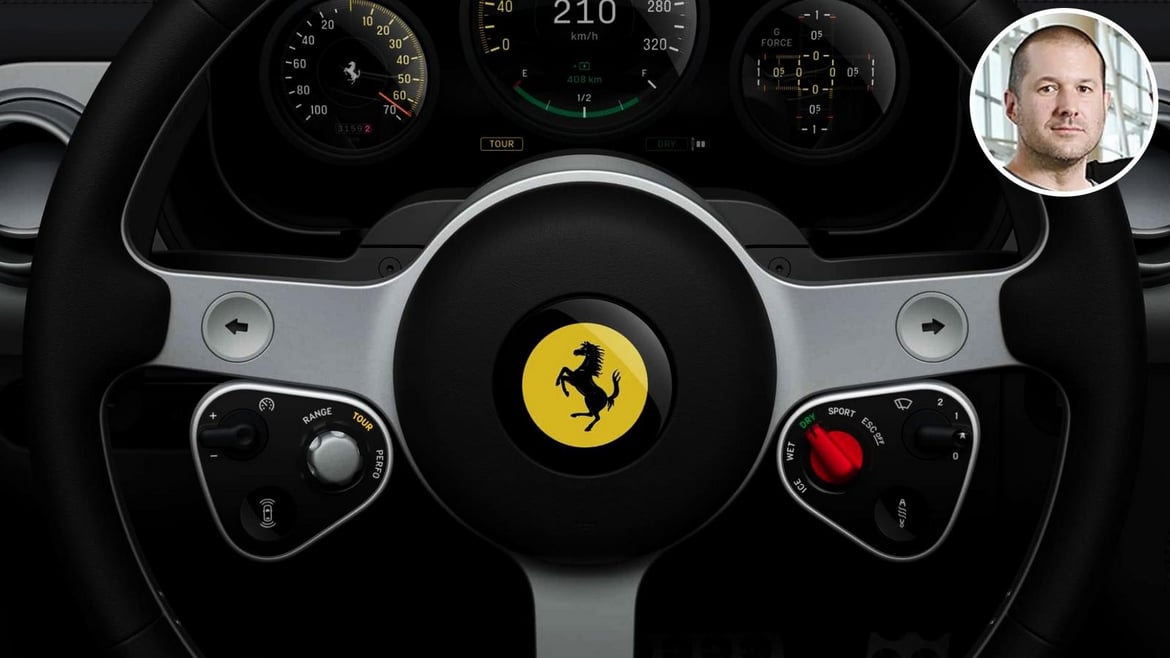
The core complaint is that the aesthetic of Luce’s interior is too Apple and not enough Ferrari. For decades, Ferrari cabins were dramatic, almost operatic spaces, dense with switches and layered forms that made drivers feel they had stepped into something slightly unhinged and passionate. By contrast, the Luce’s dashboard is calm, symmetrical, and rational. Commentators have called it cold, overly formal and industrial, praising its beauty as an object while questioning its emotional calibration for Maranello.

On GermanCarForum, posters wrote that it was “good design philosophy, but not Ferrari… not sexy, not provocative, lacking drama,” while others said it resembled a high-end sim-racing rig or even a kit-car interior rather than a coach-built grand tourer.

Ive has long criticized what he calls the proliferation of giant iPads in cars, arguing that touchscreens are the wrong technology for primary controls because they pull a driver’s eyes off the road. Yet critics were quick to note that the Luce still features multiple OLED displays, including three circular digital dials in the binnacle and a large central screen, along with an E-Ink-backed key fob and a digital clock integrated into the cluster.

Online commentators mocked the anti-screen rhetoric while pointing out that every key sightline remains a display. The more nuanced distinction Ive draws between shallow, menu-driven interfaces and carefully integrated digital instrumentation has largely been lost in the noise.

Some of the backlash is less about aluminum and glass and more about electrification. For purists, the very idea of an electric Ferrari requires an emotional leap, and pairing that powertrain with an Apple-flavored interior compounds the sense of rupture from the Testarossa and F355 fantasies many grew up with. The cabin becomes the visible symbol of a deeper anxiety about identity.

However, those who have inspected the components in person report extraordinary execution, noting that almost every touchpoint is aluminum, leather or glass, with tolerances measured in millimeters. The instrument binnacle’s anodized needles are real metal pieces, backlit and optically layered to create analogue depth over digital graphics. Even hidden hardware has been sculpted rather than stamped, a characteristic Ive obsession with detail.

Ferrari chief executive Benedetto Vigna has framed the Luce as the start of a new chapter, and Ive insists the goal was to reconnect with the tactility and mechanical feel of older Ferraris within the constraints of modern regulation. Whether that balance reads as evolution or estrangement will ultimately be decided in showrooms and order books, where Ferrari’s most loyal clients will determine whether light can carry the same heat as combustion.