Ferrari has chosen an unusually restrained way to tease its first fully electric car. Rather than leading with an exterior reveal or performance statistics, the marque has placed the spotlight squarely on the interior of the Ferrari Luce, and on the fact that it was co-created by Jony Ive, Marc Newson, and their design collective LoveFrom. It is a deliberate reversal of modern launch theatrics, and it works because the cabin itself is the statement. Visually, it stands apart from most contemporary performance interiors with calmer, more considered, and unexpectedly appealing in its refusal to chase screen-driven excess.

Ferrari presented the Luce’s interior as a series of individual workstations, with each component suspended and examined on its own. The approach underlined the philosophy behind the project. Every element is treated as a product in its own right rather than as decorative trim layered around software. Steering wheel, instrument binnacle, screens, key, vents, and seats were all designed with the same intensity usually reserved for a hero object, which gives the cabin an unusual sense of coherence and intention.

Depth over flatness
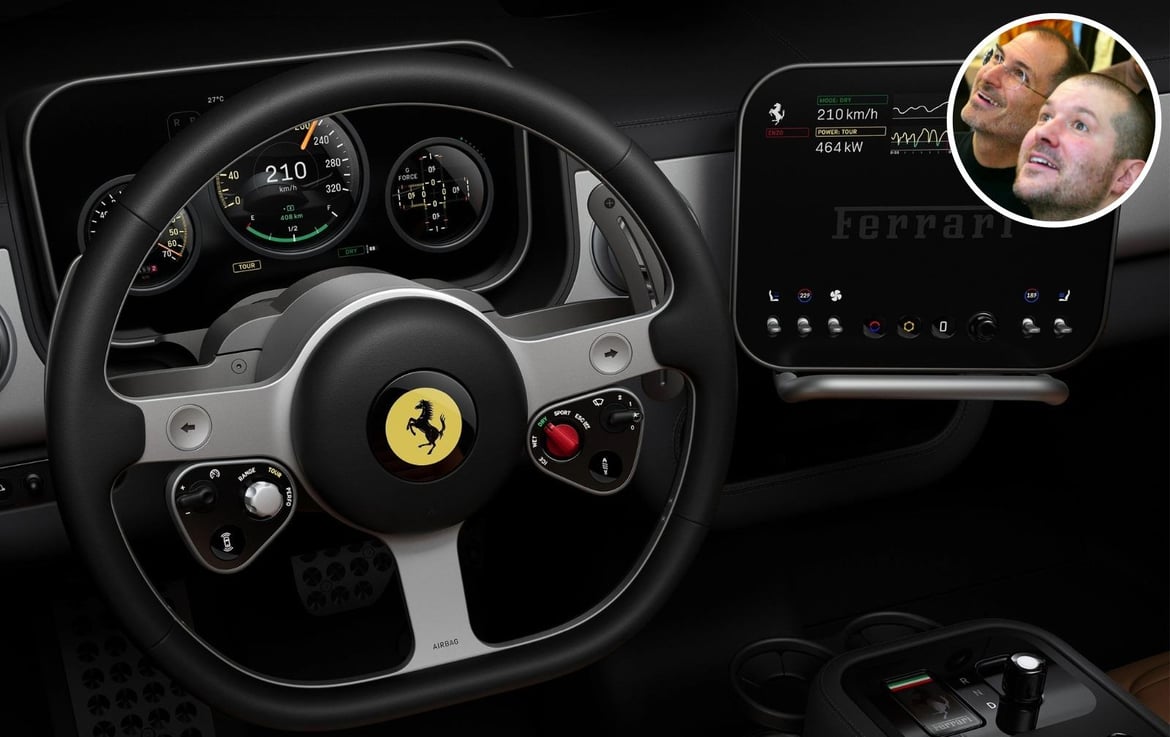
At the center of the experience is the instrument cluster. It avoids the flat, tablet-like aesthetic that has come to define digital dashboards. The Luce uses a layered Samsung OLED binnacle with three circular dials, giving it an old-school charm. The front OLED layer features precisely cut apertures framed by anodized aluminum rings and parabolic lenses. Behind it sits a second OLED screen, while a physical aluminum needle runs between the layers, backlit by a ring of LEDs. The result is real visual depth and parallax, allowing the driver’s eyes to anchor on something familiar while still benefiting from digital flexibility.

The graphics reinforce that idea. A bespoke typeface, LoveFrom Maranello, draws directly from Ferrari’s Veglia and Jaeger gauges of the 1950s and 1960s. Colors shift with drive modes, but the overall effect remains composed rather than theatrical. This is digital information presented with analogue restraint.

That philosophy carries directly into the steering wheel. The Luce uses a three-spoke design inspired by mid-century Ferraris and personally insisted upon by Piero Ferrari. It is an ultra-thin aluminum structure milled from 19 billet components, made from fully recycled material, and wrapped in leather. Despite integrating airbags and controls, it weighs roughly 400 grams less than a standard Ferrari wheel. The form is light, visually simple, and unapologetically driver-focused.

In a first for Ferrari, the instrument cluster is mounted to the steering column instead of the dashboard, so the entire binnacle moves with rake and reach adjustment. Steering wheel and gauges are conceived as a single system rather than separate layers competing for attention.

Physical controls dominate the cockpit. Two small side pods house rotary manettino-style knobs for powertrain and chassis modes, each shaped differently so they can be identified by touch. Indicators, wipers, media, regeneration, and drive settings are handled through proper buttons and dials with tuned mechanical feedback. Every surface you touch is aluminum, glass, or leather, a detail that subtly changes how the cabin feels in use.
A LoveFrom interpretation of Ferrari tradition
The Apple-like DNA is evident without ever being explicit. The materials palette leans heavily on anodized aluminum and strengthened glass developed with Corning, including Fusion glass engineered specifically for automotive durability and crash safety. Glass appears throughout the center console, buttons, display covers, and key dock. Around the shifter, more than 13,000 laser-drilled micro-holes are filled with ink to form illuminated graphics beneath a semi-matte surface designed to resist fingerprints.


Three primary display zones define the interface. The driver binnacle is joined by a central screen mounted on a ball-and-socket joint that swivels toward driver or passenger. A machined handle beneath it doubles as a palm rest, allowing controlled interaction without awkward reach. Along the top edge sits a mechanical multigraph, a glass-covered display with three physical hands driven by a proprietary movement. It can act as a clock, chronograph, compass, or launch indicator, bringing watchmaking logic into the dashboard.

Climate control is handled through five aluminum toggle switches and a fan dial beneath the screen, reinforcing that the touchscreen is not the primary interface for essential functions. Air vents are similarly over-engineered, using cylindrical outlets that can be aimed by hand and shut off with a precise quarter turn.

The sense of ritual continues with the key. It is a glass-and-aluminum slab with an embedded E-Ink display. When docked into the console, the yellow Cavallino appears to drain into the glass shifter as the key turns black, a small moment of theater achieved through light and material rather than animation. Overhead, a milled aluminum launch-control handle drops down to initiate performance sequences, reinforcing an avionic undertone.

Ive has described the brief as creating “an interface that is physical and engaging,” combining analogue familiarity with digital clarity, and treating every element “as if it was a camera or a watch.” Ferrari’s design leadership frames the collaboration as an update of Italy’s 1960s design language for the electric age, while the company’s leadership has emphasized the desire to avoid built-in obsolescence in favor of something meant to feel enduring.

After years of touch-heavy interiors that frustrated owners, the Luce represents a decisive course correction. That this rethink arrives most clearly on Ferrari’s first electric car is significant. By prioritizing depth, tactility, and calm over spectacle, the Luce suggests Ferrari understands that the future will only work if it still feels unmistakably human.