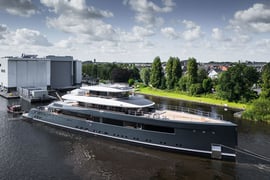
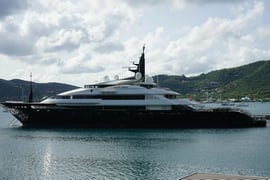
A gigantic superyacht slipped through one of the world’s most tightly managed maritime corridors while oil tankers and cargo vessels hesitated at its edges, creating a moment that felt less like routine navigation and more like a study in contrast. The vessel in question was Nord, the Lürssen-built flagship linked to Alexei Mordashov, and its passage through the Strait of Hormuz unfolded with a visibility that only sharpened the optics.

Tracking data from platforms such as MarineTraffic and VesselFinder placed Nord on a clear route out of Dubai on April 24, moving overnight toward Oman and into the strait by April 25. The detail that stands out is not just the timing, but the manner. At a point when commercial shipping volumes had thinned, and operators were weighing risks and rerouting decisions, this $500 million private yacht appeared to move steadily, its Automatic Identification System (AIS) broadcasting as it went, leaving a digital trail rather than slipping quietly through.

A quiet lane through a crowded story
The crossing itself appears to have followed a defined corridor rather than open water. Reports consistently point to a route close to Larak Island, along a lane described as safe for passage. This detail matters because it frames the transit as structured rather than opportunistic. Nord did not improvise its way across the strait. It moved within a system where access, timing, and route selection were clearly shaped by conditions on the water.

That system has created an unusual hierarchy. Tankers carrying energy supplies and cargo vessels moving essential goods have faced delays, recalculations, and in some cases prolonged waiting periods before committing to the crossing. Against that backdrop, the image of a large private yacht maintaining course stands out with unusual clarity. It becomes less about privilege in the traditional sense and more about the mechanics of selective movement in a constrained environment.

AIS visibility adds another layer to the story. Unlike instances in recent years where high-profile yachts have reduced their digital footprint, Nord appears to have remained trackable through much of its journey. While complete minute-by-minute verification would require paid historical playback, the available data strongly suggests this was not a concealed transit. Visibility, in this case, reads almost like confidence.

The superyacht that carried the moment
Nord itself is one of the most striking vessels to come out of Lürssen in recent years. Delivered in 2021 and designed by Nuvolari Lenard, it stretches just over 460 feet with a beam approaching 20 meters and a gross tonnage exceeding 10,000. The exterior is defined by a sharp, assertive bow and layered decks that give it a presence closer to a naval vessel than a leisure craft, while the interior accommodates dozens of guests alongside a large crew complement that includes specialized staff. Two helipads, advanced emissions treatment systems, and a design brief focused on strong visual impact place it firmly in the upper tier of modern superyachts.

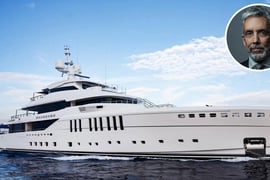
Its owner adds another dimension. Mordashov, a metals and mining magnate with an estimated fortune in the tens of billions, has been subject to Western sanctions since 2022, a factor that has shaped the movement and status of his assets globally. Nord itself has remained active, and in recent sightings has carried the Russian flag, a detail that reinforces the symbolic weight of its presence in such a closely watched corridor.

After clearing the Strait, the yacht continued toward Muscat before moving into the Gulf of Oman and onward into the Arabian Sea, with Port Victoria in Seychelles listed as a later destination in AIS data. The route sketches a longer arc that extends well beyond a simple regional transit, turning the passage into part of a broader Indian Ocean journey.

What remains is the contrast. In a moment when commercial shipping slowed and caution defined decision-making, a highly visible superyacht moved through with relative continuity. That contrast is the story’s center of gravity. Nord’s passage was not just a line on a tracking map. It was a reminder that even in constrained waterways, movement is rarely uniform, and the difference between waiting and passing can say more than the journey itself.