A Japanese company wants to make a one-hour trip from Tokyo to New York a reality by the 2030s. The concept, unveiled by Nippon Travel Agency in partnership with Innovative Space Carrier Inc. (ISC), promises to connect cities on opposite sides of the globe by briefly leaving Earth’s atmosphere before descending near the destination. As per the japanese daily Mainichi, The proposed point-to-point transport service would cost about ¥100 million, or roughly $657,000 per traveler for a round trip. Launches would take place from offshore platforms designed to reduce noise and safety risks. Applications are set to open in fiscal 2026, beginning with immersive “space-adjacent” experiences like space-food tastings and facility tours, with a full orbital-stay product expected in the 2040s.

The technology behind this service is being developed by ISC, a Tokyo-based startup founded in 2022 by CEO Kojiro Hatada. The company’s goal is to make it possible to move people and cargo anywhere on Earth in under an hour.

ISC is handling rocket and infrastructure development, including launch systems, recovery mechanisms, and offshore platforms. Nippon Travel Agency, meanwhile, will design, market, and sell the trips, branding them as a bridge between luxury space tourism and ultra-fast global transport. The idea reflects a new era in travel where aerospace engineering meets commercial hospitality.

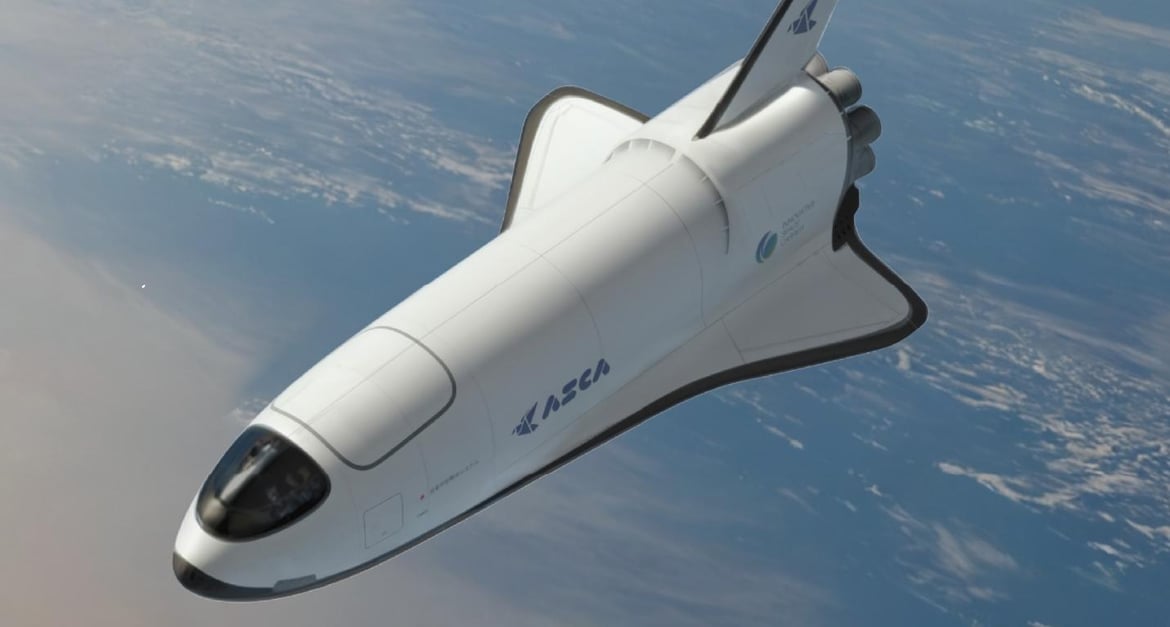
At the center of ISC’s roadmap is the “ASCA” rocket program, named after Asuka, meaning “flying bird.” The hardware is being developed in stages. ASCA 1.0 focuses on vertical takeoff and landing hops to prove guidance, recovery, and reuse systems. These early tests are planned in the United States, powered by an Ursa Major Hadley engine. ASCA 1.1 will take the next step with suborbital flights, while ASCA 1.2 aims for orbital missions capable of carrying about 100 kilograms (220 lbs.) to space, with full reusability. This tiered approach mirrors the progression from low-altitude testing to suborbital and finally orbital operations.

Supporting these efforts is a partnership with Japanese shipping giant MOL, which has agreed to study and develop offshore launch and recovery vessels for ISC’s ASCA program. This collaboration reinforces the plan to operate from sea-based platforms, helping to mitigate sonic booms and ensure safer flight paths away from populated areas. ISC has raised about ¥1.22 billion (roughly $79 million) in funding since its founding and is part of Japan’s national startup promotion ecosystem, giving it both financial backing and institutional credibility.

A one-hour Tokyo to New York journey would span roughly 10,850 kilometers, or about 6,745 miles. To achieve that distance in 60 minutes, the vehicle would need to travel at speeds close to 10,850 kilometers per hour, or around Mach 9 to Mach 10, depending on the altitude. By comparison, the Concorde flew at Mach 2.02 and completed transatlantic routes in three and a half hours. The speed required for this service would only be possible through a brief suborbital flight path rather than conventional air travel.

The cost also invites comparison with existing luxury air travel. A one-way charter on an ultra-long-range private jet such as a Gulfstream G700 or Bombardier Global 7500 from New York to Tokyo typically costs between $190,000 and $300,000, depending on configuration and season. Hourly rates for such aircraft range from $10,000 to $15,000 or more. In other words, the announced ¥100 million round-trip ticket for one person exceeds the cost of chartering an entire jet for a one-way journey across the Pacific. Yet what it offers is not merely speed but access to a completely different class of travel. One that touches the edge of space and redefines the meaning of global mobility.

The flight itself would begin with a vertical launch from an offshore platform, ascending under rocket power until exiting most of the atmosphere. It would then follow a high-arc ballistic trajectory before performing a controlled re-entry and powered landing near the destination. Each mission would last only tens of minutes, with passengers experiencing short but intense g-forces during ascent and descent. While the exact cabin conditions remain undisclosed, this would be a distinctly different experience from any luxury jet.

The ticket price may exceed the cost of chartering a private jet for the same route, but what it offers is not speed alone. It is the first step toward transforming space into a new highway for global travel.