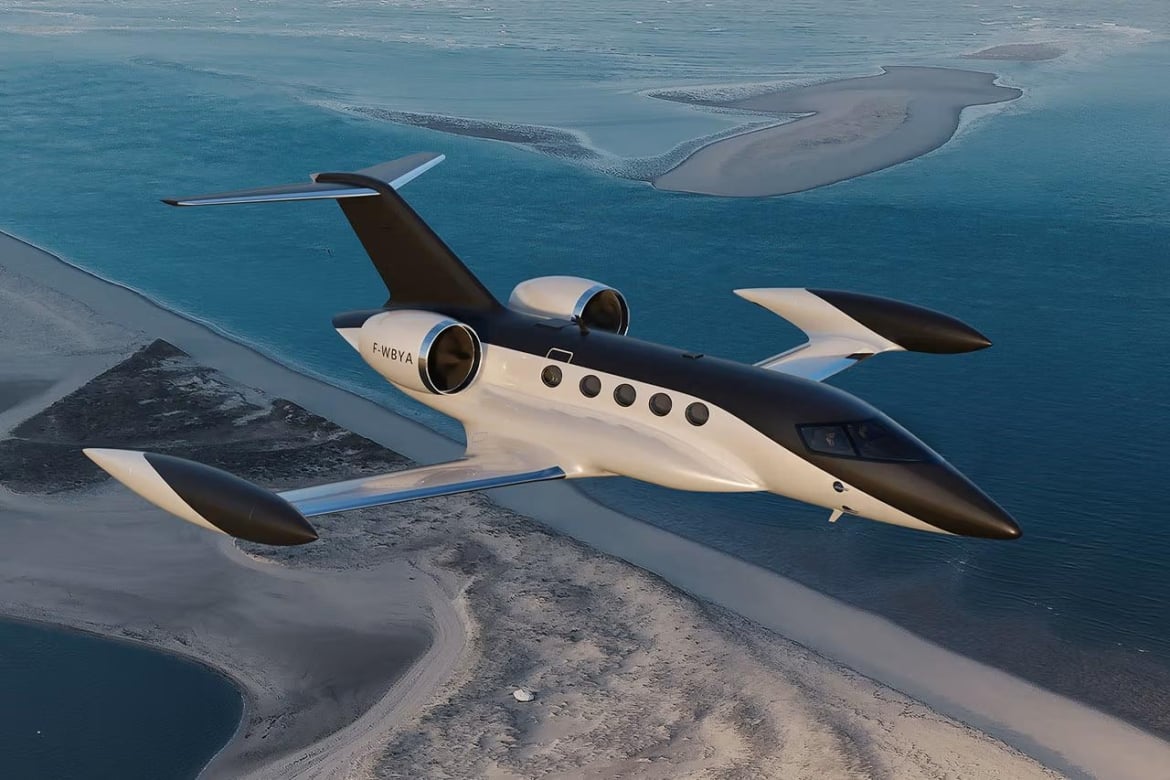
Hydrogen aviation has spent years hovering somewhere between ambition and improbability, but a small French startup has just nudged the conversation closer to reality. Beyond Aero has confirmed that its BYA-I One hydrogen-electric business jet has completed its Preliminary Design Review, a milestone that carries more weight than the understated language suggests. This is where an aircraft stops being a concept and starts looking like something regulators can evaluate seriously.

The review confirms that the aircraft’s core systems, from propulsion to hydrogen storage and thermal management, are integrated into a certifiable architecture. For a first-of-its-kind propulsion system, that matters more than any bold claim. It signals a shift from theoretical feasibility to structured execution.

A clean-sheet aircraft built around hydrogen
The BYA-I is positioned as a short-range business jet, targeting roughly 800 nautical miles of range with a cruising speed near 300 knots, as reported by Newatlas. It is designed to carry up to eight passengers and two crew, focusing on regional routes where operational flexibility outweighs long-haul capability. The numbers are modest, but they are intentional, reflecting the constraints of hydrogen rather than ignoring them.

What defines the aircraft is its architecture. Instead of adapting an existing jet, Beyond Aero has built the platform around hydrogen fuel cells that generate electricity to power electric propfans. The system produces only water vapor as a byproduct and operates far more quietly than conventional turbines. The company has also opted for high-pressure gaseous hydrogen storage instead of cryogenic liquid systems, simplifying engineering and aligning with early-stage infrastructure, even if it introduces weight penalties.

A long road shaped by certification
There are still trade-offs. Hydrogen’s low energy density demands larger tanks, which add structural weight and limit performance in certain conditions. Infrastructure remains a work in progress, and the broader ecosystem needed to support hydrogen aviation is still emerging.

The timeline reflects both ambition and caution. With the Preliminary Design Review complete, the program now moves into detailed design and validation, followed by a Critical Design Review in the next 12 to 18 months. Beyond Aero is targeting a first flight around 2029, with certification near the end of the decade and entry into service in the early 2030s. It is a deliberate pace, shaped by the decision to pursue stringent certification standards from the outset.

What the company is attempting is not to replace conventional aviation overnight, but to establish a credible starting point where hydrogen can operate within real-world constraints. The milestone does not guarantee success, but it reframes the narrative. Hydrogen flight is no longer confined to distant promises. It now has a program moving forward with certification in mind, one measured step at a time.