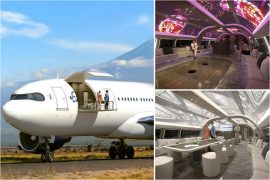
In a move that signals a shift in how private aviation is being designed and sold, BMW and Lufthansa Technik have unveiled a new VIP jet cabin concept that focuses on group travel rather than individual ownership. Revealed as “The BOW,” the new VIP cabin concept reframes the narrow-body jet as a shared space where CEOs, sports teams, and touring artists can travel with equal footing, blending privacy with collaboration in a way that reflects how modern power actually travels.

To understand the scale of that rethink, consider the baseline. An Airbus A321 in standard airline configuration typically carries between 180 and 220 passengers. The BOW strips that density back to as few as 28 passengers, replacing rows of seats with suites, lounges, and social zones, effectively turning a high-capacity workhorse into a curated, high-functioning private environment that still retains the operational advantages of a single-aisle aircraft.

A cabin designed as a continuous living space
The defining idea behind The BOW is a continuous architectural spine that runs from the cockpit to the rear of the aircraft, using light, curvature, and proportion to create a sense of flow that feels closer to a residence than a jet interior. This is a meaningful departure from the traditional approach, where VIP cabins are divided into a sequence of rooms with clear boundaries. Here, the design reads as one cohesive space, with transitions that feel cinematic rather than segmented, giving the aircraft a calmer and more immersive atmosphere.

That sense of arrival begins immediately at the entry, where the front of the cabin is treated as a reception space rather than a functional galley. A hospitality-driven bar anchors the experience, surrounded by curved forms, premium materials, and interactive elements such as a gradient screen and a foldable service table. Boarding becomes a designed moment, more akin to stepping into a members’ club than walking into an aircraft, setting a tone that carries through the rest of the cabin.

Where business, leisure, and status intersect
The central lounge is where the concept becomes especially intelligent, combining multifunctional displays with long tables that can split into smaller units, allowing the space to shift between boardroom, dining area, and social hub without friction. This flexibility is not just about convenience but about hierarchy, or the lack of it. The layout avoids the traditional master suite dynamic and instead supports groups of equals, whether that is a corporate leadership team or a professional sports squad traveling alongside its executives.

Behind this social core sit 14 private suites, each designed for one primary traveler with space for a guest, enabling private meetings or shared dining within a controlled environment, as shared by Lufthansa.

The cabin’s ability to accommodate up to 28 passengers positions it in a rare space between airline efficiency and private jet exclusivity. Storage is treated with unusual seriousness, with room for musical instruments, technical equipment, and personal gear, making the concept feel grounded in real-world use cases rather than abstract luxury.

Material choices reinforce that practicality, leaning into quiet luxury with felt, wood, and natural textiles instead of glossy finishes and heavy leather. Lufthansa Technik integrates its Hidden Touch controls, curved OLED displays, Omni-Fi speakers, and the “nice” cabin management platform in a way that recedes into the background, allowing lighting, acoustics, and climate to shape the experience without visual clutter. The result is an environment that feels softer and more restorative, prioritizing comfort through reduction rather than spectacle.
Seen in a broader context, The BOW reflects a shift in private aviation toward modular, mission-specific design, particularly on single-aisle platforms that offer range, efficiency, and access to smaller airports. It also signals a strategic evolution for Lufthansa Technik, moving from the grand, state-level spectacle of earlier widebody concepts toward a more pragmatic, collaborative form of luxury.

As Fabian Nagel described it, the goal is to elevate group-centric VIP travel to a new level, while Designworks frames it as a world where CEOs, soccer teams, and rock bands share the same space, balancing privacy with collective experience in a way that feels both contemporary and commercially viable.