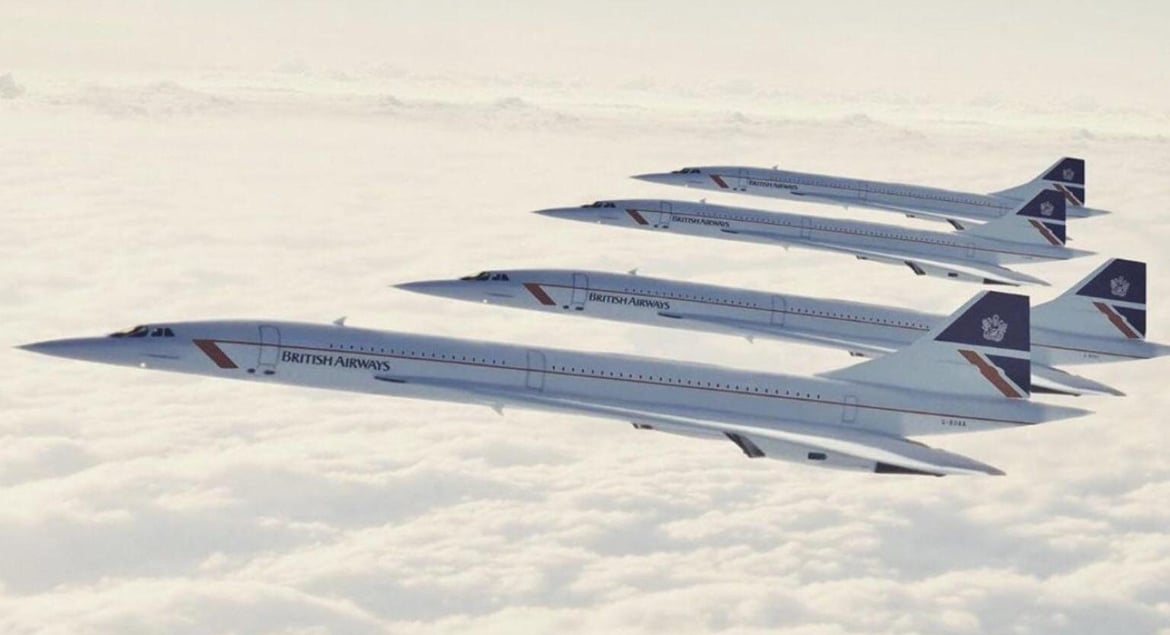
On Christmas Eve in 1985, British Airways did something almost unimaginable today. It took four Concordes off revenue service, filled them not with paying passengers, celebrities, or transatlantic executives, but with its own staff, and sent them into the winter sky in close formation. This was not a VIP charter or a PR gimmick designed for headlines. It was an internal morale event wrapped inside a historic photoshoot, one of the most extravagant employee perks any airline has ever offered.
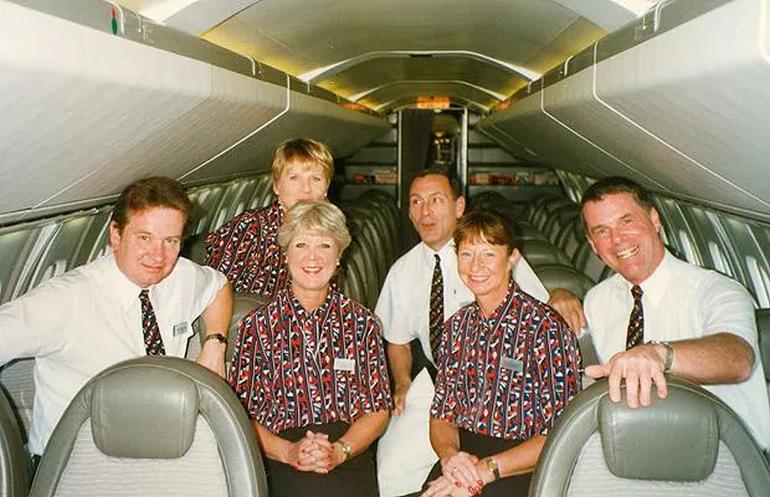
Each jet carried around 65 BA flight deck crew as passengers. Tickets were allocated internally by department heads, turning the whole operation into a festive lottery inside the company. For the lucky few who received one of those slips of paper, the next hour would mean sipping champagne while looking out of a Concorde window at three other white deltas holding station only a short distance away. It was a scene no paying customer ever experienced, and no airline has attempted since.
Concorde was already a high-cost, meticulously scheduled flagship for British Airways. The aircraft spent their lives running tight rotations to New York and Washington, earning precious revenue on one of the most competitive routes in the world. To take four airframes out of that cycle for a one-hour subsonic photo sortie was a significant commercial sacrifice. Internally, managers saw it as a morale investment. Externally, it became one of the most striking publicity stunts in aviation history.
To pull this off, planners had to find a date when at least three Concordes were free, then guide maintenance and fleet rotations so a fourth would be available in matching Landor colors. That alone was a major puzzle. The team identified Christmas Eve as a rare window when fewer transatlantic services were scheduled. Engineering then worked to ensure no last-minute technical issue would spoil the formation. Any single snag could have grounded an aircraft and ended the plan entirely.
From a safety and air traffic standpoint, the formation required military grade briefings and contingencies. Four large airliners flying close together in civilian airspace is extremely unusual. Air traffic control had to carve out protected corridors over southern England so that inbound or outbound traffic to Heathrow and Gatwick would not conflict. UK airspace was already crowded in the mid-1980s, so this was a non-trivial coordination exercise.

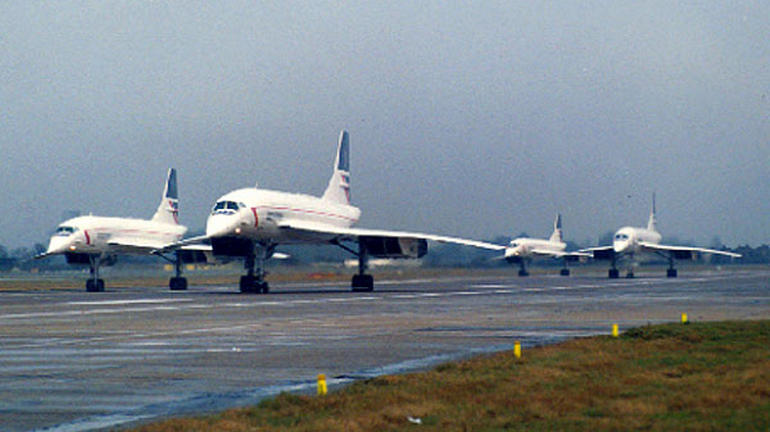
Even the departure became a kind of unofficial airshow. On the morning of the flight, crews and staff arrived at Heathrow to find four Concordes parked wingtip to wingtip outside Tech Block K. Ground photographers captured this surreal lineup before the aircraft were pushed back, engines lit, and the police closed a road crossing so that four supersonic airliners could taxi in procession across the airport. Anyone watching from the fence or from nearby roads would have seen something they would never see again.

The jets lined up on runway 28R, today known as 27R, and departed at tight intervals of roughly fifteen seconds, each using afterburner. Residents near the airport heard four Concordes thunder into the sky one after another, creating a noise event far beyond anything in normal operations.

Contemporary recollections describe people stepping into their gardens on Christmas Eve, hearing the deep roar, and looking up to see four white silhouettes clawing out of the cloud in quick succession. For the communities around Heathrow, it must have felt like a moment from another world.

The formations that made history
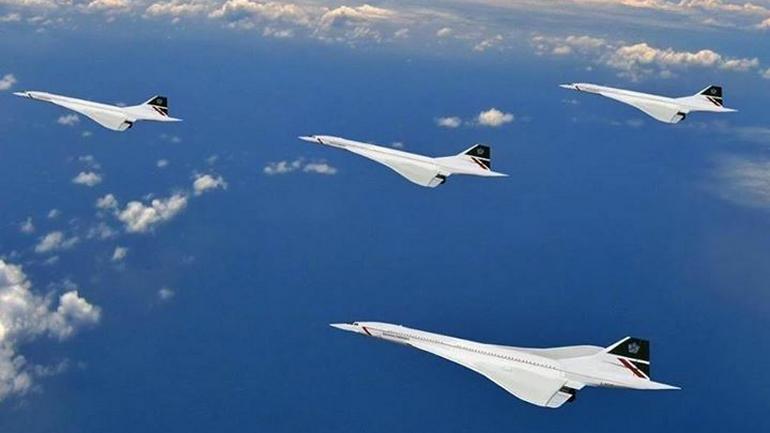
Once airborne, the four aircraft climbed to around 13,000 to 15,000 feet, settling into clear air between cloud layers. They joined initially in echelon starboard to stabilize spacing before beginning the planned sequence.

Their first major shape was the diamond. G BOAA led, with the other aircraft arranged diagonally behind in a balanced geometry that has since become the definitive image of the flight. Many of the prints, posters, and commemorative artworks of the event use this configuration, which looked uncannily like a supersonic strike group.

For the second formation, the pilots shifted into a swan-like outline inspired by a previous RAF Red Arrows and Concorde collaboration. With four delta wings arranged in a stylized curve, the silhouette created a graphic bird shape that only Concorde could achieve.

The final formation was the now-famous line abreast pass. The four aircraft appeared roughly side by side, though not perfectly aligned. The slight staggering remains a running joke among the captains involved, each insisting they were correctly formatting on the leader while one of the others was out of position. Ironically, the imperfection became a kind of proof of authenticity, showing that the photograph was real and not a studio composite.

After the final shots were taken, the sequence ended with a five-second break from echelon. Each aircraft peeled away with smooth precision before returning to Heathrow in stream, just as a display team would after a show. The staff on board stepped back into the terminal, knowing they had witnessed something that would never be repeated.

Where the four aircraft are today
All four Concordes from the formation survive today, preserved in different parts of the world. G BOAA stands at the National Museum of Flight in Scotland, while G BOAB remains at Heathrow as a training and display airframe. G BOAF is housed at Aerospace Bristol, close to where much of Concorde’s engineering heritage was shaped. G BOAG made its final crossing to New York and now sits beside the aircraft carrier at the Intrepid Sea, Air and Space Museum.
They no longer fly, but the images from that Christmas Eve still capture the spirit of the occasion. British Airways briefly took Concorde off the schedule, not for profit but for its own people, creating one of the most remarkable moments in civil aviation history.