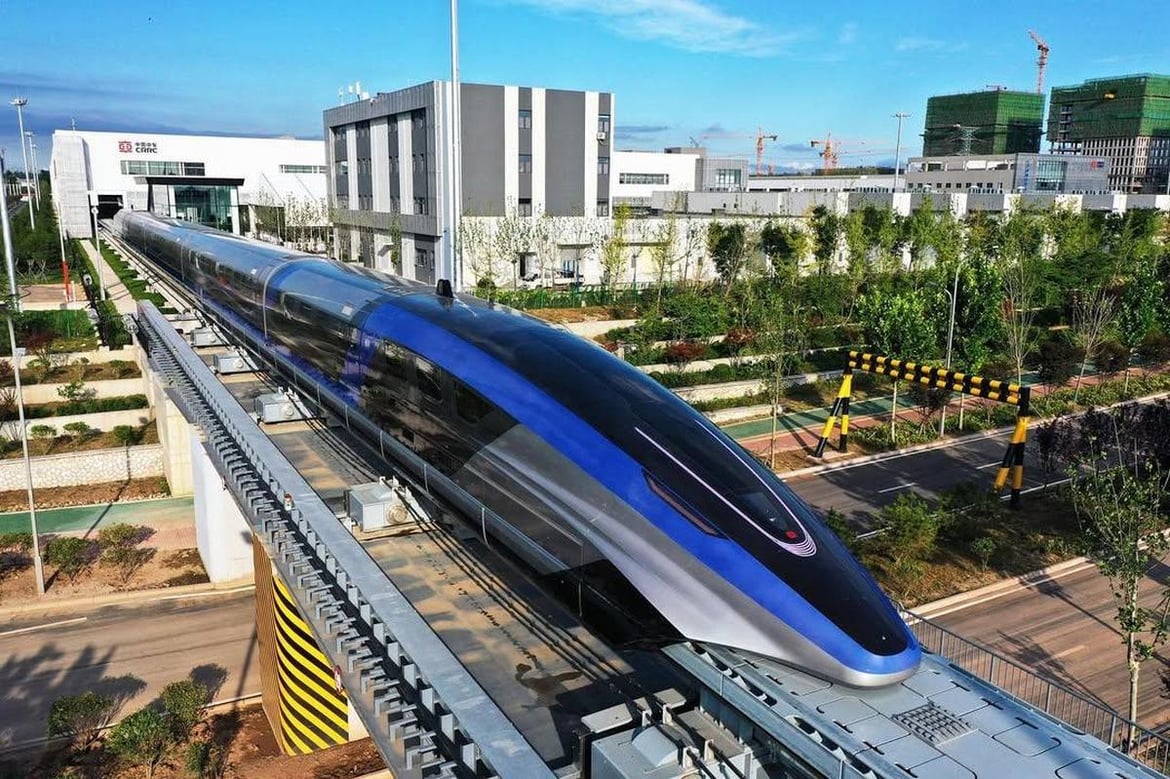
Ten years on, while California is still pouring concrete, filing lawsuits, and quietly trimming ambitions for its long-promised bullet train, Chinese researchers have just fired a one-ton maglev sled down a short test track and rewritten the acceleration record books. The contrast is hard to ignore. On one side, a high-speed rail project is now stretching past a decade with no trains in sight. On the other, a laboratory sprint that hit numbers once reserved for fighter jets and science fiction.
The Chinese test was brutally simple and brutally fast. A superconducting maglev test vehicle was accelerated from a standstill to about 435mph in under two seconds, then brought safely back to zero on a track just under a quarter mile long, roughly 0.25 miles, as reported by SCMP. Not a functional train but just proof that the physics works and the control systems can keep it all from tearing itself apart. That distinction matters. This was an acceleration record, not a transport plan. The demo was a sprint, not a commute. But sprints are how you find the edge of what is possible.

Levitation is where the magic starts. The system relies on so-called high-temperature superconducting magnets, which is a misleadingly friendly name. These coils still operate at cryogenic temperatures, around minus 196 degrees Celsius, cooled by liquid nitrogen. The key difference is what they do not need: liquid helium at minus 269 degrees Celsius. Nitrogen is cheaper, easier to store, and far more practical if you ever want to scale beyond a lab.

In plain terms, the superconducting coils on the sled generate a powerful magnetic field that interacts with the guideway below. That interaction lifts the vehicle clear of the track. Since there are no wheels, there’s no rolling resistance and almost no mechanical friction. Once you are floating, the only real enemies left are air and control errors.

Propulsion is essentially an electric motor laid flat and stretched out. Instead of a rotor spinning inside a stator, the stator lives along the track. Sequentially energized coils create a traveling magnetic wave that pulls and pushes the vehicle forward. At 435mph, the real challenge is not thrust but discipline. The power electronics must deliver an enormous burst of energy cleanly, keep the magnetic field stable, and prevent the sled from hunting or wobbling itself into disaster. That quiet success is the unsung achievement of the test.

To understand how wild those numbers are, it helps to step outside rail entirely. Bugatti made global headlines when a Chiron prototype ran from 0 to 400km/h (about 248mph) and back to zero in 41.96 seconds. That feat was celebrated as the outer edge of road-going performance. The Chinese maglev test blew past the Chiron’s entire top-speed narrative in a heartbeat; 438mph is well beyond any 300-plus-mph bragging rights, and the 0-to-number drama is almost absurd by comparison. Again, an unmanned sled, no tires, no driver. But the point lands instantly.

It is tempting to jump straight to Beijing-to-Shanghai fantasies, but that leap skips the hard part. Real intercity systems prioritize sustained speed, reliability, switching, redundancy, evacuation, and maintenance regimes. Passenger-friendly acceleration changes everything. Humans are comfortable at roughly 0.1 to 0.2 g, not the eye-watering forces used in this test.

At about 0.2 g, reaching 700km/h takes roughly 99 seconds and about 6 miles just to accelerate. Push to 1,000km/h and you are looking at around 142 seconds and more than 12 miles of straight track before you even settle into cruise. The translation is simple: at ultra-high speeds, your route geometry matters as much as your technology. Without long, straight corridors, headline speeds become marketing rather than reality.

Which brings us back to California. The state’s high-speed rail line was sold as a 220mph vision, linking Los Angeles and San Francisco. A decade later, it is a patchwork of construction zones in the Central Valley, with costs up and timelines stretched thin. No superconductors. No levitation. Just the slow grind of building.

China’s maglev sprint does not replace that grind. What it does show is a willingness to keep pushing the edges while the rest of the world argues about the middle. This was not a promise of a train you will ride next year. It was a reminder of how fast progress looks when caution is not allowed to set the pace.