J.R.R. Tolkien, the great writer behind the hugely successful The Lord of the Rings, lived a life that many do not realize is deeply reflected in his books. A man who spoke more than five languages and created two entirely his own, Quenya and Sindarin, Tolkien conjured an imaginary world that became Middle-earth, a realm built to house his linguistic inventions. While the workings of such a remarkable mind are intangible, one object that can be touched is the temple of this talent: his desk.

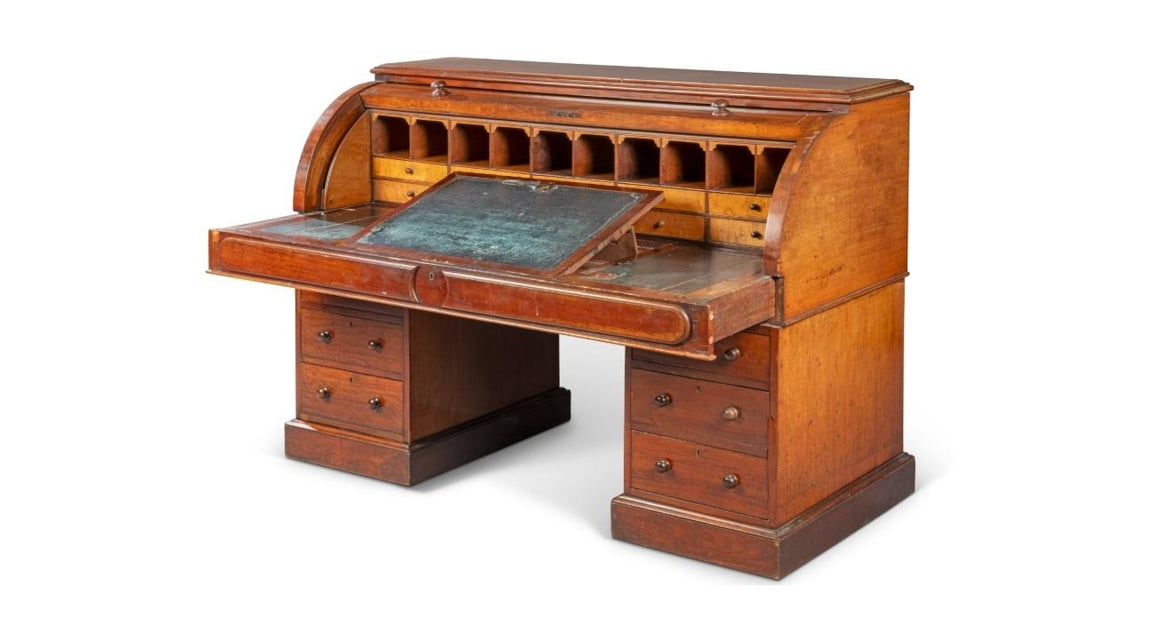
This is the Merton desk, a mid-Victorian mahogany and satinwood roll-top pedestal desk where Tolkien refined his magic into hundreds of pages while serving as Merton Professor of English Language and Literature at the University of Oxford from 1945 to 1959. It is not the desk on which he accidentally created The Hobbit (where the word famously came before the meaning), but it was at this desk that Tolkien worked on the final revisions of his epic fantasy, The Lord of the Rings.

This extraordinary literary artifact is heading to the auction block at Christie’s “Groundbreakers: Icons of Our Time” sale on December 11. Thais Hitchins, Junior Specialist at Christie’s, called the desk “one of the most important artifacts of Tolkien’s career that is ever likely to be offered for sale.” She added that the desk “occupies a pivotal position in Tolkien’s career as the site of his final touches to his masterwork: it connects the imaginative world of the early drafts with the formal apparatus of publication [of The Lord of the Rings], including proofs, galleys, and correspondence.”

The Merton desk itself is a thing of beauty. It features a molded-top roll-front enclosing five small drawers and ten pigeonholes, along with a pull-out writing surface fitted with three gilt-tooled green leather panels, the central one formed as a ratcheted slope. Below sit twin pedestals with three drawers each, all resting on a molded plinth base. The leather writing surfaces are noted as having “significant damage.” After 1959, when Tolkien’s tenure at Oxford ended, the desk moved with him to his home on Sandfield Road in Headington, Oxford. There, the work of finishing, revising, and proofing The Lord of the Rings continued in his humble abode, with the desk’s design proving to be an ideal working office.

Notably, this desk is one of only two known to have belonged to Tolkien and is the last remaining example still in private ownership. It will be offered at Christie’s on December 11 with an estimate of over $100,000.

The Lord of the Rings, which took more than 12 years to write, has since been translated into more than 50 languages and has sold over 150 million copies worldwide. For any connoisseur or author, this desk is nothing less than a shrine that supported a literary genius. For those who miss the chance to acquire the Merton desk, the Wade Center in Wheaton houses the famed “Hobbit desk,” where much of the literary saga was written. It has since become a pilgrimage site for Tolkien fans, who can feel closer to Bilbo and Frodo in what is, in many ways, their literary home.